Showing posts with label teaching. Show all posts

Thursday, July 21, 2011

Topic 194: On Apologizing for Oneself

Carol:

Going, Going….
Apologizing is an art requiring honesty and good timing. Eloquence is an enhancement but not a replacement for sincerity. Apologizing for oneself is more like an “I’m sorry but…”  I apologize for my poor cooking skills: fishing for a compliment or a sign of poor self-esteem?  Apologizing for oneself can also be a way to justify behavior one doesn’t intend to or can’t change.
 

This morning Marc is returning from a week-long motorcycle trip along the California coast, and  I am in a wee bit of stress. He will be hot and tired, and  I like to have him come home to a clean, clutter-free house. If I don’t at least pick up the bedroom and kitchen, he will wonder what his retired wife has been doing all week. Then, I will have to apologize for myself. I think I’ll line up my excuses in advance, a kind of practice round with my loyal daily theme readers before Marc pulls into the driveway.
 
Excuse #1: I’m trying hard to finish my family history book before the end of the summer. I have learned so much this week about scanning, cropping, and enlarging old photographs. The only place where I could really find the space to spread out the scrapbooks, old letters and photos was our bedroom, where I could set up a card table and use the queen-size bed.
Sacred memories
Excuse #2:  It has been really, really hot.  The air-conditioner doesn’t cool down the upstairs. I can’t get a cross-breeze going; we had to take the screen door from the upstairs bedroom balcony and move it downstairs because somebody’s dog (not mine) shredded the downstairs screen. Besides, if I get too much of a breeze in our bedroom,  those photos and letters will blow all over the room and destroy my organized stacks.  All this heat has drained my energy anyway for vacuuming or lugging laundry up and down three flights of stairs.
Sacred mounds
Excuse #3:  My fingers are a mess. I slashed my left thumb while cutting watermelon.  I dropped a heavy lid on my right thumb and now the black and blue covers half the nail. And, I have puncture wounds on the front and back of my right second finger from trying to take a bone away from Milo. He didn’t deliberately bite me, mind you (after all, he’s perfect). He just mistook my finger for the bone I had removed from his jaws. With all the band-aids I’ve gone through and the throbbing which alternates between left and right hands,  I don’t really feel like washing dishes. Megan has done a lot of the cooking and clean-up, but she is busy too (not that I would ever apologize or make excuses for her).
 
Excuse #4: today is the last day of my OLLI class on Myth in Human History, and I need to prepare for it. I haven’t really procrastinated. I got my PowerPoint presentation done a few days ago, and I wrote a poem about my geologist father because the topic is “Sacred Mountains.”  The Great Courses DVD we are showing even uses the San Francisco Peaks as an example. I still have to watch the 45-minute lecture before I leave at 11:45.
Sacred mountains


Dear readers, dear Marc. I really don’t like to make excuses for myself. I hate apologizing over and over again for untidiness, clutziness or procrastination. I would try to make my apology more sincere, more eloquent, but I just don’t have the time.
 
I’m going, going…….GONE.

Megan:
I’m not a big fan of apologies. Sometimes when I am hungry or hot, I will snap at my parents. If I’ve been extremely unreasonable, I will apologize, but usually I just make a joke after and then everything is ok. I prefer self-deprecating humor – which is different than fishing for compliments or putting oneself down. Making jokes about one’s failings is a way to find humor in an otherwise uncomfortable situation, and it puts others at ease.  I guess I just don’t think apologies mean much because the words are so often used with no hint of regret or attempt to change behavior.

Like when people say, “I’m sorry, but…” Anytime I hear that I know  it’s not a sincere apology, and what follows the “but” is usually an indictment. “I’m sorry but your feet really stink.”  Or “I’m sorry, but you’re wrong.” Or, and this one I hate the most, “I’m sorry, but that’s the way I am.” Whenever I hear this, I feel like the person is actually saying “I don’t care that I hurt you. I will not even try to be considerate of your feelings.” Of course, after I snap at my parents (if I apologize), I’ll say, “I’m sorry but I’m really hot and hungry.” And what I’m really saying (although not consciously) is that “I’m not able to set aside my personal discomfort in order to be polite to you.” These words are not sincere requests for forgiveness.

Another way people use apologetic words is when conveying pity. When a fried has suffered some sort of personal tragedy, I will say “I’m sorry.” And invariably my friend says, “It’s not your fault” – which is a response appropriate for an apology. What I really meant was “I feel sorry for you”  but people don’t like to hear it phrased that way because that’s also something we say when we’re trying to sound like the bigger person when actually we’re just being mean: “I feel sorry for that person who is going to die unloved and then burn in hell forever.” But whether we mean to be nice or not, they are not apologies.

We also use apologies to negotiate through heavy foot traffic. The British are constantly saying sorry. They use it the way we say “Excuse me” (also an apology) and in every context. If a person finds his way blocked by another, he will say “Sorry” to get the other person to move.  Although it sounds like he is apologizing for making the other person move, he’s merely making his presence known. If two people are talking and one person either cannot hear (or is outraged by) what the other person has said, he will say “I’m sorry?” (or “I’M SORRY??!!) In both cultures, Sorry’s and Excuse me’s are often replaced by Pardons – yet another apologetic word.

So, after apologizing all day long, what are we supposed to say when we are truly repentant?  “I was wrong” can work, but I’m wrong a lot without causing any harm, so that’s not a real apology either. “I can’t believe I did that” sounds like an accident. So does, “Whoops.”  “Please forgive me” is supposed to come after the apology, not in its stead. “I will make it up to you” is closer, because it promises action. Maybe that’s all we can do, accept that words are not enough and try to do better next time.

Thursday, June 30, 2011

Topic 182: First Impressions

Carol:
The Tricks Old Dogs Can Teach Us
On first impression, you might think Prescott is a sleepy little town full of old white-haired folks who drive too slow (or too fast) and spend their afternoons searching for the best early-bird dinners.  In reality Prescott is full of old white-haired folks –31% of the population is over 62 years old. But Prescott is anything but sleepy these days and people over 62 (of which I am one) have a lot to teach us about the quality of the “senior years.” In fact, a visit to two local organizations show just how energetic and varied the retirement community can be.

The first is the Rowle P. Simmons Community Center, home of the Adult Center, which   provides a wide range of activities and services for all adults but particularly meets the needs of a senior population for a gentle-on-the-wallet $50/year membership fee. Sure, you can sign up for the typical senior center activities such as bingo and bridge, but the Adult Center also houses the Veterans History Project (part of a national oral history initiative), provides one-on-one tutoring sessions for PC and Mac users, schedules numerous health and fitness classes—from gentle yoga to high-energy Zumba-- the Meals-on-Wheels program, and hosts political forums. And, the parking lot is always full. 

The second is the Osher Lifelong Learning Institute(OLLI)  on the campus of Yavapai College. The Bernard Osher Foundation, headquartered in San Francisco, provides funding for higher education and the arts, including OLLI programs at 118 college and university sites geared to older learners, who the Bernard Osher Foundation refers to as “seasoned adults.” A wide range of learning groups reflect the interests of OLLI members, who have a voice in choosing the curriculum and in facilitating the groups as volunteers.  In between a morning learning group discussing modern China or current events and an afternoon group studying Gilbert and Sullivan opera, OLLI participants gather in the college food court for lunch and talk, their own brand of non-digital social networking. OLLI members make a lot of noise, have a lot of fun, and epitomize the notion of “lifelong learning.” No grades, no required homework, but they show up for class, ask questions, engage in hearty discussion,  and let their facilitators know when they appreciate a topic—or not.

 So, what’s the message here for our daily theme readers who are at the other end of the demographic picture—under 62, not retired, not ready to get old (who is?). What can these “old dogs” teach you? Learn something new everyday, not because you have to but because you want to. Take a class. Don’t want the homework or stress of grades? Most cities have community education programs. Don’t have time? Turn off the TV. Don’t have the money? Many community education programs and activity centers such as the YMCA have sliding scale fees and offer scholarships.

My essay is on the short side today. That’s because I have to get ready for my OLLI class on mythology and human experience.  As a co-facilitator for the learning group, I have  research to do on trickster figures in world cultures, and the 25 participants in the class will have lots of questions.
Loki, the Nordic Trickster


Megan:
A Second Chance to Make a First Impression
Yesterday my mother wrote about our trip to New Orleans, so today I think I will fill you in on my experience. We made this trip so that I could attend the American Library Association’s Annual conference. For a week, more than 20,000 librarians converged on the city. Everywhere you looked you could see determined and sensibly dressed women (and men!)  carrying red ALA tote bags, and checking schedules on their smart phones. I’m sure the city, which has a huge convention center, is used to large professional conferences, but New Orleans has a special appreciation for librarians.
The ALA plans its conference years in advance, and in 2006, the Annual (as it is known) was scheduled to be in New Orleans. After Katrina hit, the ALA debated moving the conference but ultimately decided to proceed as planned. I spoke with people who’d attended the Annual that year, which was the first conference to be held in New Orleans after the hurricane.  One librarian told me that most of the stores were closed, and whole city blocks stood empty. She said that the city had bussed people in to work in the restaurants and hotels. Another woman told me how she would sit in a cafĂ© reading and would be approached again and again by locals asking for her magazines. At that point, almost a year after the storm, nothing but essential mail was being delivered by the post office.  “Some people didn’t want to come to the conference,” she said, “but I thought it was our duty to come and just spend as much money as we could.” At the opening ceremony this year, Mayor Mitch Landrieu personally thanked the ALA for all it had done to support the city.

I didn’t attend that conference in 2006 because I was in England getting ready to start working at the prison. Though I had followed the news closely when it happened, it was hard for me to imagine the level of destruction and devastation Katrina had wrought on the gulf. And I’d sort of assumed it had been rebuilt by now. Certainly that was my first impression of the city, from the downtown area where we stayed on the edge of the French Quarter. From the pictures my mother posted yesterday, there was little evidence of the storm. The beautiful houses in the garden district all had a freshly painted look to them –as did the buildings in the French quarter. Aside from the slightly “new” look on old buildings, everything looked perfect.
As part of the conference, I spent one day volunteering in a school library. It was downtown, just off Canal street and a group of us were bussed there from the conference center. The bus driver either misunderstood our destination or decided to deliberately take us the long way, but we wound up taking what the school director called “The Misery Tour.” The bus headed uptown, beyond where the street cars stopped and drove through a lower-income residential neighborhood. These homes, though smaller than the Garden District mansions, were still average sized older family homes, with porches and yards and playground sets. It would have looked like a nice place to live except that half of the homes stood vacant, boarded up and caved in. On many doors and walls it was still easy to read the spray-painted code used by rescue teams in the days following the storm: an X with the date the home was searched, and number of dead or living inhabitants. 
 

I understand why it was necessary to rebuild the tourist areas first. New Orleans relies on the convention center and the tourist industry to fuel its economy, which has also been harmed by last year’s oil spill. And everywhere I looked in that damaged neighborhood, I saw signs of construction – houses had been lifted onto cinder blocks or simply rebuilt high off the ground. While we were there, local news reported the final safeguard to prevent another breech of the levies had just been put in place. A lot has happened in five years, just not as much as I’d expected. The ALA Annual is not currently scheduled to return to New Orleans, but no doubt we’ll get back there eventually. I hope I will  see more houses like this:

Thursday, March 17, 2011

Topic 127: Mental Shock Absorbers

Carol:

  Soothing the Savage Breast (and Brain)

In Williamson Valley  the wind pretty well blows everyday. I love that sound just as I love the sound of rain falling on our roof.  I guess other people find these nature noises soothing too because there is a good market on the Internet for downloads of ambient sound.

I first heard about ambient sound in the 60’s although it didn’t have such a fancy name back then. It was called “white noise.”  My dentist began experimenting with white noise as an alternative to pain-killers like novacaine.  I would put on earphones and listen to what sounded like TV snow while he filled my cavities, directing me to turn up the sound if I needed more decibels to block the pain.  I can’t really say how effective the earphones and white noise were as I have a really high pain threshold and an almost perverse ability to relax in a dental chair.

I didn’t really think about what happened to those white noise machines until I saw today’s topic.  Turns out that white noise was not only found to be  ineffective but also potentially harmful because of the high decibel range needed to distract from the pain (source: Tekavec). It is almost never used anymore although the use of ambient sound  to “sooth the savage breast” has become quite common. Most popular are natural noises like ocean waves or steady rainfall.  Ambient sound probably works better to alleviate anxiety than pain.

Music therapy is a profession that I don’t think existed when I was listening to white noise in the dentist chair, but brain studies and new research about how we learn support the positive effects of music. Music therapists are clinically trained, licensed professionals who tailor “interventions” to the individual, depending on whether the need is pain and stress reduction, or memory and learning enhancement.  The website for the American Music Therapy Association includes testimonials from patients who have benefitted from working with a music therapist, including Alzheimer’s patients, children with autism, and people rehabilitating from both physical injuries and substance abuse.  Apparently, the type of music used in these individualized therapeutic programs varies considerably.

Educational research in the last 20 years has also shown the positive effects of music for increasing memory and cognition.  I quit nagged my son about turning off his music to study after his high school teacher shared with me the results of  a learning styles inventory he had taken showing he could actually concentrate better and study more efficiently with music in the background.

I have my own musical tastes and habits to suit particular needs. I  clean house much more efficiently with a little music to set the rhythm, something fast and peppy like Saturday Night Fever although more recently I have taken to using traditional Celtic music. The Old Blind Dogs or Jim Malcolm perks me right up for loading the dishwasher.  On a car trip, I either use classical music to buffer the road noise or I find an “oldies but goodies” station and sing along to lessen the tedium of a long ride.

I don’t think we really needed a lot of scientific research to tell us about the physical, emotional and spiritual benefits of music and sound. And, I think William Congreve said it best in 1697:
Musick has Charms to sooth a savage Breast,
To soften Rocks, or bend a knotted Oak.
Today is my day to serve coffee after our dog walk. I have just the right background music,  something with a little Irish lilt to it. Top ‘O the Mornin' to Ya.


Sources
American Music Therapy Association.: http://www.musictherapy.org/
Congreve, William. Quote from The Mourning Bride. 1697.  
            http://www.phrases.org.uk/meanings/252000.html
Tekavec, Mel. M. “Nitrous Oxide Sedation with Auditory Modificaiton.” 1976
            http://www.ncbi.nlm.nih.gov/pmc/articles/PMC2515814/pdf/anesthprog00144-0015.pdf
 

Megan:

Mental Shock Absorbers 
When I was 16, I crashed my car at an intersection just outside of Prescott Valley. I was going about 45 mph at the time, but the car I rear-ended was stopped at a red light. I remember slamming on the brakes and hearing the sound of the impact, but despite (or maybe because of) the fact that my forehead shattered the windshield, I did not feel anything. I opened my eyes and the entire front end of my car was folded up like an accordion – but the car I’d hit had only the slightest dent in its rear bumper.

My passengers and I walked away with bruises and a bloody nose, while an ambulance took the back-seat passenger of the car I hit. I remember she screamed and screamed while we waited for help and I didn’t understand. My car was totaled, and theirs was fine. Why was she hurt? The answer, according to my friend’s mechanic father, was the difference in our bumpers. Mine was full of Styrofoam, which then spilled all over the road. Their car had a steel bumper, which protected the car but absorbed none of the impact.

In addition to insulating car bumpers, packing electronics, and containing take-out food, Styrofoam is also used in bicycle helmets – another mental shock absorber. I’ve never had a serious cycling accident, probably because I never took to the sport, but almost everyone I know who rides on a regular basis has a story about how a helmet saved their lives. 

But not all shock absorbers are physical. The mind has its own way of protecting itself from a shock. I believe “going into shock” is actually one of them. Sometimes, depending on the trauma, the mind suppresses it. Or the trauma leads to a fractured personality or post-traumatic stress. If a mind is repeatedly subjected to disturbing  or stressful events, then it acclimates. It tries to cope, through meditation, or alcoholism, or exercise, or humor.

In the prison, whenever something bad happened, I always asked if any books had been damaged in the incident. This was not because I cared about the books (although I did), or because I knew that no one else gave a damn about them (which they didn’t), but because I thought it was funny. Someone gets beaten or stabbed in their cell, someone starts a fire or a flood, someone goes on dirty protest – whatever… are the books ok?

Maybe you had to be there.

The first time I asked, I was serious. There had been a flood in a cell in the segregation unit. The prisoner’s property had been bagged up to be disposed of, and I could see one of my books through the plastic. I asked if I could get it because I wanted the barcode to withdraw it from the library catalog. One of the officers handed me a pair of gloves and watched as I dug through the damp clothes and papers to reach the book at the bottom of the bag. “By the way,” he said. “That’s toilet water.”  I swore at him and threw the dripping book in the trash.  But after that came the jokes.

Wednesday, March 9, 2011

Topic 121: Nature's Language

Carol:
The Sounds of Silence       
One of my favorite teaching exercises was meant to show students how to use all of their senses, not just sight. A computer classroom isn’t the best place for that with its controlled temperature and humming, buzzing and squeaking electronic universe.  We needed to disconnect not only physically but mentally from the land of tweets and texts.

The campus was built into the side of a hill. A few yards uphill from the road that loops around the classroom buildings, students in an Environmental Ethics class had created a primitive classroom in a small grove of pine trees. Just a circle of large, flat-topped rocks in a clearing, placed at random so as not to destroy the natural lack of symmetry. 

One fall evening I moved my Women in Literature students to this outdoor classroom. We would soon be reading essays and poetry by “nature writers” like Linda Hogan and Terry Tempest Williams, but we would  begin  with our own stories. As the light faded and the temperature dropped, we huddled closer together on the rocks, not just for comfort but because the rhythm and tone of our conversation changed…quiet, calm, focused, intimate. Stories moved around the circle, recollections of long-forgotten trips into the Sonora desert or the Mogollon Rim. The stories gained force, not with volume but with detail: the whooshing of a Class III rapids, the smell of pine needles underneath a sleeping bag, the sting of icy snow pellets against the face. We had to feel our way out of the clearing, holding onto each other as we returned to the sensory cacophony of the computer classroom.

Terry Tempest Williams listens to nature. She “interprets” the languages and contours of the natural world for “newcomers” just as a park ranger interprets the geography and biology of at Grand Teton or Bryce Canyon or Organ Pipe. Williams is a fierce and eloquent advocate for the environment, what she calls “bearing witness.” When she came to Prescott about 15 years ago, I heard her speak twice. Her passion for the history, landscape and environment of the West was quiet, the kind of “bearing witness” that causes you to lean over in your seat and pay attention with your whole body, not just your ears. She left such an impression of urgency and commitment on me that I couldn’t get her out of my mind for days.

Williams’ 1997 essay “Listening Days"  begins with a visit to her dying grandfather and ends with the simple announcement of his death, “peacefully at home in the company of family.” In between she reflects on sound and lets thoughts move her from conversations with her grandfather about his radio program to “tonal memory” to the big question of “what do we know.” She walks the readers into  the hills behind her home:


           The leaves have fallen, leaf litter, perfect for the shuffling of towhees.
           The supple grasses of summer have become knee-high rattles. Ridge
           winds shake the tiny seedheads like gourds. I hear my grandfather’s voice.

           All sound requires patience; not just the ability to hear, but the capacity to
           listen, the awareness of mind to discern a story.  A magpie flies toward me
           and disappears in the oak thicket.  He is relentless in his cries. What does
           he know that I do not?  What story is he telling?

Reading these lines as I look out my window and watch the reflected pink of the sunrise on granite rocks, I think back to those students in our outdoor classroom, re-tuning their senses to experience the languages of nature, adding their own voices to the stories of ancient grandfathers, prehistoric rocks, and magpie cries.

No cartoons today, no photographs.  Take a few minutes, move some time around, and head outside, see for yourself. Calm down, breathe and listen. Nature is speaking.

Sources:
"Listening Days" by Terry Tempest Williams website http://arts.envirolink.org/literary_arts/TTWilliams_listening.html 


Megan:

Nature’s Language

Many times I have heard visitors to the countryside comment that after the noise of a city, they find it difficult to sleep with all the quiet. I suppose the reverse is often true as well. I have lived in both environments, and where I live now, which is where I grew up, has the least amount of road noise.  But if you spend  time actually listening to the Arizona desert, you would realize it is anything but quiet. Between the crickets and the coyotes, the dampened crunch of deer hooves on gravel and the sudden scratching of startled rabbit fleeing through the bushes, plenty of sounds make their way through the apparent nighttime stillness.

Of course, it is easy to fancy for a moment that these nighttime sounds might comingle into a natural dialect, unique to this particular latitude and longitude but it is difficult to argue that actual communication is taking place. You hear the noises and you know you are not alone, that you share the space with other creatures, but there is no apparent interaction.

Recently, I have come across a number of facts and anecdotes which seem to confirm that although humans grow more remote from their natural neighbors, the flora and fauna may have their own languages, or some means of shared communication. We can acknowledge this possibility by observing the results of their apparent cooperation.

On March 3, a brief article was published by CNN Money which informed the public of a recall of the Mazda6 sedans because a certain type of spider had started building nests in the fuel system, which might ultimately lead to a fire in the engine. Usually you would find this sort of article on their Oddball news page, but because of the financial impact of a recall,the story had made it to the Money section. The article does not explore how or why the spiders came to develop this habit, merely commenting that there had been at least 20 occurrences of infestation. The company spokesman speculated that perhaps the spiders like cars that "go Zoom-Zoom" (the tagline for Mazda). But this article raises all sorts of questions (in my mind) about the communication powers of these spiders.

And then, over the weekend, I spent some time with my cousins, one of whom is the manager of a series of vineyards across the state. He mentioned that he is currently helping a new vineyard get off the ground on a pistachio farm. The owners are looking to diversify their crops because the pistachio trees do not consistently produce nuts. For a comparison, he mentioned that the pinyon trees so common in Verde Valley will occasionally, and for no observable reason, stop producing nuts for years at a time. And not on an individual level, he said. Entire groves will cease production together, as though they had a collective consciousness.  There are no consistent environmental factors to point to as a reason (he gave me a word for these kinds of trees, which I cannot remember and the Wikipedia articles do not support what he said. BUT he is one of the smartest people I ever met, so I believe him).

There are countless other examples of apparent intraspecies communication (or perhaps mis-communication), such as mass animal death – large scale whale beachings, the sardines in Redondo beach in the past few days—declines in the bee population.  

I’d rather not leave this essay on a negative note, so here is a more whimsical example of nature’s language. When I lived in Brighton, England, I used to walk along the seafront in the evening specifically to watch the starlings fly about in an acrobatic swarm. I’ve never been able to accurately describe what it’s like to watch, but luckily Peter Greenhalgh has compiled a video of the phenomenon on Youtube (warning: the music is sort of startling). Enjoy.


Tuesday, January 25, 2011

Topic 94: An Apology for Bores

Carol:
   An Apology for Schmucks
Dear Family:
 
I have been distracted from my daily theme responsibilities, what with Christmas preparations, having family home for the holidays,  taking the California trip, acting as tour guide for my Canadian visitors, and… yada-yada-yada. Some might call my routine boring, but I like knowing where I will be on Monday through Friday at 7:15 a.m. (walking the dog) and Monday through Friday at 9:15 a.m. (writing the daily theme).
 

Writing takes concentration and quiet, which I have not had. My work has suffered, the typos left unattended and my standards slackened. I am beginning to sound like a bore, worse yet a bore who can’t  spell. Not so today. I am back from (walking the dog), all is quiet, and I have 2 hours to devote to my writing. I am setting a new standard,  no banal or boring attempts to address the topics.  I am a writer, not a hack.
 
First, I do want to remind you that the word “essay” comes from the French,  meaning” to attempt.” And, an apology by definition  is more than an “I’m sorry.” It is also an argument, a logically-constructed  defense of a position. The professors who assigned topic #94 to their Ivy League students in the 1920’s expected these future politicians, tycoons, and academics to apply formal philosophical principles to the debate of any topic, no matter how seemingly inane.  In fact, the challenge would be to elevate the banal by the skillful use of vocabulary, logic, and appropriate humor. One might even  write an “An Apology for Boring Topics,”  arguing that anyone can write an interesting essay about a unique or challenging topic but it takes extraordinary skill to “essayer” an essay about something boring: hairpins, dogs, bank accounts.

Dear family, you may be wondering at this point why I have addressed topic #94 specifically to the people who know me best when there must be at least 8 people outside the family and our college roommates who regularly read “The Daily Theme.” Well, I’m just going to come out and say it. I don’t want to write an apology for bores today, I want to write a confessional.  I apologize.  I am supremely, contritely sorry for having myself become the biggest bore you know.
 
I intended to write a carefully researched essay on the world’s most famous bores, or a clever comparison of the delightful 1998 French film The Dinner Game-- as the French called it Le Diner de Cons-- and the 2010 American yawner Dinner for Schmucks. But,  as my brain is wont to do when I take the Monday, Tuesday, Wednesday etc. 7:15 a.m. walk with the dog, I realized  in mid-stride at 7:20 a.m. that the only person I know who would  be invited to a diner de cons or  dinner for schmucks is… ME.

I hope that my zeal for language,  literature,  movies and books has been equally interesting and entertaining for my family and friends. In retrospect, I realize that my passionate enthusiasm for learning can be overbearing and, yes, overboring.   I have begun to intuit that my latest passion, three years of intensive family history and genealogical research, has stretched your patience to its limits. I seem to punctuate all of my dinner-table revelations with “I know you get tired of hearing about this, but…” or “Can I just tell you one more thing I learned today about…”
 
So, family and friends, I have used today’s essay not to craft an apology for bores but to profess an apology from a bore. After all these years of carefully explaining the nuances of language, the importance of, nay the beauty of, linguistic precision, I hope that you appreciate the difference between the two.
                    Your humble wife, mother, sister, and friend
                                                       C. H.  
 

Megan:

I don’t think I know any boring people. Sometimes I am bored by what interests other people, but that’s not the same thing. I don’t hold it against them. It bothers me when people don’t get to the point fast enough—when they are more concerned with accuracy than telling a good story:

“Six years ago… or was it 5? Bush’s first term it was, so that must make it… Junior was still in college so …” That makes me crazy. I’d rather tell a good story and sacrifice any semblance of accuracy. I believe the technical term for this habit is exaggeration.

Anyway, I had a prisoner who worked for me who told the longest winded stories ever and it was a real chore not to completely zone out. Sometimes he would tell the entire plot of a TV show, and it would take longer to listen to him than to watch it live. I could always tell when he was gearing up for a long one when he would lean against the counter, take off his glasses and run his fingers through his cropped short hair.
    “Well, Megan, did you uh happen to catch last night’s episode of True Blood on BBC One?
    “No Joe. I don’t have a TV.”
    “Oh that’s right you told me that before. Don’t know why I can’t remember. But you are familiar with the show?”
    “Yes.” This is the fatal mistake.


We always let him talk though because he didn’t fit well into the prison. He was older than most of the other inmates, but only recently been convicted. His wife had killed herself and his children did not visit him, and in an alcoholic black-out he beat to death his 87 year old neighbor who had refused to loan him money.

I once overheard him discussing his crime with the other orderlies who worked in the library – the only time he didn’t go into detail. “I can’t remember doing it, but the evidence was there. It must have been me.”

Most of the time people get bored because they do not understand the details, and the topic does not inspire their imagination. Sometimes the language gets in the way; the jargon can be distracting. I don’t understand the language of geneology, which is why its sometimes hard for me to get excited about 9th great-grandfathers. I’m never sure how related we are. In England, I didn’t have a TV so I was never able to participate in the daily recaps of popular shows with my colleagues. Instead, we found other things to talk about, like books and movies, and the prisoners we served.

Sometimes its hard for me to talk about my job, because librarianship does not seem like an interesting occupation. For many incarcerated people, prison is their first experience with libraries. That’s why it was so important to be friendly and welcoming and professional.  Most people’s opinions on librarianship have been shaped by their experience as a patron, and whether or not the staff were helpful. In many libraries, it is often impossible to distinguish the librarians from the assistants,and from the pages and volunteers;  a library is judged by the quality of its customer service as much as its resources. This makes sense, but it limits the general public’s awareness of the variety of duties and the skills required to perform them. Mention a cataloging problem to anyone but a librarian and it’s like hitting a snooze button. I try to get around this problem by reeling my audience in with a prison anecdote and then I hit them with the library.

Sorry.

Friday, December 17, 2010

Topic 73: On Card-Indexing One's Friends

Carol:
You Can Call On Me
When I got my first teaching job in 1974, the school librarian was working on a book,  a bibliography of books of fantasy and science fiction. She had her own indexing method, shoeboxes full of note cards, one for each book that included annotations. She could  add or subtract cards as she expanded her research. I don’t remember her name although I know the book was published. I could look her up if I had kept track of her  on an index card in a shoebox.
 
My own  method for keeping track of names and contact information hasn’t changed all that much since 1974. I have address books that are a messy record of people  who moved, married, and/or died.  Most of the time, when I meet people that I want to contact later, I end up scribbling their phone number (or e-mail address these days) on the back of a grocery receipt or used envelope, only to lose it before I can transfer it to something more permanent.

Vintage Calling Card Case
The wording of daily theme #73 is rather unusual, however, hinting at a different era where social protocol required people to  use calling cards.  As I recollect from reading period romance novels, people paid visits to each other, announcing their arrival with a calling card laid in a silver tray in the foyer: “The stack of cards in the card tray in the hall was a handy catalog of exactly who had called and whose calls might need to be returned* (source: Center for History.org). Apparently, there was an etiquette not only in the use of calling cards, but  between men and women. For example, men were supposed to carry their calling cards loose in a pocket but women were to use card cases. The Bedford Museum in England has a number of such cases of varying quality on display. Business cards were more widely used than calling cards, which were generally reserved for the middle class, but it was never acceptable to leave a business card when making a social call.
  
So, if I were a 19th century lady of distinction who received callers on a regular basis, I might need to keep and organize those calling cards so as to make sure I met my social obligations for returning visits or reciprocating with teas or evening soirees.  If I had to actually “card index” the cards from that silver tray, that might indicate social prestige or popularity. High and mighty, hoity-toity woman of means, I might even need a social secretary to keep track of my calling cards and social engagements.

The closest thing to calling cards I have ever seen have been those joke business cards that retired business people (mostly men) make up to hand out to people. They say things like “ Fred Smith, fisherman” or “Retired and Ready to Roll.” I guess that such people were used to handing out business cards when they weren’t retired. I had business cards, too. The College provided them to encourage professional networking at conferences, I assume. When I got tenure, I ordered a box of them with the college logo, my title and department, etc. I think 500 come in a box. I forgot to carry them with me, so I ended up writing my phone number or e-mail address on the back of someone else’s grocery receipt or used envelope. I think when I retired, the box still had about 485 cards in it.  If I were going to print a calling card, it would say:


Source:
Center for History.org

Megan:


In the olden days in Europe and also in America,  a person of a certain class had a calling cards, which he would deliver to another person’s house as a way of introducing himself. Then, if that second person found the first person to be agreeable and wished to pursue an acquaintanceship, he would send a servant over to the first person’s house with his own card. I’m not sure how it was decided whether a person was agreeable or not based on just a name on a card. Maybe discreet enquiries were made. Upon receipt of the other person’s card, the first person may now visit the second person in their home during certain hours. The cards were kept in a fancy case, called the card case. 

After a brief visit and conversation, then each person added notes on the back of the other's card -- some personal attributes and information which would aid them in planning the seating chart in the event of a dinner party. If a person was tipsy at 2:00 in the afternoon, then that person would not be seated next to the tee-totalling wife of the Member of Parliament. It was very important, at dinner parties, that people were seated in such a way to aid conversation and to avoid boredom and offense. That is why married couples were not seated together.

                  
Now in these modern times, we do not have calling cards. Some (employed) people have business cards and those are handed out at parties or accident scenes;  perhaps one might get a card in return but there is not the expectation there once was attached to the exchange. One is not expected to visit the address on the business card unless one has business to do. They are not designed to facilitate a social network, is what I’m trying to say.

Speaking of social networks, when I was complaining to my mother about not knowing what to write about this topic, she suggested I write about Facebook. She was sort of snooty about it, “I would expect you of all people to have something to say about your experience with Facebook.” So fine, I’ll say something about Facebook.

 Yes, it is a social network, but it is artificial. A person sends a friend request (not unlike a calling card) and if the other person finds it acceptable (after a discreet glance at their public profile), they accept the request. Then they are “friends.” One can “visit” the other’s space, leave messages and invitations to play games, but maintaining this friendship requires isolation rather than integration. A person does not need to leave the house, instead one pushes a few buttons and stares at a screen.
 
The more time a person spends interacting with virtual friends, the less time one has for real dinner parties and actual conversation with interesting people who are not your spouse (if you even have one).

The only other similarity is that some people collect friends as people collected cards in the olden days. In both cases, a person will sit by himself, staring at the friend list or the collection of cards and think “Look how popular I am.”
                 

Sidenote: 

With the exception of the first paragraph, I made up everything in this essay. The analysis of Facebook is my own, therefore also made up.


Monday, December 6, 2010

Topic 64: On Asking Why

Carol:
A Word to the Why’s

I keep six honest serving-men
(They taught me all I knew);
Their names are What and Why and When
And How and Where and Who.  
(Rudyard Kiping, from Just So Stories 1902)


For a couple of years in college I was a journalism major, that is until I became assistant editor of my college newspaper and found out I couldn’t handle the pressure of deadlines and the ritual of all-nighters to meet those deadlines. However, I did take journalism classes and I did teach a print media course that analyzed different types of journalistic writing. So, I both learned and taught what are called the 5 W’s and the H although not by way of Kipling. The 5 W’s and the H are “honest serving-men” because they elicit factual responses and because they can’t be answered with a simple yes or no.

Kids are really good at asking questions because they are naturally curious about the world around them. They don’t understand yet the idea of the rhetorical question. Why on earth would someone ask a question he or she already knew the answer to?  At a certain age, the questions seem to be incessant. But, they are a natural stage in child development; the questioning starts around three and eventually becomes internalized as the curious child is encouraged to seek the answers for him or herself, the pathway to self-directed learning and information-gathering.

In an article called “Why Children ask Why," pediatrician Dr. Alan Greene writes quite beautifully about this stage in a child’s conversational development:

But by the time children are able to speak in sentences, it sounds deceptively like they mean the same thing we [adults] do. This happens at about the same time their curiosity, imagination, and creativity skyrocket. They begin to ask, "Why?" "Why?!?!" "WHY, Mommy, WHYYYYY?"

According to Dr. Greene, adults assume that children are asking why about a particular thing and that we need to answer that question. And we adults get frustrated when we don’t know the answer to the question, or when giving the answer doesn’t stop the next why. Dr. Greene says that what children really mean—that we adults  don’t mean when we ask questions—is  “Let’s have a conversation, “ not “Tell me the answer.”That seemingly endless series of   questions is the only way young children can express their need for attention and interaction. And, as Dr. Greene points out, we can fully satisfy the child’s need for that interaction without even answering the “why.”
 
Soon enough, the why question seems to get turned around, and we parents are the ones who are craving the conversation and attention from our children. Somehow in the relationship between parent and child the table seems to flip, and the children learn pretty fast that even  the 5 W’s and the H can be answered with one word.
       Who are you going to the movie with? Nobody
       What’s on your mind, son? Nothing.
       Where would you like to go for dinner? Nowhere.
       When are you going to apologize to your sister? Never.
       Why didn’t you let me know you’d be late? Dunno
       How about we try to talk this thing through?
Whatever.
        

Sources: 
Dr. Allen Greene. “Why Children Ask Why.” Pediatrics Naturally. 
Rudyard Kipling. “The Elephant’s Child." Just So Stories.
                
Megan:
Why Why is Pointless. Or not. (Whatever)

Of all the questions typically asked (How, Who, What , Where, When) Why is probably the hardest to answer and often the most important.
Or the least important.
Depending on how much value one places on reason, purpose or motivation.

According to the slackers of the dictionary world:

Definition of MOTIVATION
1a : the act or process of motivating
  b : the condition of being motivated
2: a motivating force, stimulus, or influence : incentive, drive

Now that the word has been so clearly defined, you can see why I get exasperated sometimes.

There is a reason I’m struggling with this topic. I’ve decided to get off my lazy, unemployed rear-end and start writing The Book. The last time I tried to write this novel was in 2002.  In the process of compiling notes and observations that I recorded years ago, I’m running into the same problem I had the first time I tried to write it – I’m not sure why the characters act the way they do, or if an explanation is even necessary. At the moment, I’m thinking I’ll leave the Why until the 12th draft.

This essay is a welcome interruption and a chance for me to reflect for a moment on the problem.  Instead of letting this question stall the project like I did before, I’m just carrying on with all the other questions – the HWWWW parts.

An example:
Using my computer (How), I (Who) am typing this essay (What) in my shed (Where) at 9:28 AM (When) because…  um…
  • I guess the biggest reason is that my mother and I made an agreement with each other and with you readers to meet here 5 days a week and share some ideas. 
  • But another reason is that writing daily essays is a practical exercise to keep our brains stimulated.
  • Or because we have an inflated sense of the importance of our ideas, and you should be grateful we have deigned to share them with you.
 Maybe not that last one.

This is the problem with Why. There’s always more than one reason. It’s the hardest question to answer, but it’s also the only one that’s interesting. 


Wednesday, November 3, 2010

Topic 44: On Making Excuses

Carol:
Excuuuuuuse Me!

 If you are a teacher, which I was, you hear excuses all the time. Students make excuses for being late to class, missing class, being late to conferences, missing conferences, being late with assignments, for  missing assignments, and even for making excuses.  My favorite was from a 10th grader on Halloween who was dressed on the right side like a football player, on the left like a hooker: half a helmet, half a wig, one foot cleated, one high-heeled. The context is critical because the excuse was made completely dead-pan. “I don’t have my essay because I wrote it in red ink and a vampire sucked it up.” Remember, he was a sophomore and I have a corny sense of humor.   
If you are a procrastinator, which I am, you make excuses all the time. You make   lame ones to your dental hygienist when you don’t floss regularly, banal ones to your book club when you didn’t finish the reading on time, and silly ones to your daily theme readers when you were watching the election results on TV instead of working on topic #44. Most often, you make excuses to yourself for behaviors that you wish you could change: “I didn’t get any exercise today because   …. (insert here: it was too cold, it was too hot, my running shorts were in the wash, I didn’t want to be late for work, I’m retired, etc). 

If you are a politician, which thank goodness I am not, you create excuses about all kinds of things. Especially the day after an election. This morning a high-profile female Tea Party candidate from a state far far away, blamed her defeat on the lack of support from Republican mainstreamers she had been criticizing for months. Closer to home, a candidate for state office who  lost to the  Republican incumbent  excused his defeat  by pulling out the Race Card…”Well, it’s not a good year to run for office if there’s a D by your name.” 

The Devil Made Me Do It!
If you are a comedian, which no one would ever mistake me for, you turn excuses into high art.  Take, for instance, Geraldine Jones, a totally in-your-face sassy, bigger-than-life 70’s personality who appeared regularly on The Flip Wilson Show.   Each week she would trade jokes and jabs with the likes of Joe Namath, Muhammad Ali, and Ray Charles, and she became famous for her phrases, “What you see is what you get” and “When you’re hot you’re hot.”  The only time she made excuses for what she did or what she wore, she did it big and bold.  At the end of the show, when she pulled  off that outrageous wig and took her bows as Flip Wilson, he never had to make excuses for creating a wildly liberated character that everyone loved to imitate.

I guess there’s a lesson in here somewhere. People make excuses for everything. Either change your behavior, or quit making excuses (whether you’re a student, a procrastinator, a politician…) But, if you’re going to make excuses, do it big. In the spirit of Flip and Geraldine, shout it out “The Devil made me do it.”


Megan:

On Making Excuses
I did go to the local version of the Rally to Restore Sanity.
I have a confession to make. I didn’t vote in yesterday’s election. I meant to, but I forgot to register, and then I thought maybe I was already registered, but it turned out I wasn’t, and that’s the way it went.

When the 2008 election was coming up, I was visiting my parents and my mother reminded me several times to register to vote, and that it was “more important than ever” and that “this is a really important election.” She mentioned it so many times it sort of got on my nerves. My father even picked up the necessary paperwork from the Democratic headquarters.  Every now and then I regress to my teenage self and do the exact opposite of whatever the parents suggest. It’s sort of like whenever my dad says to me, “I know I don’t have to worry about you,” and I suddenly think of all the things I could tell him to make him worry.  But then I don’t, because life is better for everyone when there is no worry.

Anyway, I didn’t vote the whole time I was living in England because I had no intention of returning to the US to live and didn’t believe I should influence a system that didn’t affect me. Except that it did, of course, because what happens in America isn’t limited to America… so I admit that was foolish.

A month or so ago, I was driving through town and I heard on the radio that it was the last day to register to vote. I was surprised how it snuck up on me because neither of my parents had even mentioned it.   I distinctly remember thinking, “I need to take care of that … oh look a puppy!” That was also when I was actively trying to get my parents to get another dog. I’ve put that plan on hold because Milo has also regressed and confuses my bed with a fire hydrant at least once a week. So, I got distracted is what I’m saying and missed the deadline.

A couple of weeks ago, I got a notice from the Democratic party reminding me to vote or something (I actually didn’t open it because I was suddenly enraged) – and I thought my father had registered me to vote in my absence. I complained to my mother about it, and then ... I dunno ... I forgot again, because she’s the one who asked him about it, but he said he didn’t do it. Something about how it’s illegal to register someone else to vote. Then I got the same notice from the Republicans and the Green Party.  I don’t know if I was getting these notices every election, or if they suddenly found out I was in town or something … but it turned out I wasn’t registered.

In England, by the way, you have to register – it’s a law. They send you this form to fill out and you have to do it, even if you’re not allowed to vote. If you forget to return the form, someone comes to your house and knocks on your door and is kinda snippy about it.  I’d go right out today and register, except that I’m planning on moving soon (as soon as I get a job), and I don’t want to do it twice. But if I’m still here for the next election, I promise no more excuses.
                                
Rally to Restore Sanity -- Prescott, Arizona 10/29/2010

Tuesday, November 2, 2010

Topic 43: The Dilettante

Carol:
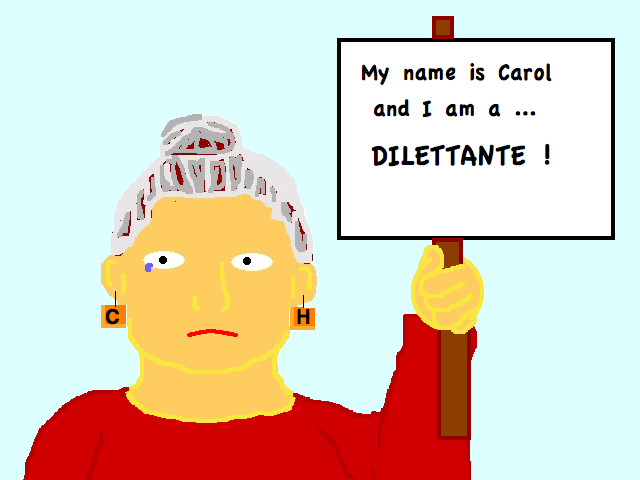
Confessions of  A …

Dear Readers,

Okay, so sometimes in the pursuit of a unique approach to the daily theme topic, I  cheat.  I  hit the Google button, grab  Bartlett’s Familiar Quotations or The Concise Heritage Dictionary in search of quick ideas  Not so today. I have foregone my usual intellectual crutches and am speaking from the heart of a sham-- oops, that was yesterday,  I mean dilettante.

Yesterday morning the dog walk crew gathered  at my house for coffee; the honor of pulling topic #43 went to our uphill friend Jim. This morning, since the dog-walking coffee drinkers now knew the topic, they were curious to hear what I wrote  about. I still had not written my daily theme, and I told a  little white lie, “It’s all in my head. I know what I want to say about dilettantes, just haven’t gotten it on paper yet.” I didn’t want to admit I was stalled, actually avoiding the topic in hopes that something clever would just pop into my head.

Then, Marilyn said that she didn’t know what the word meant, an admission no dilettante would ever make. Lively discussion ensued,  in between Jim yelling at his old white lab Cody to get his nose out of the candy bag and Peggy pointing at Halloween photos of her adorable granddaughters--our conversations rarely take a straight path to anything.  Eventually, we talked about the "Emperor’s New Clothes", snobby people at cocktail parties, and poseurs. My brain now overstuffed with ideas, I headed for home with the full intention of researching and writing about…. Governesses.

Governesses? Well, my thinking was that dilettantes are people who know a little bit about a lot of things (I didn’t have to use my dictionary to come up with that one), which was true of  19th century governesses,  whose task was to set their charges on the path towards fitting into a world of polite conversation, gentile manners  and sophisticated one-upsmanship. I guess you might say that the primary role of many governesses was to raise cultivated dilettantes who could speak a little French, play a little Mozart, dance a little gavotte. And you thought I was calling the governesses dilettantes!

In the short drive down the hill, I rejected the topic of governesses. I was tired of running to Google, of half-baked research, of twisting ideas to fool the reader. Topic #42 was still haunting me. I had actually dared to write 500 words about a poet, culture, religion, and century I knew nothing about. And I did it using the dilettante’s favorite research tool, the Google button. I had traded depth and substance for style and trickery. I had shammed Shams. 

So, here goes. I AM a fraud, an intellectual poseur. I did NOT know who the composer of Coppelia was, I did NOT know what year Hans Christian Andersen wrote his fairy tales, and I did NOT know that The Musee Granet refused to exhibit  Cezanne’s paintings. I never heard of Shams until I googled the word. Oh, the shame…. And relief… of finally coming clean and admitting:


Megan:

The Dilettante Librarian
I was going to be an art major in college, but I couldn’t get into a drawing class my first semester so I took creative writing instead. Those are the only two interests I’ve ever really had – and not so much on the art side. I like painting and drawing, have a modest ability in recreating objects (but not people – except in cartoon form) but any inspiration, any ability to paint with meaning, left me a long time ago.  I’m ok with that.

I wouldn’t have been a successful art major, because it turned out I didn’t like art history. My lowest grade in college was an Asian art history class. I thought we’d be studying sculptures of people "doing it," but it was mostly about how to distinguish different Buddhas depending on his hat style and hand position. The instructor pronounced the Himalayan mountains  “Hee-mall-yawn”. That may be the correct pronunciation, but I found it distracting and that’s all I remember about the class. I also remember crying all through the final because my best friend was having emergency life-saving surgery at that exact moment and I knew I was failing the exam. The painting of a mandala I did for extra credit, which kept me from failing the class completely, now hangs in my mom’s office. Upside down. She’s worse at interpreting Asian art than I am.

Anyway, I took creative writing instead and those were pretty much the only classes I got A’s in, and definitely the only time I felt confident in college. Or ever again.  I had no idea what I was going to do with it, or even if I wanted to pursue an MFA. I used to sit in the Mills College Library, when I worked the 9pm – midnight shift and look up things on the Internet, explore the databases and try to find something that interested me for more than a few minutes.  Or I spent the time I was working writing stories. Occasionally someone would come up to my desk and ask me a question. Annoyed at the interruption, I would smile sweetly and say, “I really have no idea. Why don’t you ask the librarian?” The librarian didn’t work that shift.

I don’t remember the exact moment that I decided to become a librarian. I was still only thinking about it when I realized I could go to Library School in England. But it seemed like it would be a low-stress, quiet job that would give me plenty of time to write. So, of course my very first professional job was the highest-stress, loudest job and required me to sign the Official Secrets Act.

I also got to find out what happens when assistants say, “I don’t know. Ask the librarian.”  In the course of looking up the answers to everyone’s random questions, I’ve learned a little bit about a lot of different things – and I’ve discovered one more thing I like to do: answer questions. Unless I’m writing, in which case I’d rather you didn’t bug me right now.


Note to future employers: This, as with most of my essays, is meant to be humorous and should not be taken as a reflection of my work ethic. I was good at my job, and I'll be good at your job.