Showing posts with label Movies. Show all posts

Tuesday, August 23, 2011

Topic 212: Bristles

Carol:


     Men of a Certain Age
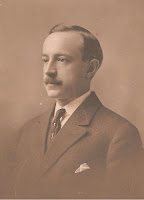
 In my genealogical climb through the branches and tangled vines of my family tree, I have discovered photographs of a lot of hairy men—beards down to the belt buckle, mutton chop sideburns, pomaded pompadours. But, the moustaches tend to show up in photos of family men around the 1920’s No matter what state they lived in, or even what country, moustaches dominated early 20th century male fashion.
 

The   photograph of Walter Lugrin Sr  (1878-1940) shows a man who is meticulous in details of dress. He wears a stick pin in his carefully knotted tie, a white handkerchief in the pocket of his expensive-looking suit. The moustache is bushy but neat, somewhat between a chevron and a paintbrush (American Moustache Institute). I wouldn’t expect less than thoughtful, measured care in the looks of a watchmaker and businessman who worked for  the  A. Wittnauer Co in Manhattan.  Married to my great-aunt Hattie Edwards, Walter was a family favorite who had gotten jobs in the jewelry store for Hattie and three of her sisters.
 

Edward John Scott (1857-1925) also sported a moustache although we have no photos of him as a young man. He too was a “company man” who worked for the same employer for over 20 years, as a printer in New Mexico for the Las Vegas Optic newspaper.  This photo (around 1918) shows a more casual  approach to dress. appropriate for the West. Hand cocked on hip, jacket thrown open, topped with a straw hat to keep off the New Mexico sun, E. J. Scott wears a bushy moustache too, not quite as contained as Walter’s but nevertheless in the “chevron” mode.  His expression is less business-like, less imposing than that of Uncle Walter back in New Jersey E. J. is often shown with that same affable smile in photos with his grandchildren, including my father, another Edward Scott.
 

Frederick William Stanley York (1876-1968) was from the Canadian branch of the family.  His mother Catherine was a first cousin of E. J. Scott’s wife Selina Jane, whose parents had immigrated to the American Midwest in the 1860’s from Ontario.  Stanley and several siblings moved west from Ontario to Manitoba and Alberta in the late 1880’s.  Stanley’s photo shows a young man of ramrod posture, eyes staring directly into the camera, high collar and white tie.  Although not as bushy as E.J.’s moustache,   Stanley York’s bristles add a good two inches to each side, a much truer chevron. This photograph  was probably taken around 1898, about the time he traveled with a group from the Churches of Christ congregation of Carman, Manitoba, all the way to Nashville for training at the Bible School.  From  photos of his horses and chickens, I know he farmed in Alberta with his wife Ella. They lived long enough to celebrate their 50th wedding anniversary in 1953. The moustache was long gone.
 

Go back one generation from Walter, E.J. and Stanley and you’ll find that men of a certain age—staid, married men—wore beards. But, the beard only really came into fashion in the United States in the 1850’s after several decades of a vogue of clean-shaven faces.
By 1920, the beard went out of style again, replaced by either a moustache or goatee, no doubt influenced by Gillette’s invention of the safety razor which became standard-issue gear for U.S soldiers in World War I (source: “Safety Razors”). As fashionista Heidi Klum might say, “Bristles. One week they’re in, one week they’re out.”

Sources:

 “The Lemania Legacy.”
“Moustache Styles.” American Moustache Institute.
Safety Razors.” Wikipedia. 


 *Please note that Carol was very late in finishing her essay today, and Megan's essay reflects that fact. 


Megan:
The many uses of Bristles
Yesterday, on the way to the movies,  Mom and I had a conversation about this topic. Conversation is probably not the right word. I tried to guess what she was going to write about and she wouldn’t tell me.

“Are you going to write about hair brushes?” I asked thinking it sounded like something she would write about.
“No,” she replied. “I thought that might be what you were going to write about.”
“I could write about how it annoys me that you think your scalp is too sensitive for my brush, and I can’t even get your brush through my hair.”
“You mean like how you bristle about the bristles on brushes?”
“Oh my god.”

“Bella has bristles on her chin” she suggested.
“Those are whiskers. Are you going to write about facial hair?"
“I’m not sure how much I have to say about that,” she said, stroking the whiskers on her own chin.
“This morning,” I offered,  “I found this long curly black hair growing right out of the side of my face.”

She finished choking just as we arrived at the movie theater and saw the worst movie of the year – One Day. It was so bad. Also, it had the same premise as a story I’ve been working on which follows a character (me) on the same day each year. I was going to use my journals. I’ve put a lot of hours into this project, not to mention the ten years that had to pass in order for me to accumulate the entries. I’m not sure it’s going to work – it’s more of an exercise, but I can assure you that the unedited and angsty journaling from my late teens is still much more interesting than that movie we saw yesterday.

I guess the fact that the movie was bad is a good thing. It’s worse when you come up with an idea and then someone else has beat you to it and theirs is better. At least I have a chance to improve it.

Anyway, I’m not doing too well with this topic today. I keep wanting to add that my mother did not finish her essay because she had obligations this morning, obligations she has known about for a while – so she could totally have written the essay before. But I skipped out all last week, and I knew about Kelly’s visit for months. So, I don’t have any right to be annoyed. Except, have you ever noticed that getting annoyed at something is not a logical reaction anyway, it happens whether you have been rightly wronged or not? Still, when I write and she doesn’t, I bristle with annoyance.
   

Friday, July 15, 2011

Harry Potter Day, Pt. 2

No essay today, we're off to see the final movie.
Happy Harry Potter Day!
 

Wednesday, May 18, 2011

Topic 166: On Hugging a Conclusion

Carol:
So Long, Farewell,  Auf Wiedersehen, Good-bye

I was very disappointed when Megan and I were watching the Masterpiece Theater mini-series South Riding. I suddenly realized it was the final episode,  which  took me by surprise.  I would have paid closer attention to how the various characters marched, tripped, or leaped to their respective conclusions. We did agree that the final minutes of the show provided satisfactory closure for all but poor Midge Carne who left a public school  education in a working class English town to live with her rich grandfather and go to a Swiss finishing school. Poor, poor Midge.   I love a satisfying conclusion, whether to a movie, a book, or real  life.
 
My favorite film ending  was  a surprise that would  have been a literal seat-grabber if I had anticipated the final scene. Instead, I settled back into my seat to wait for the credits, so when Carrie’s bloody hand reached up from her fresh grave and grabbed hold of what’s-her-name’s  wrist,  I jumped a foot out of my seat.  Another movie ending I think I would like is A Letter to Three Wives (1949) where Addie Ross announces which of her three best friends’ husbands she has run away with.  Next time I watch this movie—I think it will be the 4th time—I plan to record it in case I fall asleep AGAIN during the last 15 minutes.
 
I appreciate literary endings with a punch to them but also with internal consistency. For example, a good mystery does not resort to red herrings  or last-minute clues  thrown in to account for a completely implausible solution to a crime. The clues need to be doled out along the way --with  subtlety because if the solution is too obvious, the reader doesn’t have the opportunity to feel smart  My very favorite ending  is John Collier’s  story  “Thus I Refute Beelzy,”   a little slice of dark, shocking fantasy in a 9th grade literature anthology I taught. The story is quite short and the text happened to fit exactly on two pages.  But, it ends abruptly without any resolution (denouement).  I loved to watch my students react when they invariably turned the page to read the rest of the story—which, of course, wasn’t there.  We always had fun talking about why they expected more, why the author stopped when he did, what makes a great ending, etc.
 
One end  I’m really looking forward to  is my online driving school, which I wrote about last Thursday for Topic 166 “Mental Detours.”  Just as I was really getting into writing this essay, the dogs began to bark and I saw a car stopped in front of our house. The subject of the doggish uproar was a process server—omigod—who was luckily intercepted by my husband (thank you thank you thank you) who promised that I would contact the Court tomorrow to verify that I am doing traffic school.  It seems that I never sent  notice to the Prescott Valley Magistrate that I signed up for traffic school . In fact, there it is next to my computer, the form all filled out and ready to mail.
 
I told Megan she has to stay home tomorrow and watch me like a cop (how apropos) so that I actually DO finish the online course and send in my paperwork.  A John Collier ending with Surprise and Shock is okay in fiction, but in the real world, my idea of  a conclusion worth hugging is Safe and Dull.


Source:
Collier, John. “Thus I Refute Beelzy.”


Megan:


I cheated again and read mom’s essay first. She finished it yesterday, which almost NEVER happens and now for once, she’s waiting around for me. I like her idea of talking about endings to books or movies that she really likes. I wish I had thought of it. All I can relate this topic to is the feeling I keep having that “When this is over, I’m going to be so happy.”

I’m really sort of frustrated today. Everything is a mess. I have a sneaking suspicion that this is a ploy by my parents to get me to move out of the house. My mother denies it, and makes the novel suggestion that if I don’t like the way the house is, then maybe I should help out more. I do help out. I still do most of the cooking. But I can’t cook if the kitchen is dirty, and I can’t wash my clothes if your clothes are in the washer and no, I’m not going to do your laundry because I would never ask you to do my laundry cuz it’s gross.

And then the puppy ruined not only my new favorite dress (which replaced my old favorite dress that she ruined last week), but ALL of my dresses because I left them hanging next to her crate. One by one she tore them off the hangers and pulled them into her lair, shredding them methodically, not along the seams because that would be too easy to mend, and then nesting in the pieces. This  was my fault obviously, but it’s not hard sometimes to see why people return dogs to the shelter. But it’s not really the dog I’m frustrated with, it’s myself.

Whenever I make up my mind to change something, to get started in a new direction, I’d rather skip to the end than wade through all the crap on the way. I’ve always been less of a goal-oriented person and more of an instant gratification type person. In my mind, I know how the world works, how grownups are supposed to act. But I’m impatient. I want results now. I want the house clean and the puppy trained.  I’ve decided to apply for grad school, so now I want to fast forward to being accepted – skip over the GRE,  and the application process.

Actually, I’m looking forward to some of that process. I like working on the stories, figuring out which samples would be appropriate for which program. I like researching the programs and figuring out which ones would be appropriate for me. I have an idea again of where I want to be and what I want to do, and I’m willing to do the work to get there. I just wish I was there already. 


Wednesday, April 13, 2011

Topic 144: On Seeing One's Name in Print

Carol:
The Name Game
Living in a small community for so long, everyone in my family has been named in the local newspaper more than once. Our son made the front page when he was about four years old and happened to take a big taste of salsa at a food contest on the Courthouse Square at exactly the moment the photographer came by. I suspect that today’s topic deals more specifically with those people seeking fame or recognition of their life’s work, say in the theater section of the NY Times or the best seller stack at Barnes and Noble. There are, however, a lot of famous people who decide NOT to use their birth name in print, choosing instead the glamor or simplicity of a stage name or the anonymity of a pseudonym.
 
Cary Grant & Audrey Hepburn
In the entertainment industry, the position of an actor’s name on the marquee or the screen credits is important. Imagine the marquee of  your local theater if the stars of the 1963 romantic thriller Charade had used their real names “Edda van Heemstra Hepburn-Ruston” and “Archibald Alexander Leach.”  Not much space left for their co-star “Walter Matuschanskatasky.”  Sometimes the birth names are maybe a little too ethnic or just too complicated, like “Natasha Nikolaevna Zacharenko-Gurdin.”             
 

Ellis, Acton & Currer Bell
Authors use pseudonyms-- “noms de plumes”-- for more complex reasons.  Historically, it was not only more difficult for women to get their work published, but also to be taken seriously once their work was in print. When Ellis, Acton and Currer Bell published their 1846 collection of poems, there were questions about who the “brothers” were, if there were actually three of them, but never speculation about their gender. When Currer Bell published Jane Eyre the following year, contemporary reviewers began to consider whether or not a man or woman had penned the book, about which “…though relating to a woman, we do not believe to have been written by a woman” (source: Fonblanque qtd in Evans 364). The true identity of the Bell brothers as the Bronte sisters was not revealed until Charlotte visited her London publisher in 1848.
 
Sometimes authors use pseudonyms to keep a safe distance between professional and literary careers. An Anglican deacon and mathematician wrote professionally under his own name in the early 1850’s but his best-known work was published under the name Lewis Carroll. James Tiptree Jr. had been writing popular science fiction for over 15 years before “his” identity was revealed as the psychologist Alice Sheldon.  Over 13 mystery novels were published under the authorship of Amanda Cross, all set at Ivy League universities and featuring the English professor cum sleuth Kate Fansler. Determined not to jeopardize her tenure or her substantial academic reputation,  " Amanda Cross" protected her true identity until a zealous fan tracked down the copyright information which led to Carolyn Heilbrun,  a full professor at Columbia University, author of some of the most important feminist literary studies of the 20th century, including Writing a Woman’s Life (1988).
 
I just found out one of my retired college colleagues has published a kind of memoir, a recollection of the people and events of his time at the college. It’s on sale at our College bookstore. I understand my name is in the book. If I can get this essay finished early, I’ll just have time to drop by and take a peek. I don’t mind seeing my name in print. Not vain, just curious.

 Sources:
Evans, Barbara and Gareth Lloyd. Companion to The Brontes. Everyman: 1985.
Want to know the real names of the actors mentioned in this essay: go to
Trivia: Pseudonyms 

Megan: 
No essay from me today. 
I think I'm sick. 
Puppy sick...

 Introducing Bella. 

Tuesday, April 5, 2011

Topic 139: On Thinking for Oneself

Carol:
The Rugged Individualist and the Marlboro Man             
 Any list of American cultural values invariably includes Individualism, emphasizing the importance of thinking for oneself, achieving independence, and making important life choices without the “interference” of family. Independent, Individual, free—the American Ideal.  The ideal aside, we are routinely bombarded with messages that attempt to manipulate us to NOT think independently, the in-your-face, overt messages media and advertising use to influence our spending and social habits. 
 
“Product placement,” is the use of branded items in television and movies. Next time you watch one of your favorite TV shows, look at what the characters are drinking and eating, or what the logo is on their laptops. According to Broadcasting & Cable, 80% of commercial television programming includes product placement, or “branded entertainment” (source: sourcewatch.org).  Products are also advertised through corporate sponsorship at sporting events, use of branded clothing, and promotion of products by the athletes who are paid a lot of money to wear a particular brand.
 
One egregious example of “product placement” is the collusion  between entertainment industry and tobacco companies. In a 1983 speech for a marketing meeting, then Philip Morris president Hamish Maxwell emphasized the importance of putting cigarette smoking into films: “Smoking is being position as an unfashionable, as well as unhealthy, custom. We must use every creative means at our disposal to reverse this destructive trend” (source: Smoke free Movies). Despite increasing regulation against such practices and  denials  by the tobacco industry, 74% of US movies in 2002  showed smoking, and 11 of the top box office films showed special brands. Six of those films were PG-13, i.e. oriented towards a teen-age audience.  What about in 2011? Current films with PG-13 or PG ratings that show smoking without negative consequences include Sucker Punch, Limitless, Rango, and The Lincoln Lawyer.
 
I didn’t begin this essay with the intention of writing about tobacco, but I’ve kind of gotten myself riled up here. You can sneak alcohol into someone’s drink, but you can’t sneak a cigarette into someone’s mouth. Tobacco does NOT taste good when you take the first puff. Or the second, or after the first pack. Euphemistically, it is an “acquired taste,” encouraged by peer pressure and the glitzy notion that smoking is Cool, or whatever the current slang is. Despite the highly publicized health risks and decline in smoking by American adults, the number of adolescent smokers has increased in the past several years.
 
A 2009 article from scientists at Dartmouth shows the powerful link between smoking in movies and smoking in teen-agers. According to the authors, frequent viewing of movies that include smoking increases 3-fold the likelihood that an adolescent will smoke. (source: Heatherton and Sargent).  Parents may be scrupulous in monitoring their children’s exposure to violence in the media but not even consider the impact of exposure to positive images of smoking. Ironically, many of the actors shown smoking on camera are actually using clove cigarettes or other tobacco-free substitutes. In other words, they wouldn’t be caught dead smoking tobacco themselves.
 
There you have it, the ideal of Americans as independent human beings, unique and able to think for ourselves. The reality is that we crave to be accepted as attractive, happy and hip. Forget about exposing the insidious plots of subliminal messages in Walt Disney movies. Forget about analyzing the sexual messages in the magazine ads for vodka. Stand up, speak out, and use the power of your pen and pocketbook to fight  the tobacco industry’s hold on entertainment. That’s the American Way.
 
Sources:
Broadcasting & Cable qtd. In “Product Placement.” Sourcewatch.org
Smoke Free Movies.

Megan:
Confirmation Bias
I came across an article called "Citizenship Duties" on Salon.com a couple days ago, which offers an interesting perspective on this topic. The author, Glenn Greenwald, compares two quotes about trusting the judgment of a President. The first is Britney Spears speaking about President Bush in 2003: 
“Honestly, I think we should just trust our president in every decision he makes…”

The second is Kevin Drum, of Mother Jones, speaking on Obama: 
“I mean that if he and I were in a room and disagreed about some issue on which I had any doubt at all, I'd literally trust his judgment over my own. I think he's smarter than me, better informed, better able to understand the consequences of his actions, and more farsighted.”

Greenwald’s point seems to be that this type of single-minded trust and deference is dangerous, no matter which party is in power. He compares such submission to a religious act:
“Venerating a superior being and blindly following its will is a natural human impulse, as it frees one of the heavy burden of decision-making and moral and intellectual judgment, and it also creates a feeling of safety and protection.”
But he encourages us to rise above this natural impulse (and rise above Britney Spears) and do our duty as citizens, which is to question our leaders.

In an effort to spend a little more time researching for this essay than I normally do, I went back and read the original Drum article as well as his irritated follow-up after Greenwald’s piece was published.  It is clear that Greenwald took Drum’s quote somewhat out of context, considering the entire article is about questioning President Obama and the Libya Intervention.  Drum said his original quote had been written hastily and upon reflection, “If I weren't unsure of myself, after all, I'd hardly be interested in Obama's views or anyone else's.”

 And then Greenwald responded (update added to original), basically saying that if Drum had said what he meant in the first place, there would have been no need to compare him to Britney Spears. Aside from the Britney Spears comparison, Drum and Greenwald’s arguments were fairly respectful, most likely because they are otherwise politically aligned. Both made references to respecting the other’s writing and ideologies, and the conflict only became personal because one liberal compared another liberal to a red-neck pop princess's unquestioning faith in the stupidest President we’ve ever had. 

Neither of them actually said that, but that’s gotta be from where the outrage stems. Similiarly minded people can argue smaller points of rhetoric respectfully, but (as the media constantly reminds us) Democrats are always going to think Republicans are stupid, and Conservatives are always going to think Liberals are elitist (perhaps rightfully so).  Greenwald isn’t the only commentator to call Drum out on his  apparent unquestioning devotion, but Drum disregards them because they are not Obama supporters anyway. He’s only interested in responding to criticism from someone who usually agrees with him, even though all the critics made the same point.
 
Everyone wants to believe that they think for themselves – that they are aware and informed and able to make up their own minds. But the truth is no one has enough time to fully investigate every issue they are expected to feel strongly about, so it is often easier to defer to the party line or the dogma of their faith.  Add to that, the problem of confirmation bias which suggests that people tend to favor information which confirms what they already believe even when presented with evidence to the contrary. Perhaps we must first question our beliefs before coming to any further conclusion about our capacity for independent thought.


Sources:
Greenwald's " Citizenship Duties" Salon.com
Confirmation Bias. Wikipedia.
Drum, Kevin. "Obama, Libya, and Me." Mother Jones.
and the follow up.


Tuesday, March 22, 2011

Service Interruption


I had a phone interview this morning and prepared for that instead of writing today's essay. Mom has been working on her essay for 1.5 days and still cannot finish. She had "5 minutes left" over an hour ago, and I have no doubt that this time tomorrow she will still need 5 more minutes.

So, you'll have to wait until tomorrow to for "Nursing a Grievance." Any guesses what mine's going to be about?

Wednesday, March 16, 2011

Topic 126: Animal Resemblance in People

Carol:
Animalia Mania

I told Megan not to worry about me being late on my daily theme today because I had no intention of doing research. Generally, it takes me about four times as long as Megan to write my essays because that’s what I do, get sidetracked on all kinds of little Googly research trails. In search of animal resemblances, I looked up:
  • David Naughton: loved him dancing through the Dr. Pepper commercials, then loved him even more in An American Werewolf in London, one of my favorite   wolfian incarnations);
  • James Naughton: did not know he was David’s older brother; loved him in Glass Menagerie, thought to myself maybe he acted or directed in an Edward Albee play;
  • Edward Albee: well, James Naughton was in Albee’s Who’s Afraid of Virginia Woolf? But, I was really hoping that he was in Seascape, which Marc says is one of the best plays he has ever seen performed at the Prescott Fine Arts theater—the lizards were incredible.
  • Frank Langella—omigod, did anyone know he made his broadway debut in Seascape? The same Frank Langella who was the first actor to make vampires sexy in the 1979 John Badham version of Dracula. Maybe the word is sensuous,  which neither Tom Cruise nor Brad Pitt are in Interview with the Vampire.
  • Being Human—so, vampires and werewolves just kind of go together. And, this British TV series proves that they can co-exist and even like each other. Not like those shapeshifters in Twilight. Now, the British version (haven’t seen the American copy-cat) is filmed in Bristol, which looks to be about 2-3 hours west of London. London! American Werewolf in…that takes me back to David Naughton
  • I’m caught in a perpetual google-loop!

But, like I said, I wasn’t going to do any research on this topic because it is too time-consuming.  And, I don’t want people to think that just because I’m retired, I have so much time on my hands that I don’t do anything but watch British TV shows on my big-screen HDTV, go to B-Grade teen flicks with my daughter, and obsessively surf the Internet.

I used to read, folks. I mean I really read a lot of great things. And I went to plays, all kinds of plays. Here is what I can say about animal resemblances in people without using the Internet.
 Great world literature:
  •  Frankz Kafka--who can forget Gregor Samsa, the caripaced protagonist in   Kafka’s “Metamorphosis.” Those first few lines of the story where Gregor wakes up  to realize he has turned into a cockroachian insect with multiple legs are creepy.
  • Julio Cortazar’s surrealistic short stories.  In one story a man goes to a zoo to observe a group of lizards, then suddenly he becomes one of the lizards. Cortazar also wrote a great story translated as “The Man Who Vomited Rabbits,” but the man doesn’t actually resemble a rabbit.
  • Eugene Ionesco's play Rhinoceros, a great example of Theater of the Absurd. I never saw the play, but in the movie version, Zero Mostel is incredible as he gradually transforms into a rhinoceros. His best acting work, I think.
  • Ichabod Crane—don’t have to be a genius to get the picture of this character in “The Legend of Sleepy Hollow.” Disney got him right in the cartoon version with his long, knobby knees.
  • Aristophanes’ The Frogs—haven’t read it in a long time, but Marc saw a production of it at Yale that was performed in the University swimming pool. Look it up yourself. That was the year Christopher Walken and Sigourney Weaver were both Yale drama students, so one of them might have been in that pool.
  • Beauty and the Beast—an old story with many incarnations, one being Cocteau’s film, another being, okay I admit it, the B-grade teen flick Beastly I saw last week with my daughter.

I think I may have completely muddled the topic because most of the references I have made are not, strictly speaking, people who are like animals but people who become animals.

I have to wrap up this not-quite-an-essay because Megan has come up to check on my progress. She can be doggedly determined, stubborn as a mule, quiet as a mouse, wily like a fox depending on her mood. If I get this essay to her right away, maybe she will give me a great big bear-hug.


P.S. I refuse to list all the sources I went to for the first list. I blame any misinformation on the second list for faulty memory. Look them up yourselves. However, here is a gift.
Read Julio Cortazar’s story Axotol online. Here’s the link.
http://sayberklas.tripod.com/anthology_short_stories_in_english/id32.html

Megan:
People Resemblance in Animals
Yesterday, and not for the first time, Milo rolled over to escape my admittedly aggressive affection and fell off the bed. At the same time, my mother knocked over a jar of paper clips and I said, “See that? He gets his clumsiness from you.”

A simple Google search will provide plenty of proof that there are people out there who look like their pets, or who behave like animals. I worked with an officer in the prison who had a squirrell-like habit of keeping stashes of food hidden in drawers and other places around the library. But other than that one example, I can’t think of anything else to say about the topic as it is stated. So, I’m gonna reverse it and talk about Milo.

Aside from his remarkable gracelessness, my mother claims he is a very intelligent dog. He knows exactly what he can get away with from each of us in the house. Obviously, I am the most lenient and my father is the most strict. Considering that he pretends not to even like the dog, Milo hasn’t noticed. And if imitation is the sincerest form of flattery, that dog clearly worships my father.

Milo has studied Dad’s habit of never closing a door behind him. In the dead of winter, my father will go down to the laundry room, via the basement, and then out the garage, leaving every door in between wide open which creates a perfect tunnel of arctic wind to circulates through the house. He may claim his hands are full with the laundry or the trash, but I believe it is simple carelessness. Just as Milo is careless when he opens the sliding glass door on the porch and lets himself in after dinner. Never thinks of shutting it behind him.

And when Milo sneaks into the kitchen for a snack if he thinks no one is looking (something he may have inherited from me), he leaves the cabinet doors open too. After he finishes (or is caught) rooting through the trash, my mother will say, “Look how smart he is! He knows just where to go.”

Well, the other day, he knew just where to go when he regurgitated corncobs in the middle of the night– her room. I’d known it was coming because the last time he had corn on the cob, it was my room he puked in.  This time, I locked my door.

Speaking of having to lock my door – remember when Milo was peeing on my bed? Well, we finally figured out that  he was jealous of my cousin’s kids. He’s too rambunctious for them, so when they come over he is banished outside. The moment he is let back in, he marks the corners of my bed. My mom told me this story once about how shortly after my brother was born, she was feeding him on the couch. I resented his introduction into our family, and peed on the floor right in front of her, knowing she couldn’t get up to stop me. I wouldn’t normally reveal something like that about myself, but I can honestly say that I don’t remember doing it, and have not urinated out of jealousy in the 27 years since. I guess it’s another example of the complexity of the nature vs nurture argument. Some behaviors are learned, and others are just in the blood.

Mom and Milo

Friday, March 11, 2011

Topic 123: The Vogue of Boredom

Carol:
Men of the Ton
George Sanders in All About Eve
The title of the article is “Bored to Death,” and it recounts the suicide of actor George Sanders in 1972.  After a career that included such films as Rebecca, Picture of Dorian Gray, and All About Eve, which won him an Oscar in 1950 for best supporting actor, he was tired and sick, and sick and tired of life.  Whatever the real reason for his suicide, the note he left behind  seems to befit the style he had set for himself as an actor and writer of Memoirs of a Professional Cad: “Dear World, I am leaving because I am bored” (source: Asher-Walsh).
 
The word that comes to mind is “ennui.” The dictionary uses synonyms like listlessness, apathy, indifference and, of course, boredom. In the late 20th century of existentialism, the word evokes a sense of “world weariness.”  It is just as likely to be discussed by philosophers as by psychologists -- “the human condition” or “a human’s condition.”
 
I love reading Austen and the Brontes, and I never get tired of watching whatever TV and movie adaptations of their works show up although I am picky about Jane Eyre. These novels portray middle and upper class women as on a perpetual hunt for love and security as they embroider, loll around in parlors, stroll in country gardens, sigh and flirt at soirees. Elizabeth Bennet and her sisters would never use the B-word although there are characters in the novel who portray a sense of cynical detachment. The word “boredom” itself shows up  in the 19th century Oxford English Dictionary and apparently it starts showing up in Dickens. According to Wikipedia, he uses the word six times in his 1852 novel Bleak House.
 
Looking back to the previous century, we get a glimpse of boredom as an affectation, a “fashionable”  lack of interest or passion in the world. In her 1782 novel Cecilia, Fanny Burney captures this “vogue of boredom.” Cecila is approached by a Mr. Meadows, a fellow guest at a concert, who announces in a languid voice, “I am tired to death! Tired of everything.”  After he abruptly leaves her side, another guest explains that Mr. Meadows is the absolutely height of fashion both in his dress and in his comportment. 
A man of the Ton [Mr Gosport explains]... must invariably be insipid, negligent, and selfish... He must never... confess the least pleasure from anything, a total apathy being the chief ingredient of his character; he must, on no account, sustain a conversation with any spirit... (Book 4, Ch.6)

Beau Brummel caricature
The term “man of the ton” was in common usage during the late 1700’s and even shows up in a New York literary magazine in the 1890’s. It refers to the phaeton, a racing carriage frequently used by young men of the day to dash from party to party in search of divertissement. So, a “man of the ton” was the equivalent of a 20th century playboy knocking about in his Jaguar or Lamborghini (source:McDowell). By the early 1800’s this type of bored, self-absorbed fashion type would evolve into the dandy personified by Beau Brummel, the early 19th century stylesetter. Brummel would become the model for such modern “bodice-rippers” as Georgette Heyer’s character Beau Wyndham in The Corinthians whose “air proclaimed his unutterable boredom, but no tailoring, no amount of student nonchalance, could conceal the muscle in his thighs, or the strength of his shoulders” (source: quoted in Guest Poster).
 
I suppose if Beau Brummel had lived in Hollywood in the ‘50’s, he might have run into another “man of the ton.” Mr. Brummel, meet Mr. Sanders.

Sources:
 Ascher-Walsh, Rebecca. “Bored to Death.” 8 May 1992.
            http://www.ew.com/ew/article/0,,310396,00.html
Burney, Fanny. Cecilia: Memoirs of an Heiress.  (Book 4 Ch. VI )  http://en.wikisource.org/wiki/Cecilia/Book_4/Chapter_vi
Guest Poster. “A Closer Look at Georgette Heyer.” 27 July 2010.Austen Blog.
http://austenblog.com/2010/07/27/a-closer-look-at-georgette%C2%A0heyer/
Walsh, Carolyn. “Revolutionaries and Romantics: The Regency—“. 31 Oct. 2010. The Culture Concept Circle. http://www.thecultureconcept.com/circle/romantics-and-revolutionaries-02-the-regency-characters-caricatures-and-connubial-bliss-harmony-before-marriage


Megan:
The Blessing of Boredom
I have this memory of my childhood, complaining to my mother that I was bored and she told me I was lucky – that boredom was a luxury. The suggestion was that the luxury lay in being worry- and responsibility-free – that the state of boredom could only be achieved once all other basic needs such as clean water, food, shelter and the support of a loving family had been met. I’m not sure if this is a real memory, but I’m sure she would agree with the sentiment.

I almost never get bored anymore. Even when I’m not interested in what’s happening around me, or on TV, I find myself fairly content to sit around and remember how lucky I am that my needs are met. Most of the time I can sit comfortably with myself in silence, and I’m pretty lucky there too because I know a lot of people can’t do that.

It’s hard to concentrate on the topic right now. Our morning began with a panicked phone call from my grandmother reminding us that my aunt is in Kauai right now. My father managed to reach her – asleep in her rental car parked on a hill where she and her friend had taken refuge from the incoming Tsunami waves. I have friends in Japan and Okinawa and most of them have reported, via Facebook, that they are safe.

My grandmother called back again, this time about the Tsunami warning for the west coast, after hearing reports that a coastal Oregon community had been evacuated. My brother lives in Portland, and it was concern for him that prompted the second call. The Oregonian  has a headline still proclaiming that 7.5 foot waves and river flooding are expected, but the article itself has been updated that the expected arrival time has passed and the wave never came. 

Earthquakes are frequent enough in Japan that they seem to have invested in ensuring the strength of their buildings, but how does anyone prepare for wall after wall of water, except to try and get out of the way? We don’t know the extent of the damage yet, probably won’t know for days.

The next few weeks are probably going to be very difficult for Japan, but luckily they have the resources and infrastructure in place that they won’t experience the devastation of the Haiti earthquake or the Indonesia Tsunami.  But still, satisfying those basic needs of clean water, food and shelter will probably be everyone’s main concern for awhile.  And for those of us safely out of the way, maybe we can look for ways to assist them (even if only through thoughts and prayers) before we return to our blessedly boring lives.
 

Friday, March 4, 2011

Topic 118: Conservation of Social Resources

Carol:
Clutter-Mania   
Generally, I love working in my office, which has undergone a complete renovation since I retired. Fresh paint, new bookshelf,  desk and now a new computer. The room is small, but the space would function perfectly well except for one problem. I have become the conservator of not only the boxes of historical memorabilia handed down from my mother and grandmother, but also the boxes of social records of a women’s group I belong to. Conservation is about time and space, both of which I don’t have a lot of.
 
I knew I was in clutter trouble a few weeks ago when I was downloading photos from my camera. I couldn’t find  the charger for the camera’s rechargeable batteries. Yesterday morning, I found the charger but by then I had misplaced the camera. I only found the charger  because I was hunting for the book and notes I needed for the mythology class I take on Thursday afternoons.  I finally found the mythology stuff which I had put in a file box right next to my desk for “easy access.” My organizational system was clearly breaking down.
 
Megan tells me it’s because good organization is based on “intuition.” What does “intuition” have to do with organizing, I asked Megan--  the only person I know who alphabetized the books in her room when she was a kid (a natural-born librarian if I ever met one).  She explained that my kitchen is NOT set up intuitively, and that’s why Marc never knows where things are and never puts things back in the right place. I got huffy.  My kitchen is organized in zones: all the prep materials (cookbooks, measuring and mixing equipment)  to the left of the sink , all of the dishes, glasses, cutlery to the right of the sink closest to the dishwasher, spices and mixing spoons next to the stove. And, I NEST everything to maximize shelf space, which is a good example of conservation of kitchen resources.  It’s not my fault if people—i.e. Marc—haven’t caught on to the system
 
Okay,  I got so frustrated looking for my camera and my mythology books that all I could think about during the class itself  was that I needed to come home and totally re-organize my office. There I was watching a DVD of a professor talking about Mesopotamian flood stories, and my mind was drifting off to plan   how I could NEST my photo boxes in the closet to get more space. By the time he was talking about Aztec and Chinese flood stories, I was mentally mapping out “social resource” zones for the closet, one area for the file boxes from the women’s group, a separate bookshelf dedicated to my family history materials.  If there had been 15 more minutes on that DVD, I would have created a whole new file system for my personal correspondence and retirement benefits.
 
By the time I arrived home from my mythology class, I was ready to get upstairs and whip that space into shape. I had just enough time before dinner to shift all the contents of the closet into our upstairs hall and loft. By the time dinner was over, I had just enough energy to walk upstairs and move the file boxes from the couch to the floor so that I could watch TV. 
 
I’m feeling a lot of pressure right now. I had to get in my morning walk, my morning coffee talk with the neighbors, and now my morning daily theme. When I “deconstructed” my office, I thought I would have the rest of the day to implement my organizational plan (the zones, the nests, the filing system) . But, I forgot….I promised my temporarily-out-of-work-otherwise-known-as-she-who-must-be-obeyed –daughter that I would go to the movies today. Organization is all about intuition—I intuit that if I break my promise, I will be in big trouble. 


Megan:

Conservation of Social Resources

Social support provides a major reservoir for resources outside those endowed to the self (e.g. high self-esteem, sense of mastery).

When we pulled this topic from the little basket we have designated to hold the scraps of paper upon which the topics have been printed, my mother groaned and I cheered. “I don’t know what this means,” she said, “I don’t know what I’m going to say.” I guess it was the fact that the tables were turned for once, but I gleefully shouted, “I’m gonna write about how my friends don’t have time to hang out with me!”

And then I got sad for a moment.

And then I perked up again, because that’s not true anymore. But I should preface this by mentioning that in England, I met almost all of my friends through my job at the prison. We spent the day working together and then we went out to the pub after work and talked about work, or the people from work. I had an extremely active (if somewhat repetitive) social life. When I moved back here, I wasn’t prepared for the toll work, marriage and parenthood had taken on my childhood friends in terms of the free time they had available to spend with me. It was sort of a blow to realize that they had not just been sitting around for the 10 years I was gone, hoping and praying for my eventual return.

Anyway, after a few months, I adjusted to my new place in the world, and we’ve come to a sort of satisfactory arrangement. Instead of spending 12 hours together at a time, we have coffee, or lunch. We have children’s birthday parties. We have roller derby, and tonight, my friends’ friend’s band is playing in a local bar.

I have been looking forward to this all week, which means that it will not go well. I will spend more time getting ready than I will at the event.  It will be too loud to talk, so my friend and I will stand next to each other and watch the band and text our observations to each other. Observations like, “Your friend’s band sucks” to which she might respond that my parents were never married. (They were married. Twice!) I will wonder if anyone notices how amazing I look (even without the makeup with the extra coverage) and then I will remember that nothing good ever comes of meeting someone in a bar. Especially a bar called Hooligans.  Then it will be time to go, because my friend has to go to Phoenix in the morning and I have to go to a first birthday party.  But before we say goodnight, we’ll make plans to meet soon for coffee or dinner or roller derby.

The quote at the opening of this “essay” is from an abstract of a study with the same name as the topic. I couldn’t access the full-text of the article because it cost $25. That seemed like too much money to spend to read a jargon-filled study about social relationships, especially because I can guess the results. Having friends is important. Young people spend a lot of time establishing friendships they hope to maintain through the rest of their lives, once they are too busy working, being married and having families to devote much time to making new ones.  It probably concludes that those resources “endowed to the self,” such as self-esteem, are also supported by those external social resources (friends).  That seems logical to me, but if you want to know for sure, take your $25 and follow the link below.
 
Sources:
Stevan E. Hobfoll, John Freedy, Carol Lane, and Pamela Geller. "Conservation of Social Resources: Social Support Resource Theory" Journal of Social and Personal Relationships November 1990 7: 465-478, doi:10.1177/0265407590074004 http://spr.sagepub.com/content/7/4/465.abstract

Wednesday, March 2, 2011

Topic 116: Face Value

Carol:
What’s the Value of a (Pretty) Face?
Every woman in the United Sates participates in a daily beauty pageant, whether she likes it or not. Engulfed by a popular culture saturated with images of idealized, air-brushed and unattainable female physical beauty, women and girls cannot escape feeling judged on the basis of the appearance. YWCA. "The Consequence of American's Beauty Obsession on Women and Girls."
When my daughter was about 13, she received a subscription to a teen magazine  as a gift.  Thumbing through the magazine, I was appalled.  The “tween” models in the fashion ads were pencil thin, made-up,  junior versions of the high fashion models in Vogue and Cosmopolitan. Not a real girl in the lot, certainly not anyone who looked like Megan and most of her friends.  What bothered me the most was the advertisements, which were already bombarding 12-14 year-old girls with the messages that (1) beauty is the key to popularity, and (2) you can buy your way to beauty. 
 
The beauty industry is big business and not  just in America. The British department store Debenhams  released  a study on February 9, 2011 showing that the most expensive item in a woman’s  purse was not her cell phone or her I-Pod, but her make-up kit, the equivalent of $407,  professional women between 35-44 having the most expensive make-up bags. Debenhams concludes that women should consider adding make-up to their insurance inventory along with the digital doo-dads in their purses (source: Debenhams homepage).
 
Many studies look at female body image, about eroding self-esteem and increasingly narrow standards of beauty, but what is interesting about the YWCA 2008 report Beauty at Any Cost   is that it considers the economic impact. Women in the US spend $7 billion dollars a year on cosmetics. The study notes that the average money spent in 5 years on cosmetics is equivalent to a year’s tuition at a public university.
 
What about their daughters?  According to a Feb 14, 2011 article in the Pittsburgh Tribune-Review, the number of girls between the ages of 8-12  who use eye make-up has doubled in the last 2 years, and 43% of 6-9 year-old girls already use lipstick or lip gloss. Wal-Mart is getting ready to market its own line of “tween” beauty products, but that’s okay because they are “eco-friendly.” The target age group?  The 9- to 12-year olds.
 
If beauty products aren’t enough to transform women into happy, successful beauty queens,  there is always the next level of artifice.  The American Society of Plastic Surgeons’  2009 “Quick Facts Sheet” shows that the number of cosmetic procedures has increased 69% since 2000.  Surgical procedures have declined by 20%, but  “minimally-invasive procedures” have increased by 99% with Bo-tox the #1 treatment. Typically Bo-Tex injections are about $500 a shot, and need regular repeats. Other popular non-surgical procedures include facial fillers, dental veneers, laser hair removal and electrolysis.  According to the 2009 Quick Sheet, 91% of all cosmetic procedures are performed on women.
 
There is another economic reality to the beauty fixation which affects both women and men.  “Lookism” shows up as work-place discrimination. According to the YWCA report , workers with “below average” physical looks tend to earn about 9% less more money than those judged as “above average.”  I doubt, however, that any woman will tell you she has $400 worth of make-up in her purse so that she can get a salary increase.
 
My daughter at 13 decided to give away her magazine subscription after she took a close look at the ads. How much make-up she carries in her purse is her story to tell. Me? I quit wearing make-up because of allergies, But, I have a drawer in the bathroom with about $50 worth of cosmetics I bought out of total vanity and used only once.
Woman at her Toilette

 
Debenhams homepage. http://www.prweb.com/releases/2011/02/prweb5043704.htm
“Girls are Wearing Cosmetics at a Younger Age.” Pittsburgh Tribune-Review.
          http://www.pittsburghlive.com/x/pittsburghtrib/lifestyles/family/s_722835.html
YWCA Beauty at any Cost.
    http://www.ywca.org/atf/cf/%7B3B450FA5-108B-4D2E-B3D0-C31487243E6A%7D/Beauty%20at%20Any%20Cost.pdf


Megan:
The Value of the Face
This is one of those days where I need to produce an essay in 15 minutes or else I won’t have time to take a shower before we leave the house to do important things (like see a movie).  And this is also one of those days where washing my hair, which is the most troublesome and lengthly part of the shower, is non-negotiable. It simply has to be done today or my hair will bond together in a single, waist-length, lock of dred. And then I’d have to shave my head.

Mom has the same time pressures on her today, not because she needs to take a shower, but because she is the one who has to be somewhere in an hour and a half. She isn’t anxious about it even though she has not finished her essay, she’s not dressed and is in the kitchen making toast. She has also been awake a lot longer than I have and has obviously put some thought into today’s topic because she asked me whether I remember the time I exercised good judgment about a teenage magazine. I didn’t remember that particular incident but it must have been a defining moment in my life. Criticizing advertisements is the reason I yell at the TV for having diet commercials at 10:00 in the morning (“They’re trying to make the stay at home moms feel fat and useless!”), and that is why I can’t watch day-time TV – the yelling upsets Milo.

But her question about the teenage magazine and the makeup advertising also brings to mind something that happened only yesterday. I went to the mall to buy more of that liquid make up that goes on your face after the moisturizer but before everything else. There’s a word for it, but I can’t remember it right now. I always take the old bottle with me because if I don’t, I cannot remember the brand I prefer. Anyway, I have been using this particular shade and type of this particular brand for the past 5 or 6 six years, but I knew that yesterday would be different. Despite the fact that I have applied sunscreen to my face every day for the past 10 years, I was going to ask the helper lady to find me something with a “little more coverage.”

And the helper lady said she could help me, that they had the very thing, and that it would indeed provide me with… and then she forgot the word and I had to say it again. Coverage. For my face. I need to cover my face. 
I handed her the old bottle so she could see what shade I used. The shade was 0, by the way. The very palest shade they had and she said, “Oh no no no. Your face is too pink. You have a very pink face.” So, she picked out another color, while I called her names in my head.  “I used to live in England,” I said, by way of explaining why I would have required such pale makeup and also because I wanted to feel like I once had a more interesting life, when buying makeup was not the main event of the day.

Then she told me that if I could wait a week to purchase the new makeup, it would come with a gift bag worth $60 of additional makeup and I said, “Sure! Sign me up!” and I know when I go to collect it next Monday, it really will be the highlight of the day. Unless I go to a movie afterwards.

Tuesday, February 22, 2011

Topic 110: On Knowing When to Stop

Carol:

Stop in the Name of Love   
 I guess I have a problem with not knowing when to stop. Frankly, I didn’t consider it a problem until other people started complaining, mostly …well, mostly my daughter. I spent quite a few years doing whatever I wanted before SHE was born.
 
 My husband was easy going and had his own interests in the pre-kid years. So, it wasn’t a big deal during summer vacations that I might start a book, not get dressed, not cook dinner until I had finished that book. Who could put The Exorcist down in the middle, or The Omen or even The Amityville Horror? Marc would arrive home, greeted by the promise “ I just have a few more pages, then I’ll get up and make dinner.” He would usually laugh, shrug and make a sandwich. 
 
After I gave up horrifying myself into insomnia, I was introduced to videogames at the Belly Up Tavern on the weekends.  It was pretty exciting when we bought a Pac-Man for our new television so that I could play as long as I wanted without having to hang out at a bar.  We set up the TV in the spare bedroom, which also housed our clunky stationary bicycle, and I soon perfected the technique of cycling and playing Pac-Man at the same time. I was getting the best work-out of my life because I would get so excited gobbling up the power pellets in the videogame maze that I would pedal faster and faster.  Marc would head off with his stack of running magazines after I promised, “One more game, then I’ll come to bed.”
 
Things changed when child #1 came along. Megan was so much more demanding than my patient husband.  When she was six weeks old, I decided to re-start my Pac-Man/bicycle schedule and laid her on a blanket on the floor while I exercised. Just as I was getting into the rhythm of the game, she began to whimper. I couldn’t stop then, could I, just when I was racking up the points for a new record? Fifteen minutes later, I was pumping full-speed on the bicycle when she escalated the whimper into a full-out tantrum. I looked down at that sweet, little, puffy red face  and promised, “Just 5 more minutes, kiddo. I’ll feed you when I get to the next level.” Neither the love in my eyes nor my soothing tone satisfied her. Volume and pitch of the screams went up another notch. This kid just didn’t know when to stop.
 
It has pretty well been that way ever since. When we bought the Game Boys for her and child #2, I had to try out the Mario Brothers, didn’t I, to see how long the batteries would last? She got soooo cranky after the third hour even though I promised her, “Just one more level, kiddo, then you can have your Christmas present back.” I did have a few years of peace when she moved to England. Marc and I got back into our comfortable, pre-kids routine. I would spend 6 or 7 hours at the computer working on my family history book.  He would head off with his stack of motorcycle magazines after I promised, “Just 20 more minutes and I’ll have this section finished.”
 
Megan doesn’t throw screaming tantrums anymore, but she gets this tone in her voice when she thinks I’ve been working on something too long and she wants to go to the movies, or eat dinner, or post the daily theme. She hates it when I break a promise. My daughter just doesn’t know when to stop.  Here she comes now. “Megan, I promise, just 5 more minutes and I’ll be done with essay 110. I just need one more perfect sentence to…..”

Megan:

On Knowing When to Stop

I don’t know whether you noticed but I added a search bar to our site yesterday. I could say I did it for your convenience, but really, I did it for mine.  Some of these topics are so similar, I’m starting to repeat myself. I think. I’m not sure yet. I need to go through and re-tag all the entries, which will also make navigating easier. And then maybe we can add one of those word clouds where the key words get bigger depending on how often we mention them. I am 100% sure that the biggest word will turn out to be MILO, followed closely by Prison.

So, I added the search bar so I could see if I’d written about why I quit working at the prison.  I got 8 pages of results – each page having 4 entries, and I’m not really in the mood to read 32 essays right now. Also, I’m writing this from a coffee shop, using their internet and ISP, and every time I click on an entry, it inflates our stats. Those numbers go up enough from my mother’s visits (on days I’m particularly funny, she will revisit the site several times to read the essays. I know this because I can hear her crying laughing). Anyway, I’m pretty sure I’ve alluded to quitting several times, and talked about some of the bad things and now that I think about it, I don’t really have a “why I quit working at the prison” story that would tie in to the topic of knowing when to stop.

I still have my ups and downs about leaving the prison and England, lately more downs than ups. This is probably because I still haven’t found a job.  It has been 8 months. I have been trying to take some of the advice I got from the conference last month by increasing my professional online presence. I’m now on Twitter and try to tweet at least once a day about something library or information related. I have 8 followers, which is the same as the number of people who subscribe to this website (different people though). Sometimes I forget why I’m there, and I spend most of my time laughing at my favorite celebrity tweeters (Steve Martin, Sarah Silverman, Stephen Fry).  I’m also trying to be more involved on LinkedIn – keep meaning to involve myself in some of the discussions happening there. The problem with that is that for some reason, CILIP (England’s library association) is far more active than the ALA, so all the stuff I’m reading about has to do with England and then I get a little sad.

While all that is going on, trying to be more involved in the library world, I am also thinking about giving up and trying another career. Yesterday’s ideas involved becoming a nun or a mortician. I don’t really want to be a nun and the mortician idea is ridiculous because of my phobia of all things dead, but for a second I thought maybe I should just face my fear. When I was little I was afraid of wolves, so I decorated my room with posters and pictures of them and got over my fear. Maybe becoming a mortician would be the same thing. Probably not though. I saw The Rite yesterday, that’s where I got both those ideas… and it was the 4th movie I’ve been to in the last week, so I thought again about being a movie critic. But all I can think of to say about The Rite was that it was not very good.

So, this essay is once again all over the place and only semi-related to the topic. I’ve never been very good at knowing when (or how) to stop. Mom complains I rarely have a good conclusion. Usually I just look down at the word count and think, crap, I’ve gone over the limit by 164 words.

Tuesday, January 11, 2011

Topic 85: Wasting Time

Carol:
I can't waste time thinking of a title 
Sunday afternoon I dropped Marc at the San Diego Airport for his return to Arizona. Megan was at the final session before her conference ended, so I had about 3 hours to kill. Freedom. Adventure Opportunity. The opposite of killing time.  

 I am not an adventurer and not the kind of person that likes to poke around strange cities by myself, especially when I have a car to deal with. So,
I intended to return to the now familiar Gaslamp District. Safe, secure, I knew how to get there, and an interesting Greek movie would just fit that pocket of time nicely. But, sitting in the parking lot of the Cabrillo Monument memorizing the maps while Marc was actually out on the edge of the monument trail looking at the fantastic view and bird-watching, I came across another possibility for afternoon fun and adventure. The library.

Now, I love libraries, and whenever I have a few hours in a new city, I will look for the library. When our Alaska cruise ship docked in Juneau, about 80% of our fellow travelers ducked into the nearest gift shop to the pier. I followed the signs to the public library.  Two years later when we had a Sunday afternoon in San Francisco, Marshall headed off to the Asia Museum for a Samurai exhibit, Marc headed off in search of coffee, and Megan and I went to the library. 

I knew where the San Diego library because Marc had pointed it out to me earlier in the day.  I marked its location on my map with a big black circle, traced my route, and headed out of the airport full of confidence and excitement. Freedom. Opportunity. Cheap opportunity—the library was showing a free Sunday afternoon movie.

I would zip right down to Market Street, turn left on 7th, right on E and find free parking near the library. Who would have thought that on a beautiful, sunny Sunday afternoon in one of the most popular tourist cities in America, a person would not be able to find an empty parking space. I made at least 4 passes by the front of the library as I circled around the one-way streets hunting for a parking spot. Time’s a ‘wasting, Carol. You’ll be late.

I finally found an opening, but who would think that I could be so out of practice at parallel parking. There was plenty of room to back in between two cars, but somehow I ended up on the sidewalk and several attempts to pull out and renegotiate the space failed. Time’s a’wasting, Carol. Finally, as I got out of the car a 3rd time to check my rear wheels,  a young woman with a lollipop in her mouth strolled out of a beauty salon and asked if I needed help. Nice San Diego people. She got into my car, pulled out onto the street and started all over again. Never took the lollipop out of her mouth, didn’t even get phased when the woman on the motor scooter she almost wiped out started screaming. Lollipop Lady handed me the keys, I thanked her and ran off down the street, hoping to slip into the movie late and find a seat in the back without disturbing too many people. Into the library, up three flights, open the door, fumble into an empty seat, just as the opening credits were ending, my earlier humiliation at the parallel parking debacle dissipated. Freedom. Adventure. Opportunity.

Then, the huge rock head came floating through the sky, and the camera panned in on Sean Connery, red silk loin cloth, pony tail and hairy chest. My favorite 007 had been kidnapped and forced into playing a futuristic exterminator in one of the worst movies ever made, Zardoz.
Talk about a waste of time.


 Megan:
As I type this, I am acting as a squeeze machine for my friend Kelly’s neurotic little dog Bo. I don’t mind because he is acting as a miniature space heater for me. Kelly’s house was sprayed by a skunk the other day, and for reasons I don’t understand she thinks this means she needs to keep the doors and windows open all the time. And I’m like, Dude. Have you not considered that this might be how the smell entered the house to begin with?

Anyway, I’m coming up to the end of this little post-holiday vacation, spending these next two days with Kelly and her husband (and their neurotic dogs). When we were in college together, Kelly and I were masters of wasting time. We sat in the back row in the classes we had together and did crossword puzzles, we went to Wal-Mart at 3 a.m. to hang out, and we spent hours planning her weddings and coming up with names for future children.

 At some point she must have learned to stop wasting time because she is a lawyer now. I’m hoping though, that I have managed to get her to abandon responsibility for today to hang out with me. But even though she is now pretending to be sick in order to play hooky from work, she is not wasting time. She is cleaning her house and putting away Christmas decorations.  But there is evidence that not all of the old habits have died away… she’s been married for over a year now, but current bridal magazines can still be found piled in the corner. And pick up any scrap of paper, you’ll find a list of names under the heading of either For a Girl, or For a Boy. There are no current plans for divorce or remarriage or a baby, this is just the way she relaxes.

My own way of wasting time involves compulsively writing the alphabet over and over in my journal (which explains my excellent handwriting), playing with dogs and making up songs about dogs. The biggest timewaster I can think of is Facebook. I spend more time trying to get information about people who are not my friends than the ones who are – Facebook stalking is what that’s called. Because of my MA in Information studies, and my experiences in the prison, I am super good at this – finding information about people. I could probably make a living as a private eye ala Veronica Mars. In fact,  I have discussed at length setting up this business with another friend and then contracting our services with Kelly. I am so enamoured of this idea that instead of working on my resume or applying for a job, I am going to waste the rest of the day designing a logo and letterhead for this business.  That is, if Bo is comfortable continuing to act as my little heating cushion.