Showing posts with label cartoons. Show all posts

Thursday, September 8, 2011

Topic 215: The Pleasures of Loafing

Carol:
The King of Loafers
I don’t read the Sunday comics much anymore, but I had my favorites when I was young. Many of the comic strips in our newspapers, no matter what city or state we lived in,  were syndicated by King features, a company owned by the Hearst corporation that not only distributed cartoon strips but editorial cartoons, puzzles and games.  Beginning around 1914 the King syndicate produces most of my favorites, including: “The Better Half,”  “Beetle Bailey, “ “Dennis the Menace,” “Family Circus,”and  “Popeye” (source: :King Features Syndicate”)
 
In grade school my favorite cartoon was Chick Young’s creation  Blondie, featuring the Bumstead family. Dagwood Bumstead is the king of loafers, his domain the couch, hammock and refrigerator. He has a job at J.C. Dithers and Company, and we do see him rushing off to work, rushing home from work. However, his default  mode is loafing. He has perfected the nap, stretched out on the sofa with an open newspaper covering his head. When he isn’t napping, he is enjoying the king of sandwiches, that gigantic meat, cheese and whatever pile of jaw-breaking proportions now known as the Dagwood sandwich.  Even with Blondie’s loving nagging and the distraction of two teen-agers in the house, Dagwood Bumstead always finds a way to indulge in his greatest pleasure, loafing.
 
Blondie first appeared in other cartoons before 1933, and apparently there is a back story to the Bumstead family. Blondie’s dimpled looks and yellow curls are reminiscent of the flapper cartoon character Betty Boop, and before she married Dagwood, her last name was “Boopadoop.” Dagwood was disinherited by his  wealthy family when he married Blondie, so he was forced to give up a life of privileged leisure for the middle class rat race. Apparently, the story of the romance and foibles of the Bumsteadd family was built over several years as part of the comic strip serial’s ongoing storyline, but I’m sure later generations of readers like me didn’t really know this history.
 
You don’t hear the word “loafer” so much these days. The more current expression “slacker” just doesn’t fit.  McSweeney’s magazine takes a fun swipe at Dagwood’s loafing in the Joe Moe essay “Excerpts from Dagwood Bumstead’s Intervention.” In the essay Blondie, neighbor Herb Woodley, Mr Beasley the mail carrier, and other Blondie characters have finally had enough after putting up with Dagwood’s eccentricities after 70 plus years. So, they conduct an intervention. Blondie hones in on the napping:
The only thing I hate—HATE—more than the eating is the sleeping. I’ve been reading some things online and I think you have undiagnosed clinical depression.  Listen, just because you’re asleep, it doesn’t mean that life stops.  You can take your naps on the couch, you can sleep in a hammock, you can oversleep before rushing off to work. But I have news for you, Dagwood: the world is still here. And you have to face it just like everyone else (source: Moe “Excerpts”).

I am trying to imagine a post-intervention, 21st century incarnation of Dagwood. He still prefers a life of leisure, but his Dagwood sandwich has shrunk to the thickness of pannini, meat and cheese replaced with heart-healthy veggie alternatives. He continues to enjoy the paper version of the newspaper even though Blondie and the kids have switched to reading on their laptops. You just can’t get the same coverage with  a computer that an open newspaper gives when you’re stretching out for a good, loafer-worthy nap before work, before dinner, before bed. ZZZZZZZZZ

Sources:
 “King Features Syndicate.” Wikipedia.
Moe, Joe. “Excerpts from Dagwood Bumstead’s Intervention.” McSweeney’s.
              
Megan:

I've spent the past 24 hours in bed, and that's the plan for the rest of the day as well. I had a lot planned for how I was going to spend my last few free days, and working my way through a Kleenex box wasn't close to being on the list. But that's what I'm doing.

Friday, July 1, 2011

Topic 183: Diddling

Carol:
Hey, Diddle Diddle
Oh, fiddle faddle. The kitchen sink is stopped up, and  the water is full of tiny, moisture -seeking ants. We have tried the usual non-mechanical “solutions” with no results.   After a phone call to one of the family fix-it types, we are at the stage of (1) taking the pipe apart or (2) calling a plumber. We can’t really diddle around because the same family fix-it types are coming for 4th of July weekend;  we want to de-clog the sink , take control of the pile of dishes, and make the ants disappear before they arrive.
 
Now here’s the real problem. One member of our family considers calling a professional plumber a waste of money, so he has decided to tackle the pipe himself. This man is very bright and creative, the best kind to call in a legal emergency  or personal crisis. But, he is what we call mechanically challenged.  This is the guy who proudly  installed vertical blinds in the dining room—didn’t even need to use the directions—and then held up a “left-over” metal clip.“ What do you suppose this does?”  So, Mr. Not-so-Fixit  is going to disconnect the garbage disposal, pull apart the pipes, and then finish the job hours later when he gets back from taking his mother grocery shopping.
 
The response to that idea was an almost unison cry of protest from his wife and daughter. I’m surprised the dogs didn’t join in with their own howls of protest. After we talked him into waiting, Megan walked him to the door and took control of the situation. “Dad, I’ll fix the pipes. I’ve done it before in England.”  I think I detected a little spring in his step as Mister Mechanically Challenged walked out the door, fully confident that his daughter was not only up to the challenge but wouldn’t diddle around before getting to it (although she does need to finish her daily theme first).
 
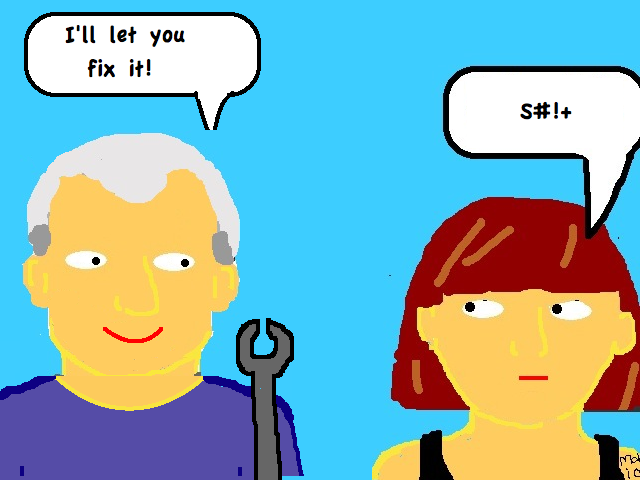
You see, we do have a family fix-it type living in this house. She has been honing her mechanical skills  since she was a young girl, usually after her father’s efforts had failed. Like the downstairs toilet. It had a leak that made it run off and on,with a disconcerting sound of water rushing that can be heard all over our house.  Sir Fix-it-Not made several trips to the hardware store, changed out part.  Just when he thought the toilet was working, we would hear it run again.  One day when we arrived from work, 12-year-old Megan greeted us at the door. Grinning, she proudly announced, “I fixed the toilet.” And she had. After the vertical blind incident,  she decided to install the blinds in her bedroom herself. She followed the directions, no extra parts, no swearing (which always accompanies her father’s efforts at home repair). 

I may sound like I’m complaining about my husband. Like I said, he is a talented, creative and resourceful guy, just not with a tool or mechanical device like a TV remote or a DVD player. But, why should he diddle with projects that waste his time and raise his blood pressure when we have  Ms Tool Time living in the house. She’s the real “go-to” person for things mechanical.  I know she’ll be really excited when I show her the little to-do list I’ve been working on. I’ll even let her use my tool box, the one I keep in the downstairs closet for when I tackle home repairs. Heck, now that I’m retired, I may just give her that tool box.

Megan:
Diddling: an illustration
When we drew this topic yesterday, my mother and I looked at each other with exasperated confusion. She recited the nursery rhyme (hey diddle diddle) and I was wondering if I was once again going to have to write an essay about euphemisms. Separately we looked up the word in the dictionary, but when I shared the definitions with her, my mom seemed surprised – as though the definitions she found didn’t line up. Or maybe she was just surprised I was sharing any information with her at all, since I’m usually so concerned about her stealing my ideas.

What I didn’t tell her was that I found a delightful essay by Edgar Allan Poe on this very topic. He starts the same way she did, with the nursery rhyme, and then proceeds to philosophy, and then:
 
Diddling; or the abstract idea conveyed by the verb to diddle; is sufficiently well understood. Yet the fact, the deed, the thing diddling, is somewhat difficult to define.
The rest of his essay is then concerned with examples of diddlers – examples of con-men really. I encourage you to read it. And since I have nothing to add to the topic, instead I will simply illustrate the definitions as I found them in Merriam-Webster. 

 1. to move with short, rapid motions

 2. to waste (as time) in trifling

3. hoax, swindle

4. often vulgar: to copulate with


Sources:

Wednesday, June 8, 2011

Topic 174: The Humor of Cartoons

Carol:
    The Laugh’s  On Us
I was going to write about Gary Larson today because he’s one of my favorite humorists.  But, over the years I’ve spent a ton of money on Gary, giving out Far Side memo pads and Far Side calendars to friends and family members as gifts. He doesn’t need my money or my publicity, so today I pay homage to several more of the family whose Gemini birthdays I mentioned earlier this week in Topic 173.
 

Brother Hugh (June 9) was born on his maternal grandfather’s  birthday. I don’t know when Grandpa Fike started scribbling in words and pictures, but his letters from the 1930’s and 40’s showed an almost whimsical flair for language.  And, he loved Hugh’s cartoons.  In 1945, Grandpa Fike wrote to my mother in Texas: “Hate to have you so far away.  We will just be a name to your boys.  I expect to see Hugh develop into an artist or cartoonist even if it is hard working crawling up hills.” In 1947 Grandpa Fike sent Hugh and Doug a birthday letter typed in red (For a Red Letter Day) along with  “a little money so that you can have the fun of spending it just as you wish, foolishly or wisely, as you prefer.” Hugh’s thank-you note included illustrations of his purchase:
 
By the early 1950’s, Hugh had gone public—with cartoons for the “Queensboro Quack” newspaper and then as art editor for his high school newspaper. His drawings also began to take on political overtones.  In response to the McCarthy hearings, Hugh created a fake ID that made him a “card-carrying member of the Communist Party,’ almost getting himself expelled when the Principal found out.  By the time, Hugh finished College, my mother had started a collection of his illustrated letters which she put in a box with the letters she kept from Grandpa Fike.
 

Brother Doug (June 11) is a scribbler too although he is more of a word guy than a picture guy. He designed a fake ID in high school too; it made him a "card-carrying member of the Mickey Mouse Club,” and it matched the large Mickey Mouse he had painted on the front of his junkie old sedan. And, that same box of treasured letters that belonged to my mother contained hand-made Valentines and birthday cards Doug had sent over 30 years.
 

I guess it was inevitable that he and Hugh would find a way to combine their talent with words and pictures to start a greeting card company. They conducted their own market research at a family gathering, waiting until my mother was busy in the kitchen before unveiling some of the more risqué messages for our review. Hugh designed the cartoons, Doug designed the messages, and they achieved enough success to catch the attention of a major card company and national distribution.
 
That box of letters and pictures my sentimental mother kept eventually came to me when she died, and I keep it next to the boxes of letters and drawings I saved from my big brothers and other family members. My two children may not be Geminis, but they also have a unique gift for capturing humor into word and picture.
 

Somewhere in all of those complex maps of human DNA, there has to be a marker called “scribble and doodle.” I would create a cartoon to illustrate—a humorous doodle—but I only got the “scribble” part of that DNA inheritance.


Megan:
Cartoons are distractions too
If you've spent any time on this website, you've probably gotten to know me quite well. 
(If you spend any time on this website, there's a good chance you already know me quite well).

I have problems with motivation and procrastination. For quite some time now (like since I was a teenager), I've intended to get in shape and generally be a healthier person but I haven't been properly motivated. There's just too much to distract me:

Like spending time with my friends.
 
And going to the movies.

And now that I'm planning to take the GRE and apply to MFA programs, I've suddenly lost all interest in writing. It's sort of like how I'll go days without doing basic chores like laundry and the dishes, but as soon as there's a job to apply for, I have to get all the cleaning out of the way. 

So, this is what I've been doing instead of working on my MFA applications (or applying for jobs):

I take the dog for a walk every day.

I'm taking a Pilates class.


And a nutrition class.


I am so uninterested in writing right now, that I've resorted to exercise and eating healthy.
(Not that I'm particularly enjoying it.)


Monday, June 6, 2011

Topic 173: Dangers of Narrow-mindedness

Carol:
June Star-Gazers
In America, June is the traditional wedding month although I can’t think of a single person in my family who got married in June. Not that June isn’t a big celebration anyway—six family members have birthdays between June7-15, their ages ranging  from six to seventy-six. We are celebrating the 50th birthday of one family member next weekend in California, all those Geminis in one place.
 
I confess a certain fascination with Astrology, enough that I kept the newspapers with the astrological forecasts on the dates my children were born. And, I do take a quick peek at the daily horoscopes, which I only share with my husband if they back up a brilliant idea I have concocted or make dire predictions about my Libra spouse’s day.
 
We got behind in our schedule today (as always happens when the cleaning people come), so I promised another Libra in the family that I wouldn’t spend too much time lingering over the dangers of narrow-mindedness, keeping my research to a minimum. So, I thought I was on pretty safe ground choosing astrology because I do know my Sign. So, what do I find out? That I really needed to have my birth chart cast to examine the alignments between the planets for a more accurate analysis of my “predispositions” and that I not only have a Sun sign but a Moon sign and an element and a ruler. Too much for my brain to handle this afternoon.
 
I did find a site I like, which means the description of Geminis is to my liking.
A pure Geminean is a person with whom it is almost impossible to argue for any length of time. His/her mind is so subtle, moving ahead like quicksilver, that one can never be quite sure what one is arguing about. Gemineans have golden tongues as well as quicksilver minds; like the monkeys of Chinese Astrology, they can charm the birds off the trees, induce others to follow courses of action which they don't really think advisable, and fascinate almost anyone they wish.   (source: Futurescopes.com)

Well, I can tell you that we June borns’s DO like our debates and WILL argue for any length of time on any subject. My mother, who was not a Gemini, used to start every family gathering with the admonition “No arguing, no politics, please.” Yeah, right! And since the Geminis in my family not only represent a variety of ages but a variety of political and religious viewpoints, we have lots to argue about. And, we do it loudly. Just ask the family members who don’t have June birthdays.
 
Apparently, astrology wasn’t all that popular in American until after World War I when a British astrologer named Nayor started putting horoscopes in the daily newspaper. An interesting website called “North Texas Skeptics” notes that 90% of Americans under 30 know their astrological sign and that there are 10,000 astrologers in the United States and only 3,000 astronomers. And, according to the same website, Americans spend over 200 million dollars a year consulting those 10,000 astrologers while only about 100 million dollars is spent on non-space related basic research in astronomy. Now, that’s scary!


Megan:

This is one of those topics where I think it’s gonna be a good one until I actually sit down to write about it and everything I want to say is obvious and cliché. Being narrow-minded limits a person, makes informed decisions impossible, and contributes to discriminatory practices. Broadening a mind can be done through reading and research, but is probably best achieved through action. For example, one can read about other countries and cultures, but travelling and meeting new people in real life is much better.

So, there. Essay done.
 *   *   *

What’s that? Ninety-two words isn’t sufficient?

Ok. I’ll tell you why today’s essay is so late (it’s almost related).  Now that I’ve been unemployed for a year, I’ve decided it’s time to take some classes and acquire some new skills.  I’m starting slow though. I’m starting with PE.

A few weeks ago, my father emailed me a brochure for a weight loss and nutrition class. He never emails me, and I took this as a hint, so I deleted said email and cursed him loudly in my mind. This was not a complete overreaction on my part as he has a history of encouraging me to lose weight (or as he puts it, “eat healthier”).  There was also the time when I asked him how much it would cost to go to Hawaii, and he said “It ‘s free but you should put a dollar in the basket when it passes.“
I paused and then said, “What is it you think I just asked you?”
“How much does it cost to go to OA?”

See what I mean?

Anyway, after the anger subsided, I whined about the email to my mother who told me that my father had been hoping we could take the class together and that softened my heart towards him a little bit.  So I went ahead and registered, had a look at what else was on offer and signed up for Pilates too.

The first Pilates class was this morning, which is sort of the reason the essays are late (other reasons include but are not limited to the early arrival of the cleaning service, an emergency load of laundry, and a sudden desire to rearrange the furniture in my bedroom).The last time I took a Pilates class was about ten years ago, and I weighed at least 60 pounds less. Pilates is so much harder than it used to be. I almost died.

It will be interesting to see how the next 8-10 weeks go with the two classes. If I  am able to apply what I learn in the nutrition class, then Pilates will get easier. And I might end up with a narrower waist and a broader mind (I told you I could make it relate).

Thursday, May 19, 2011

Topic 167: On Being Misunderstood

Carol:

            Let Me Make One Thing Perfectly Clear
I wouldn’t want anyone to misunderstand daily theme essays 163 and 166 about getting a speeding ticket, ignoring the paperwork, and putting off taking the driver’s ed course. After the process server showed up Tuesday night, I cleared yesterday’s busy retirement calendar completed the online course. I am now a success graduate of the A_________Driver’s University. I have a degree in online driver’s training.
 
I felt pretty good about it too. I think my retention rate is pretty high after plowing through the material in 4 hours without taking a break (mental retention, not bladder retention—please!).  For instance, I can remember almost every single embedded factoid used as a “verification check” that I wasn’t just skimming the material or skipping sections. Did you know that the kid who designed the “swoosh” logo for Nike only got paid $35.00? Or that the New Year’s Eve falling ball from New York City is made of Waterford crystal?
 
Not, that I didn’t learn some driving facts, too.  As we were driving into town for dinner last night-- because I was too tired to cook from the mental/physical overload of finishing the online class and Megan was too tired from her shopping trip to replace the dresses Bell had shredded with her tiny little teeth-- I pointed out to Marc that the wet road we were on is most dangerous just after it starts raining because the rain mixes with the road oil. And,  when he did what is known as a “California stop” at the corner of our road, I pointed out that he had not followed Arizona statutes for length of stop and distance from corner. He must have misunderstood my intention because he was grumpy about that. “We don’t need no stinkin’ backseat drivers!”
 
Thursday mornings are always tough for essay writing  because the neighbors come for coffee, which means my usual  5-7 a.m. writing time is taken up cleaning several days’ worth of accumulation of newspapers, unwashed dishes,  counter stains, etc. Although Marc usually takes care of making the coffee and washing the big stuff that won’t fit in the dishwasher, I asked him to vacuum the living-room instead. And a good thing he did. When he moved the washstand cum mail center in our front hall, he found an envelope wedged underneath. He brought me the envelope because he didn’t have his reading glasses although he could make out that it was from the Prescott Valley Magistrate Court.
 
It turned out to be addressed to Marc, not me. He pulled several sheets of paper out of the envelope and handed them to me. And, there it was, another photo from the exact same intersection where I and our other two dog-walking friends had received their photo-radar generated speeding tickets. He grabbed the paper. “Does it look like me?” Not only was Marc’ his photo was just as crystal clear as mine had been, but he was even driving the same vehicle. 

Please don’t misunderstand me. I’m not complaining here that the town to our east with all the speed cameras has a racket going just because 4 out of 5 of us dog-walkers got a ticket in the last two months at the same intersection (where the speed drops from 45 mph to 35 mph). After all, my online driver’s education class taught me that being a good driver means being a careful driver, remaining ever vigilant for hazardous road conditions, traffic obstacles, changing speed zones and…. the camera’s evil eye!


Megan:

 (but not too sore for cartoons)

Wednesday, May 11, 2011

Topic 162: Epitaph Humor

Carol:
Grave Matters
 Generally, I don’t talk about the Daily Theme topics with my husband before I get my ideas, but this morning I did. That’s because when we were in college, we wrote humorous obituaries one evening when we were traveling. Since we were traveling light and didn’t have any paper, we wrote in the blank pages of used paperback books. Our obits were fairly similar:  grand, overblown descriptions of lives as a literary Nobel Prize winner and accomplished Supreme Court Justice. Each of us wrote of outliving our spouse after a Methuselah-like life of 150 years. I would guess that people write humorous obituaries and epitaphs either about themselves when they are young or about someone else when they are old.
 

 Marc didn’t remember writing that silly obituary 30 years ago, but he did remember a quote. He said, “Well. You know W.C. Field’s epitaph, don’t you? Frankly, I’d rather be in Philadelphia.”  Turns out that Fields’ actual epitaph  is simply “1880-1946 W.C. Fields.” The origin of the quote is actually a 1925 article for Vanity Fair magazine, in which famous literary and theater people were invited to write their own epitaphs. And, what he actually said was “Here lies W.C. Fields—I would rather be living in Philadelphia.”   The comment is only humorous if you understand its context, i.e. the humor of W.C. Fields and his recurring sarcastic comments about his hometown Philadelphia. I think they call this “wry humor.” 
 
Another contributor to that Vanity Fair article was the poet Dorothy Parker, who wrote simply “Excuse my dust” (Source: Bauman).  Her words are witty rather than wry and need no context. We don’t guffaw at wit; we smile and appreciate. What of Dorothy Parker’s last remains? She left her estate to Martin Luther King, and she was cremated. Her “dust” was later scattered in a memorial garden at the headquarters of the NAACP in Baltimore (source: Findagrave)
 
Click to enlarge
I have been reading a lot of epitaphs lately as I continue my family history research. I haven’t come across any that stray from either the solemn or the sentimental, but apparently graveyard humor wasn’t that uncommon before the 20th century, often using short rhymes or puns on the deceased’s name or occupation, as in the example of the lawyer whose grave marker read “The Defense Rests.”  Boot Hill in Tombstone, Arizona south of Tucson has its share of both famous people and grave humor. My favorite is the wooden marker for Lester Moore, Les to his friends and apparently the anonymous undertaker or casket maker who came up with the epitaph.
 
What is the difference between an obituary and an epitaph? As tributes or markers of people’s passing, they are the long and short of it. Since this essay is about epitaphs, not obituaries, I will keep it brief. And, I will end with the words from the gravestone of another famous comic. In this case, a picture is worth a thousand voices:


Sources:
Bauman, Richard. “Grave Commentary.” Military Officer.     
Dorothy Parker obituary on Findagrave. 
Image of Tombstone Grave> Mhlradio. Matthew High. Taken Dec. 31, 2008 using a     Kodak EasyShare C613 Zoom.    
Image of Mel Blanc tombstone. Robert A Estremo. 22 Sep 2006.
          

Megan:

I have no source for this but my memory, but as I recollect after Dr. Robert Atkins died from a brain injury, his lawyer released the following statement about the accident:
“Dr. Atkins was negotiating with the ice, and failed in that negotiation.”

If you Google this topic, or lookup “funny headstones” you will find a plethora of examples odd final statements. “I told you I was sick” is one.

Last night I attended a short talk on the National Writing Project given by a friend of the family. As part of her presentation, she had us do a couple of exercises, including a "bio poem." We were discussing its applications beyond creative writing, and someone mentioned that they could be used in a history class to describe the famous dead people. So, now I’m thinking they could be used to great effect with creating epitaphs.

Here is what mine would look like:
Megan
Creative, Sensitive, Insecure (at times)
Daughter of Marc and Carol
Lover of books, dogs and travelling
Who felt confident when writing
Who felt conflicted about religion
Who doubted every official version
Who feared failure, depression and dead animals
Who would have liked to see her name in print
Who would have liked to see her children’s children
Who would have liked to know how it all worked out in the end.
Resident of this little plot of earth
Hammond

Of course, that’s not very humorous. 
How about this instead:

Friday, April 22, 2011

Topic 151: Why the Dessert Course Last

Carol:
Getting Your Just Desserts
Because eating sweets first  will spoil your dinner.
Because your parents (or their parents) always did it that way.
Because it’s the way people in your community, state, or country do it.
Because it’s good to exercise delayed gratification (unless you don’t like sweets)

My quick research confirms that the idea of dessert as a course in a meal is relatively new but not the idea of sweet foods, which until the 19th century were mostly sweetened with honey or  fruits. All kinds of seasonal pies were in the repertoire of  Colonial American  housewives.  The 19th century publication The National Cook book: by a Lady of Philadelphia (Peterson) lists over 3 pages of desserts, ranging from quince, apple, and potato puddings to plum and peach pies to blackberry mush and Parsnip cake.  Not a processed dessert to be had, all baked from seasonal fruits and grains.  Sugar was just too expensive for ordinary homes. As sugar became affordable in the 19th century, the number of sugar products multiplied: peanut brittle, candy floss, chocolate bars, marshmallows, toffee, etc, (source: Lambert)
 
The answer to why desserts are eaten at the end of a meal  may come from the origin of the word itself  The name is derived from from the French  verb “desservir,” meaning to clear the table. So, the dessert was a way to clear the mouth of the tastes of a multi-course meal with something  sweet (source: Hassan). That’s why at fancy restaurants you may get a little scoop of sherbet in between several heavy courses as a way to “cleanse” the palate when moving from one rich or spicy item to the next. 
 
Most cultures have traditional desserts that are served at holidays, Easter season being one of those ritual occasions.  In Greece, the traditional Easter meal may finish with Tsoureki, a yeast bread flavored with orange and a special spice ground from wild cherry pits, or a sweet, hand-shaped pastry called Koulourakia.  In England, the Easter  meal may end with a Simnel cake, a fruit cake  topped with  11 Marzipan balls that represent  all of the apostles except for Judas.  The traditional plate of a Jewish seder meal of Pesach (Passover) includes a sweet concoction called charoset made with honey, cinnamon, nuts, apples and other ingredients particular to different culture that symbolizes the bricks made by the Hebrews during their Egyptian enslavement.  After the Passover meal, the dessert table may include a variety of kosher desserts , including macaroons.
 
In our home, Easter traditions often reversed the notion of “saving the dessert for last.” When our children were young, I loved to get an Easter basket together for each one, filled with a variety of decorated hard-boiled eggs, jelly beans, chocolates, etc. The rules were bent as we popped a Cadbury Crème in our mouth or bit off the ears of a Chocolate bunny.  Brunch usually came after church, so the eggs and ham were eaten after the sweets.  This year we will have to be careful as chocolate is poisonous to dogs (see yesterday’s theme on “table manners). 
 
Why the dessert course last? Because.


Sources:
Peterson, Hannah Mary Bouvier. The national cook book.: By a lady of Philadelphia. A practical housewife ; and author of the "Family save-all." The Making of America website
Hassan, Taugeer Ui. “A Short History of Desserts.” Ezinearticles.
Lambert, Tim> A Brief History of Sweets
         
Megan:
Googling this topic turns up a number of answers to the question it poses. Some are joking    (“To keep the kids at the table”); some  are scientific (“to slow the absorption of the sugar and avoid sudden changes in blood glucose levels”); and some that don’t make much sense (“it helps you digest the food you already ate”).

My theory is that the food that is worst for you is served last so that you will eat less of it. Most of the time, especially when I eat in restaurants, I don’t have room left in my stomach to have dessert. To avoid this problem, I occasionally go to a place and only order dessert.

This may be the dumbest topic yet.  I don’t have anything else to add. Except maybe this:

Tuesday, April 19, 2011

Topic 148: Temporal Halos

   
Carol:

            Word Play


Today's topic is second choice. The one we threw back was not appealing to either of us, and we only allow ourselves one "throw back." So, we're stuck with "temporal halos." I vowed with T148 not to do any research, resort to Google for ideas, and not to spend many hours on it because there is just too much fun stuff going on around the house right now. There are puppies to play with, after all. Instead, I'm going to play one of my favorite games. Fictionary.
 

We used to play Fictionary on Saturday nights with our college friends while  were waiting for Saturday Night Live to come on. The game is cheap and simple,  requiring  only a dictionary, paper and pencils. The idea is to find a really obscure word in the dictionary and then make up several definitions for it, the more elaborate the better, then read them out loud along  with the real definition. Winners are the ones who guess the correct meaning of the word. Winners are also the ones whose phony definitions get chosen instead.  I love this game because it takes full advantage of my experience with word play. During detention time at my Canadian junior high school, I was required to either memorize stanzas of poems or copy out the dictionary pages. Very civilized, eh?  I write good dictionary.

I’ll use today’s topic “temporal halos” to illustrate. Here are 3 possible definitions, with a whimsical nod to some of my favorite TV shows.

(1)    The Bio-medical Definition:  According to the medical sleuths on House, temporal halos are bio-electrical phenomena that show up as round shadows on brain scans. Generally, temporal halos are symptomatic of increased neural activity in the temporal lobe, neuropathic manifestations if you will, that most frequently signal the presence of brain lesions.  What causes these brain lesions will only be revealed at the 55-minute mark of a 60-minute, high-stakes,  medical guessing  game. Diagnosis: epileptic seizures brought on by pulsating waves of, not STD’s as you might suspect, but HDTV’s that are left on all night  when people fall asleep on the couch instead of going to bed at a normal hour.


(2)    The Paranormal Psychology Definition: The science team on Fringe identifies temporal halos as emanations from doppelgangers who travel between parallel universes. “Temporal” here refers to time and space aberrations as opposed to brain abnormalities. While the Housian bio-electric halo is distinguished by its silver metallic flicker, the Fringian halo appears as a translucent rainbow much like the delicate  multi-colored shimmer of a soap bubble or oil puddle.  This halo only manifests for that split second when the doppleganger slides through one world into the other, pushing through a kind of osmotic, membranous force field that keeps parallel worlds from bleeding into each other.

(3)    The Prismatic-Pyramidic-Spiritualistic Definition: Reruns of  Michael Landon’s Highway to Heaven provide convincing proof for a third definition, much favored by crystal collecting Sedona psychics. Angels walk among us, heavenly guardians, ephemerals  whose presence in the temporal world is kept secret lest humankind become distracted from performing everyday functions or acts or bravery. These Earth Angels use eye-deceiving clothing to hide their wings, but their temporal halos can be seen with the peripheral vision, what we might call the Divine Parallax View.  These halos present as auras rather than the gold disks represented in traditional sacred iconic art. Unlike the Housian and Fringian temporal halos which retain a fixed ring shape, the Landonian halo appears to vibrate and even elongate during high-intensity intervention, we might say a heavenly adrenaline rush.

 
There you have it, three plausible and distinct definitions for an archaic expression.  If you want to play the game, post your own definition. But….no googling,  no Merriam-Webstering, please.


Megan:


Mom is right. There IS a lot going on around here right now and my essay did not get written.

Thursday, April 14, 2011

Topic 145: Humorous Dyspepsia

Carol:

    Excuuuuuuuuse Me!       
Dyspepsia is an old-fashioned word we don’t hear much anymore, like consumption and apoplexy. And, most people don’t associate it with humor unless they are 5-year-old boys or fans of the Farrelly brothers (Dumb and Dumber, There’s Something about Mary, Hall Pass).  I had to look dyspepsia up because I wanted to make sure I appreciated the full scope of the word. We all get the “dys” part; anything with “dys” means it isn’t working well (dysfunction, dystopia, dysentery dysturbance). The complaints associated with dyspepsia generally fall into the “rude and disgusting” realm of bodily sounds and smells that are definitely not humorous to the dyspeptic.  We have three kinds of dyspepsics in our family. And there are rules about each type.
 
The first are the senior members of the family (i.e. “the old farts”), whose digestive systems begin to talk back after spicy meals and whose discomfort is clearly not funny. We show an appropriate level of compassion for their bloated moaning and provide a few sympathetic moans for emphasis as they go to the medicine chest and grope around for the antacid tablets. We do not poke fun at them until after they have gone to bed and are out of hearing. We are polite.

 The second type is the youngest members of the family, several of whom right now are at the prime age to to fart and belch on demand and to make that “whoopy cushion noise” with their hands and armpits. Parental authority dictates that such behavior is inappropriate and should not be encouraged, and definitely not during meals. Adults are thus expected to keep a straight face and enforce the rules even when the parents aren’t around. This is not as easy as it sounds given the gusto and comic timing of the junior family members. But, as I said we are polite, so we wait until they have left the room before we explode with appreciative laughter for digestive prowess of these Farrelly brothers wannabees.
 
The final category is the non-human family members. We get all of our dogs at the Humane Society, so we have a 35-year history of bringing home pound dogs whose digestive tracts take a while to “adjust” to their new homes. First there was Freebie, an 8-week old puppy Marc brought home from the Santa Monica Pound in 1974. Freebie (a cute but ironic name it turns out) immediately collapsed on the floor of our living-room and no manner of treat or talk would jar him out of his gastric distress. No, that’s wrong. All it took was a midnight trip to the vet and 30 seconds on the cold metal examining table for Freebie to pop back to life. Then, there was Annie, a 10-month old cocker mix that Marc brought home from the pound after Freebie’s untimely demise. Annie expressed her lack of enthusiasm all over the back seat of Marc’s car. Our current pound dog Milo the Magnificent had such bad dyspepsia the first week in our home that he could clear the room with his flatulence. Luckily, tinkering with his diet got rid of the odors although he still belches, much to the delight of the family Farrelly brothers wannabees.
 
The animal population in our house has doubled since yesterday, the details of which I will leave to Megan. Let’s just say that we are going through the same digestive adjustments, but the rules have changed. It is Megan’s job to clean up after Megan’s puppy.  We don’t want to aggravate the senior family member’s dyspepsia.


Megan:
Bella the Beautiful

I am writing this from my bed and Bella is asleep next to me. Considering that she is only a third the size of Milo (for now), she shares his habit of taking up the entire space.  I feel like I should take advantage of her naptime, and sleep a little myself, but I already skipped out on the essays twice this week.

Here is how we decided to get a puppy. It was an incredibly impulsive, yet carefully thought out decision. I have been asking for another dog since I moved back from England but my father would not agree to it.  I would bring it up from time to time, bargaining and making promises, but still couldn’t get him on my side (mom, of course, was on my side from the beginning).  For a while we got distracted by the idea that we might get new furniture for the loft, which would require re-training Milo to stay off the couch, and that would have meant a new dog was out of the question. Luckily, Mom couldn’t find any couches she liked.

Then I applied for a job here in town. When I was notified of the date of the phone interview, I started thinking about a puppy again, and how it would be easier to train the dog if I was home during the day, as opposed to working full-time. Then I got a second interview, which is why I didn’t write on Monday. I thought it went pretty well, and when I got home I said, “If I get this job, I’m getting a dog!”

Yesterday morning I got the call that the position was offered to someone else, so I had a little cry and went on the Yavapai Humane Society’s website. I found pictures of two Lab/Retriever/Hound puppies and took the computer up to show Mom. She told me it was okay to be upset about not getting the job, which made me cry some more, so I just pointed at the picture of the puppies.

After a brief conversation where I convinced her to come with me (Mom can’t handle animal shelters – they make her upset), I called my father at work and told him I was taking Mom and Milo to the Humane Society. He asked if I had come to my senses and was finally getting rid of Milo. I told him I didn’t get the job, so I was going to look at the puppies and we had to take Milo to make sure he approved --Milo’s approval mattering more at this point than my father’s.

On the website, there were two puppies – litter-mates – a male and a female. The male looked much cuter, but I wanted a female that wouldn’t pee on my bed whenever children came around. When I got there, it was clear the pictures had been reversed on the website, so I wound up with the female and the cute one.

According to my mother, I picked a pretty good time to get a puppy. My father is spending nights at my grandmother’s house this week, so he won’t be around for the events which will turn him against the new dog – the accidents, the howling from the crate, and the humorous dyspepsia (excitement induced vomiting) from playing too hard with Milo.
I keep thinking that if we’d got the puppy when I first suggested it – last summer – then she would be trained by now.  But that’s just because I need a nap.

Milo, by the way, seems to approve of her. She may just be the first dog he’s ever met that is submissive to him – although it’s hard to say if that will last.  
She's even harder to see than Milo. Click image to enlarge.


Wednesday, April 6, 2011

Topic 140: On the Art of Eating Spaghetti

Megan:
Two things I've learned from my Father
I know I’ve learned a lot from my father, but I can only remember him deliberately teaching me two things: how to type using all of my fingers and how to eat spaghetti. With the typing, I remember my parents had just bought one of the first Apple’s – when everyone was still calling them Macintoshes. He wouldn’t let me play with it unless my fingers were placed properly on the keyboard. I resented it at the time, because it seemed slower, but my father assured me that eventually it would be faster. He was right.  I can type faster than almost anyone I know, and I don’t need to look at the screen while I do it.  It used to freak out my colleagues in the prison – sometimes it was hard to get work done when everyone was talking, so I would turn my face to the speaker so they would think I was paying attention, but I would continue typing. This backfired though, because I’d get distracted and start transcribing the conversation. Same thing happens when I write in my journal while watching TV.

Anyway, he also taught me how to eat spaghetti, by twirling a fork against a large spoon. Before I learned that, I had to cut up the spaghetti to eat it.  (I’ve since learned you can also use the side of the plate or bowl to do the same thing. )


I just remembered, he also taught me how to drive.  


Carol:
Tutta La Famiglia
 Today’s topic came up at dinner last night.   Megan said chopping up the spaghetti is only for kids. I had heard that twirling the spaghetti in a spoon was considered “peasant-style” Marc commented that he learned how to eat spaghetti properly from the Sicilian brothers who owned Carretos in Dewey. Frankly, the art of eating spaghetti has nothing to do with twirling or chopping. It has everything to do with “La Famiglia.”
 
My first experience with Italian cooking was not in a restaurant.  Flavia  introduced us to Italian cuisine. My cousin had been stationed in Italy and brought home an Italian wife. Flavia was loud and huggy. Loud wasn’t new to our family, but huggy was. Flavia would make a huge pot of Italian sauce and let it simmer on the stove for hours, the aroma wafting through the house. I would get to stir the sauce for a while and loved to watch the concoction thicken and explode  bubbles like red lava. By the time we actually ate, our appetites had reached the appropriate crescendo to really dig in and enjoy the spaghetti.  Flavia’s father came to visit once, a cute little bald man who couldn’t speak English, more huggy than loud.
 
I experienced a different kind of Italian family meal in the late 1970’s.  I was on a European study trip with students from the Catholic girls’ school where I worked in Los Angeles. We had been invited to meet the family of our only Italian student, who had been sent to Los Angeles because her father had received kidnapping threats.  Maria was an innocent little sweetheart beloved at the school, so we were excited as a bus picked us up and drove to their country home outside Rome. We arrived at a huge estate with its own winery and rolling expanse of lawn set with white-clothed tables for dining “al fresco.” The meal was unforgettable, course after course of Italian specialties served by elegant waiters, and the adults were given bottles of wine marked with the family label. Maria’s father was short, bald and round in the middle, a humble man who was grateful for our kindness to his only child. No English, lots of body language, loud  and huggy.
 
Most of the Italian restaurants in Prescott are family-run.  Marc’s favorite was a block from the courthouse, and a group of lawyer friends would meet there regularly in a corner booth by the window.  The owner’s parents had owned a succession of Italian restaurants in California before retiring to Prescott, so Jody was carrying on the family tradition. Her kids worked at the restaurant on weekends, and her parents would come by for lunch and help out. Marc became one of the family  and was given a custom bib to protect his tie and shirt from spaghetti sauce. He was a particular favorite of daughter Isabella who sat in a baby seat  while her mother greeted the customers. When Isabella got older, she would pout when Megan or I would join Marc at lunch. She didn’t like sharing him with others. He was her family. 

My cousin and Flavia eventually got a divorce. Marc’s favorite restaurant is under new ownership, several of the lawyers have died and Isabella has grown up. We trekked out to Dewey a few weeks ago, but Carretos was closed—permanently. Last night, we ended up at an Italian restaurant in Prescott Valley. Giovanni, a loud and huggy kind of guy, was chatting at the next table about his daughters, and our waitress shared a story about her grandson. Our little family was in the mood for celebration, so we ordered the house special.  It’s called “Tutta La Famiglia.”


Tuesday, March 22, 2011

Service Interruption


I had a phone interview this morning and prepared for that instead of writing today's essay. Mom has been working on her essay for 1.5 days and still cannot finish. She had "5 minutes left" over an hour ago, and I have no doubt that this time tomorrow she will still need 5 more minutes.

So, you'll have to wait until tomorrow to for "Nursing a Grievance." Any guesses what mine's going to be about?

Thursday, March 17, 2011

Topic 127: Mental Shock Absorbers

Carol:

  Soothing the Savage Breast (and Brain)

In Williamson Valley  the wind pretty well blows everyday. I love that sound just as I love the sound of rain falling on our roof.  I guess other people find these nature noises soothing too because there is a good market on the Internet for downloads of ambient sound.

I first heard about ambient sound in the 60’s although it didn’t have such a fancy name back then. It was called “white noise.”  My dentist began experimenting with white noise as an alternative to pain-killers like novacaine.  I would put on earphones and listen to what sounded like TV snow while he filled my cavities, directing me to turn up the sound if I needed more decibels to block the pain.  I can’t really say how effective the earphones and white noise were as I have a really high pain threshold and an almost perverse ability to relax in a dental chair.

I didn’t really think about what happened to those white noise machines until I saw today’s topic.  Turns out that white noise was not only found to be  ineffective but also potentially harmful because of the high decibel range needed to distract from the pain (source: Tekavec). It is almost never used anymore although the use of ambient sound  to “sooth the savage breast” has become quite common. Most popular are natural noises like ocean waves or steady rainfall.  Ambient sound probably works better to alleviate anxiety than pain.

Music therapy is a profession that I don’t think existed when I was listening to white noise in the dentist chair, but brain studies and new research about how we learn support the positive effects of music. Music therapists are clinically trained, licensed professionals who tailor “interventions” to the individual, depending on whether the need is pain and stress reduction, or memory and learning enhancement.  The website for the American Music Therapy Association includes testimonials from patients who have benefitted from working with a music therapist, including Alzheimer’s patients, children with autism, and people rehabilitating from both physical injuries and substance abuse.  Apparently, the type of music used in these individualized therapeutic programs varies considerably.

Educational research in the last 20 years has also shown the positive effects of music for increasing memory and cognition.  I quit nagged my son about turning off his music to study after his high school teacher shared with me the results of  a learning styles inventory he had taken showing he could actually concentrate better and study more efficiently with music in the background.

I have my own musical tastes and habits to suit particular needs. I  clean house much more efficiently with a little music to set the rhythm, something fast and peppy like Saturday Night Fever although more recently I have taken to using traditional Celtic music. The Old Blind Dogs or Jim Malcolm perks me right up for loading the dishwasher.  On a car trip, I either use classical music to buffer the road noise or I find an “oldies but goodies” station and sing along to lessen the tedium of a long ride.

I don’t think we really needed a lot of scientific research to tell us about the physical, emotional and spiritual benefits of music and sound. And, I think William Congreve said it best in 1697:
Musick has Charms to sooth a savage Breast,
To soften Rocks, or bend a knotted Oak.
Today is my day to serve coffee after our dog walk. I have just the right background music,  something with a little Irish lilt to it. Top ‘O the Mornin' to Ya.


Sources
American Music Therapy Association.: http://www.musictherapy.org/
Congreve, William. Quote from The Mourning Bride. 1697.  
            http://www.phrases.org.uk/meanings/252000.html
Tekavec, Mel. M. “Nitrous Oxide Sedation with Auditory Modificaiton.” 1976
            http://www.ncbi.nlm.nih.gov/pmc/articles/PMC2515814/pdf/anesthprog00144-0015.pdf
 

Megan:

Mental Shock Absorbers 
When I was 16, I crashed my car at an intersection just outside of Prescott Valley. I was going about 45 mph at the time, but the car I rear-ended was stopped at a red light. I remember slamming on the brakes and hearing the sound of the impact, but despite (or maybe because of) the fact that my forehead shattered the windshield, I did not feel anything. I opened my eyes and the entire front end of my car was folded up like an accordion – but the car I’d hit had only the slightest dent in its rear bumper.

My passengers and I walked away with bruises and a bloody nose, while an ambulance took the back-seat passenger of the car I hit. I remember she screamed and screamed while we waited for help and I didn’t understand. My car was totaled, and theirs was fine. Why was she hurt? The answer, according to my friend’s mechanic father, was the difference in our bumpers. Mine was full of Styrofoam, which then spilled all over the road. Their car had a steel bumper, which protected the car but absorbed none of the impact.

In addition to insulating car bumpers, packing electronics, and containing take-out food, Styrofoam is also used in bicycle helmets – another mental shock absorber. I’ve never had a serious cycling accident, probably because I never took to the sport, but almost everyone I know who rides on a regular basis has a story about how a helmet saved their lives. 

But not all shock absorbers are physical. The mind has its own way of protecting itself from a shock. I believe “going into shock” is actually one of them. Sometimes, depending on the trauma, the mind suppresses it. Or the trauma leads to a fractured personality or post-traumatic stress. If a mind is repeatedly subjected to disturbing  or stressful events, then it acclimates. It tries to cope, through meditation, or alcoholism, or exercise, or humor.

In the prison, whenever something bad happened, I always asked if any books had been damaged in the incident. This was not because I cared about the books (although I did), or because I knew that no one else gave a damn about them (which they didn’t), but because I thought it was funny. Someone gets beaten or stabbed in their cell, someone starts a fire or a flood, someone goes on dirty protest – whatever… are the books ok?

Maybe you had to be there.

The first time I asked, I was serious. There had been a flood in a cell in the segregation unit. The prisoner’s property had been bagged up to be disposed of, and I could see one of my books through the plastic. I asked if I could get it because I wanted the barcode to withdraw it from the library catalog. One of the officers handed me a pair of gloves and watched as I dug through the damp clothes and papers to reach the book at the bottom of the bag. “By the way,” he said. “That’s toilet water.”  I swore at him and threw the dripping book in the trash.  But after that came the jokes.