Showing posts with label nature. Show all posts

Wednesday, July 6, 2011

Topic 185: Animal Facial Expressions


Carol:
Making Faces                   
 Lots of websites help pet owners interpret the facial expressions and body language of their animals. That includes such variables as the position of the tail, alignment of the body, position of the eyes, lips and teeth, and appearance of hackles. Vocalization is another thing all together. Mostly, with domestic animals, I think we interpret animal facial expressions as we would human expressions. Lips curl up as if to smile says, “Look, I’m happy to see you.” Eyes look sad, happy, or angry.  We spend a lot of time in the daily theme talking about the antics of our two canine pets and the challenges of introducing a puppy into our once placid environment.. Dogs have always been a part of my life.  But in reality there is one animal I have always loved to  watch with fascination on television or at the zoo. Chimpanzees.

I have viewed almost every documentary about the work and life of Jane Goodall, and I was given time off from work to hear her speak when she came to Yale. The large room was absolutely full of students crammed into every possible space. Twenty-five years later, she continues to attract the interest—and affection of people all over the world. And, her website “Lessons for Hope” provides opportunities for students and teachers to learn more about chimp behavior. She describes her experiences with the chimpanzee William in her work The Shadow of Man (68). William, a scarred, submissive male used both facial expressions and hand gestures to send notice to other adult males that he knew his inferior status; he would “often pull back the corners of his lips and expose his teeth in a nervous grin.” (source: Lessons for Hope)

Researchers continue to examine the behavior of chimpanzees, including how they communicate using facial expressions and body language. The Yerkes National Primate Research Center housed at Emory University (Georgia) conducted research into Chimpanzee facial expressions under the direction of director Lisa Parr, not just to learn more about chimpanzees but to help understand “the evolution of human emotional communication” (source: Science Daily). Parr notes that the study has determined chimpanzee expressions to be much more complex than they expected, requiring more detailed studies. For instance, an open mouth and bared teeth that may appear to be “playful” must also be examined for muscle action, whether the eye brow is raised, etc.

When we say a chimpanzee, or any animal for that matter, smiles or pouts or frowns, we are associating human emotions to their expressions that may be inappropriate.  Right now, my dog (the well-behaved prematurely grizzled one) is looking right at me. He is in a full state of relaxation with ears slightly cocked, lower lip jutting out a bit (caught in his teeth again), and I would interpret that to mean he is relaxed but alert—wondering if I’m going to come over and give him a treat or a pat on the head. He’s tired because he had a big adventure on his morning walk. When he turned around at the sound of barking behind him, he took Marc by surprise and leapt for a young coyote, dragging his extension leash behind him, ruining in fact the second one in several weeks. The first time it was a rabbit. I wasn’t there to observe his facial expression, but it was probably one of completely satisfaction since he had been in full running mode all over the hills for about 15 minutes.

But, I wasn’t going to talk about dogs today.
 
Sources;
“Chimpanzee Facial Expressions…” Science Daily. 26 Mar 2007.      

Image of chimpanzee at LA Zoo. Wikipedia

Megan:
Animal Facial Expressions: a photo essay


I spent a long time this morning looking at the photos I've taken of Bella and Milo, and I have to be honest. There's little change to their to their expressions. Milo almost always looks resigned and calm (but maybe that's just the expression he adopts when I pick up my phone to snap a picture).

Considering that Bella is one of the clumsiest dogs I have ever seen, she does manage to look dignified,  and even noble every now and then. Of course, it could be the camera angle.


Usually, Bella looks like this:
 

Milo, on the other hand, almost always looks dignified. Except when I force him out of his comfort zone. Here, he is looking profoundly embarrassed.

Milo likes to hang out on the porch in the sunshine. Until a certain someone irritates him and then he retreats to higher ground.
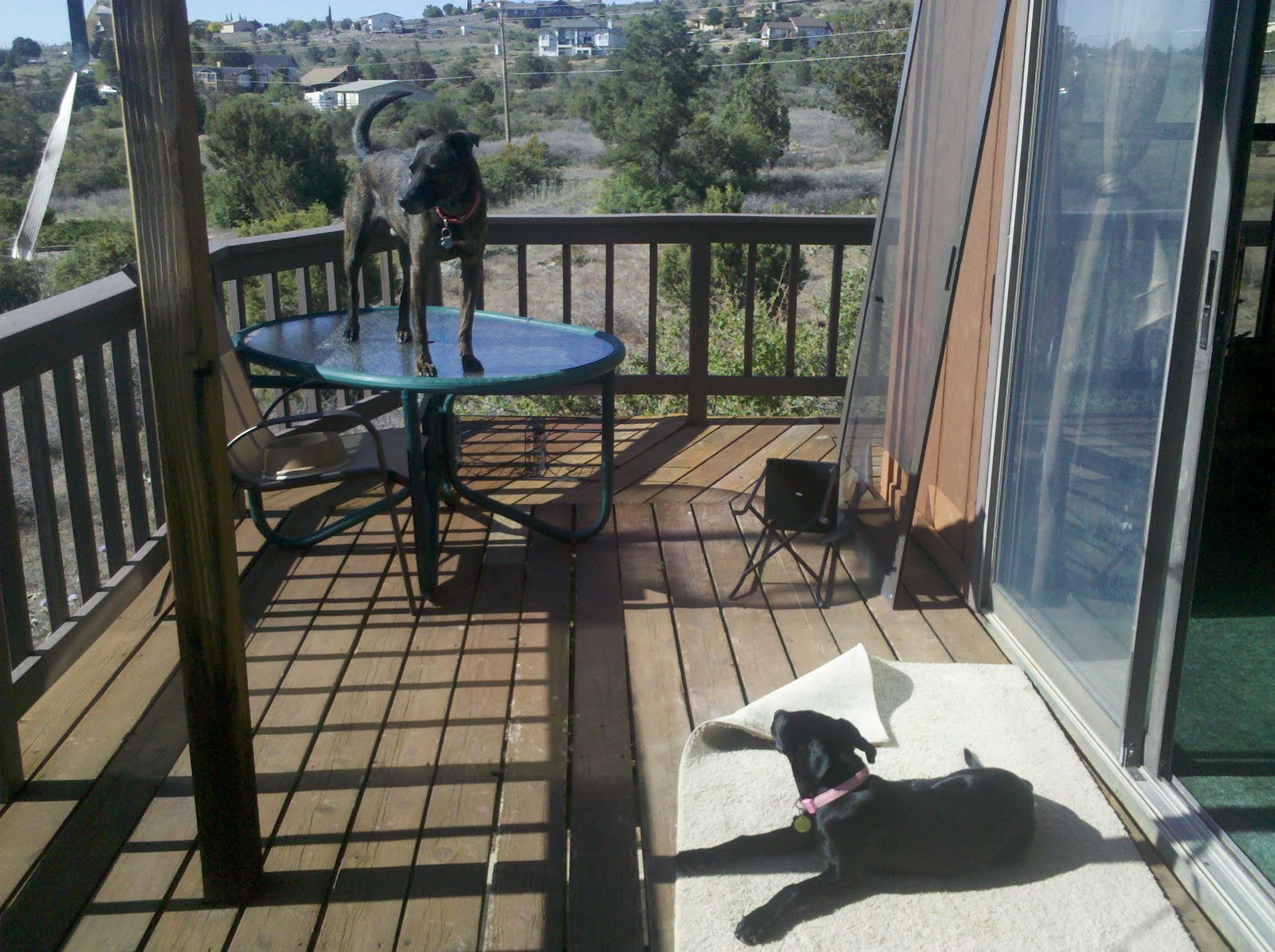
Note that the furniture in disarray, and the torn screen courtesy of Miss Bella.

 Speaking of Miss Bella. She has a bit of a temper. This is the only picture I could get of her in "demon" mode. The white flashes by my blurry finger are her teeth.

But she's a pretty good girl, aside from her occassional outbursts. We finally got her the pool she's always wanted, which she seems to enjoy.

Monday, April 18, 2011

Topic 147: The Joys of the Country Cottager

Carol:
The Pause that Refreshes

I wish to speak a word for Nature, for absolute Freedom and Wildness, as contrasted with a Freedom and Culture merely civil, — to regard man as an inhabitant, or a part and parcel of Nature, rather than a member of society. (Thoreau, “Walking”)
I am married to a Massachusetts native who remembers visiting Walden Pond when he was a teen-ager, riding his bicycle from Lexington to Concord. When I asked about his recollections, Marc’s response was “It’s tiny.” I guess reading about it from Henry David Thoreau might make one curious to see what it is like—the pond, not Thoreau’s wilderness lifestyle.  

In Thoreau’s time, Walden Pond wasn’t exactly an isolated wilderness. Apparently it served as a “nature retreat” for the town of Concord. A number of people lived in the woods around the pond, including Irish railroad workers and an assortment of interesting outsiders described in his journals. “An elderly dame, too, dwells in my neighborhood, invisible to most persons, in whose odorous herb garden I love to stroll sometimes, gather simples and listening to her fables” (Walden 152); Thoreau was as isolated as he chose to be because he was also in easy walking distance of Concord and could find company if he desired it.   
Walden Pond

Thoreau’s experiment  at Walden Pond was not just about solitude and nature; it was also about simple living, stripping away the conveniences and  encumbrances of a modern, materialistic life. The first chapter of Walden, called “Economy,” serves as an introduction to the book. Thoreau addresses the readers directly from the perspective of someone who has returned  from having “earned my living by the labor of my hands only” (Walden 1). Most of the chapter is really an examination of what people need to keep themselves alive, what is necessary versus what is luxury.  Thoreau looks to the ancient philosophers as having eschewed a rich outer life for the rewards of a fuller inner life. “Most of the luxuries, and many of the so-called comforts of life, are not only not indispensable, but positive hindrances to the elevation of man” (Walden 15).

Most of us have neither the time nor the inclination to step out of the world for two years into the solitude of a Walden Pond.  The term “social networking” has become such a part of our thinking that it may be hard to imagine disconnecting from our adult toys, computers, media and frenetic lifestyles. A couple of years ago when I took a nine-month class at my church, the participants were asked to “turn everything off” for just one day as part of experiencing “voluntary simplicity.” No phones, computers, I-pods, answering machines, electrical appliances. Just one day to slough off that accumulation of the “comforts of life” that Thoreau refers to. I closed the door to my office, seated myself with a view of Granite Mountain, poured a glass of water and started reading. I felt an incredible freedom when I heard the phone ring and didn’t answer it, when I became master of my day.

Thoreau didn’t have a wife and children to feed. And I no longer have kids that need to get to soccer practice or piano lessons. The solitude and inward journey described by Thoreau is itself a luxury. But, I imagine everybody appreciates the value of a little peace and quiet, a temporary time out from life. The pause that refreshes.

Sources:

Walden; or, Life in the Woods. Image of Cover: Schward103. (Public domain file from en.wikipedia: Category:Books made in the 19th century)
Thoreau, Henry David. Walden. Boston: Houghton Mifflin, 1906. The Walden Woods Project:


Megan:
You'll never think of cottages or dogs the same way
I’m sure this topic is meant to be about the pleasures of country life. It certainly evokes the image of the thatched-roof tiny white house out of one of a Thomas Kinkade painting, with a bubbling brook and scattered wild-life. I have always been attracted to the ethereal fairy-tale images, and when I picked out the flat I rented in England, it resembled that dream.

The thing is, in England the term  “Cottager” is also a euphemism. In its verb form, “cottaging” is the act of having anonymous homosexual intercourse in a public toilet (ala George Michael).  According to Wikipedia (it’s times like this I LOVE the internet), cottage became a term for a public toilet in Victorian times but cottaging wasn’t picked up as term within the British gay community until the 1960’s. 
Public Toilet, Pond Square, London
I first became familiar with the expression when I was studying abroad at the University of Sussex. My friends and I frequently watched an adult cartoon series called Monkey Dust. On the show, there was a recurring character by the name of Geoff who was a self-proclaimed “First-time cottager.” Geoff was very unlucky. Although he was determined to participate in this ritual, he was regularly thwarted by obstacles and misunderstanding and never managed to achieve his goal. Youtube has many clips, but none of them are appropriate for me to post here because I don’t want to have to register this website as having "adult content."

When we pulled this topic, I got the giggles and had to explain it to my mom. However, I mis-remembered the details and told her it was anonymous public sex on the side of the road, occasionally with an audience. That is actually called “dogging” – which was gleefully described to me by a housemate’s boyfriend, again while I was living in Brighton.  Last October, the New York Times featured an article about a lay-by (or, as we would call it: a rest-stop)  in Puttenham, Surrey in England.
“So popular is the woodsy field below the ridge as a spot for gay sex (mostly during the day) and heterosexual sex (mostly at night) that the police have designated it a “public sex environment.””

After learning about this phenomeon, which is in no way restricted to Surrey, it became impossible for me not to notice all the cars parked on the side of the road in the middle of nowhere. According to the NYT article, this practice is so popular, there are websites and guides devoted to popular areas in the UK. When I was working in the prison, I once heard one officer joke about another that she knew the location of every lay-by in the county, and I only now understood what was being implied.

I bet this isn’t what you were expecting when you came here today. I can’t wait to see how the search statistics will change to reflect some of the keywords I’ve used today. 

Sources:
Wikipedia: "Cottaging" Image taken from this entry.  New York Times: "Here’s the Pub, Church and Field for Public Sex" October 7, 2010


Wednesday, March 9, 2011

Topic 121: Nature's Language

Carol:
The Sounds of Silence       
One of my favorite teaching exercises was meant to show students how to use all of their senses, not just sight. A computer classroom isn’t the best place for that with its controlled temperature and humming, buzzing and squeaking electronic universe.  We needed to disconnect not only physically but mentally from the land of tweets and texts.

The campus was built into the side of a hill. A few yards uphill from the road that loops around the classroom buildings, students in an Environmental Ethics class had created a primitive classroom in a small grove of pine trees. Just a circle of large, flat-topped rocks in a clearing, placed at random so as not to destroy the natural lack of symmetry. 

One fall evening I moved my Women in Literature students to this outdoor classroom. We would soon be reading essays and poetry by “nature writers” like Linda Hogan and Terry Tempest Williams, but we would  begin  with our own stories. As the light faded and the temperature dropped, we huddled closer together on the rocks, not just for comfort but because the rhythm and tone of our conversation changed…quiet, calm, focused, intimate. Stories moved around the circle, recollections of long-forgotten trips into the Sonora desert or the Mogollon Rim. The stories gained force, not with volume but with detail: the whooshing of a Class III rapids, the smell of pine needles underneath a sleeping bag, the sting of icy snow pellets against the face. We had to feel our way out of the clearing, holding onto each other as we returned to the sensory cacophony of the computer classroom.

Terry Tempest Williams listens to nature. She “interprets” the languages and contours of the natural world for “newcomers” just as a park ranger interprets the geography and biology of at Grand Teton or Bryce Canyon or Organ Pipe. Williams is a fierce and eloquent advocate for the environment, what she calls “bearing witness.” When she came to Prescott about 15 years ago, I heard her speak twice. Her passion for the history, landscape and environment of the West was quiet, the kind of “bearing witness” that causes you to lean over in your seat and pay attention with your whole body, not just your ears. She left such an impression of urgency and commitment on me that I couldn’t get her out of my mind for days.

Williams’ 1997 essay “Listening Days"  begins with a visit to her dying grandfather and ends with the simple announcement of his death, “peacefully at home in the company of family.” In between she reflects on sound and lets thoughts move her from conversations with her grandfather about his radio program to “tonal memory” to the big question of “what do we know.” She walks the readers into  the hills behind her home:


           The leaves have fallen, leaf litter, perfect for the shuffling of towhees.
           The supple grasses of summer have become knee-high rattles. Ridge
           winds shake the tiny seedheads like gourds. I hear my grandfather’s voice.

           All sound requires patience; not just the ability to hear, but the capacity to
           listen, the awareness of mind to discern a story.  A magpie flies toward me
           and disappears in the oak thicket.  He is relentless in his cries. What does
           he know that I do not?  What story is he telling?

Reading these lines as I look out my window and watch the reflected pink of the sunrise on granite rocks, I think back to those students in our outdoor classroom, re-tuning their senses to experience the languages of nature, adding their own voices to the stories of ancient grandfathers, prehistoric rocks, and magpie cries.

No cartoons today, no photographs.  Take a few minutes, move some time around, and head outside, see for yourself. Calm down, breathe and listen. Nature is speaking.

Sources:
"Listening Days" by Terry Tempest Williams website http://arts.envirolink.org/literary_arts/TTWilliams_listening.html 


Megan:

Nature’s Language

Many times I have heard visitors to the countryside comment that after the noise of a city, they find it difficult to sleep with all the quiet. I suppose the reverse is often true as well. I have lived in both environments, and where I live now, which is where I grew up, has the least amount of road noise.  But if you spend  time actually listening to the Arizona desert, you would realize it is anything but quiet. Between the crickets and the coyotes, the dampened crunch of deer hooves on gravel and the sudden scratching of startled rabbit fleeing through the bushes, plenty of sounds make their way through the apparent nighttime stillness.

Of course, it is easy to fancy for a moment that these nighttime sounds might comingle into a natural dialect, unique to this particular latitude and longitude but it is difficult to argue that actual communication is taking place. You hear the noises and you know you are not alone, that you share the space with other creatures, but there is no apparent interaction.

Recently, I have come across a number of facts and anecdotes which seem to confirm that although humans grow more remote from their natural neighbors, the flora and fauna may have their own languages, or some means of shared communication. We can acknowledge this possibility by observing the results of their apparent cooperation.

On March 3, a brief article was published by CNN Money which informed the public of a recall of the Mazda6 sedans because a certain type of spider had started building nests in the fuel system, which might ultimately lead to a fire in the engine. Usually you would find this sort of article on their Oddball news page, but because of the financial impact of a recall,the story had made it to the Money section. The article does not explore how or why the spiders came to develop this habit, merely commenting that there had been at least 20 occurrences of infestation. The company spokesman speculated that perhaps the spiders like cars that "go Zoom-Zoom" (the tagline for Mazda). But this article raises all sorts of questions (in my mind) about the communication powers of these spiders.

And then, over the weekend, I spent some time with my cousins, one of whom is the manager of a series of vineyards across the state. He mentioned that he is currently helping a new vineyard get off the ground on a pistachio farm. The owners are looking to diversify their crops because the pistachio trees do not consistently produce nuts. For a comparison, he mentioned that the pinyon trees so common in Verde Valley will occasionally, and for no observable reason, stop producing nuts for years at a time. And not on an individual level, he said. Entire groves will cease production together, as though they had a collective consciousness.  There are no consistent environmental factors to point to as a reason (he gave me a word for these kinds of trees, which I cannot remember and the Wikipedia articles do not support what he said. BUT he is one of the smartest people I ever met, so I believe him).

There are countless other examples of apparent intraspecies communication (or perhaps mis-communication), such as mass animal death – large scale whale beachings, the sardines in Redondo beach in the past few days—declines in the bee population.  

I’d rather not leave this essay on a negative note, so here is a more whimsical example of nature’s language. When I lived in Brighton, England, I used to walk along the seafront in the evening specifically to watch the starlings fly about in an acrobatic swarm. I’ve never been able to accurately describe what it’s like to watch, but luckily Peter Greenhalgh has compiled a video of the phenomenon on Youtube (warning: the music is sort of startling). Enjoy.


Thursday, February 24, 2011

Topic 112: The Life Urge in Nature

Carol:

I Came, I Saw, I Condored
The Science Channel’s website has “top 10” links that are curiosity-catching if not deep science. "Top 10 Mating Rituals" fits today’s topic, but I prefer “Top 10 Species We Miss.” The list includes such favorites as the Dodo Bird (#1) and the Dinosaur (#2). Less colorful is a bird whose extinction is the result of a conflict with the life urges of another species, the human being.
 
Passenger Pigeon 1889
Number 3 is the Passenger Pigeon, which at one time represented 25-40% of the bird population of the United States. Between the arrival of the first pilgrims in the early 1600’s  and 1914, the passenger pigeon population  dropped from over 3 billion to zero with the death on Sept 1914 of the Cincinnati Zoological Garden’s captive pigeon Martha.  During the late 19th century, human intervention failed to re-establish the species, which needed large, healthy flocks to survive. What happened to the passenger pigeon? Some of their demise came from habitat loss as the European settlers moved westward.  More devastating was the appetite for pigeon meat, which became a commercial product in the mid-1800’s. Human beings literally ate the passenger pigeon to death. (Source: Encyclopedia Smithsonian.)
 
A bird not on the Smithsonian’s top 10 is the California Condor, North America’s largest land bird, with a wing span of 10 feet and a life span of up to 60 years  Again, human beings can take dubious credit for the decline in the condor population, not because anyone would consider these vultures edible. The growing people population overtook  their territory, and pollution weakened the eggs and killed the parents.  By 1987, the population of wild condors had dropped below 10. Scientists had been already been collecting eggs for breeding programs, so they captured the remaining wild condors and stepped up captive breeding efforts. (Source: National Geographic website).
 
Almost 100 years after the extinction of the final passenger pigeon, the California Condor population is rare, endangered, but growing.  Human intervention was controversial and extreme, pinning all hopes for reviving the species on ambitious and expensive captive breeding/re-introduction programs through the collaboration of the U.S. Fish and Wildlife Service, the Los Angeles Zoo, the San Diego Wild Animal Park and later groups such as the Peregrine Fund. 
 
The current estimated population of California condors is over 320, with half in the wild. In 1996, the Peregrine Fund began releasing captive-bred condors into the Grand Canyon, with the National Parks Service in 2009 recording 8 wild-bred condors in Arizona and Utah along with 5 nesting areas. If you want to see a California Condor up close, your best bet is probably a zoo (San Diego Safari Park, Santa Barbara Zoo). If you want to see a Condor in the wild, California’s Big Sur and Pinnacles National Monument  near Hollister.
 
The Grand Canyon?  Ask my husband about his field trip to the Canyon with the bird-watching class from Yavapai College several years back. The trip started at the North Rim, where a dinner-time sighting caused a stampede of birders to the windows of the Grand Canyon Lodge to glimpse a Condor. Their best viewing came later at the South Rim, right outside Kolb Studio where the condors soared close enough for Marc to see their numbered ID tags. Marc was so excited, he bought a t-shirt announcing to the world, “I Came…I Saw… I Condored.”
 
Two bird stories with very different endings. Ironically, the extinction of the passenger pigeon led to the enactment of many of the conservation laws that would later rescue the Condor from becoming one of the “Top 10 Species We Miss.” 
California Condor in flight, 2007


Sources:
Discovery Channel.” Mutant Planet. Top 10 Extinct Species—Passenger Pigeon
  http://science.discovery.com/top-ten/2009/extinct-species/extinct-species-03.html
Encyclopedia Smithsonian on line.”Passenger Pigeons” 
  http://www.si.edu/encyclopedia_Si/nmnh/passpig.htm
National Geographic online.”California Condor.”
 http://animals.nationalgeographic.com/animals/birds/california-condor/
National Parks Service: Grand Canyon Condor Re-introduction Program. http://www.nps.gov/grca/naturescience/condor-re-introduction.htm

Passenger Pigeons. Encyclopedia Smithsonian on line.
http://www.si.edu/encyclopedia_Si/nmnh/passpig.htm

Megan:
No essay from me, sorry. Turns out I don't get along with the pain medication at all. So, I'm hanging out in bed today.