Showing posts with label Geneology. Show all posts

Tuesday, August 23, 2011

Topic 212: Bristles

Carol:


     Men of a Certain Age
 In my genealogical climb through the branches and tangled vines of my family tree, I have discovered photographs of a lot of hairy men—beards down to the belt buckle, mutton chop sideburns, pomaded pompadours. But, the moustaches tend to show up in photos of family men around the 1920’s No matter what state they lived in, or even what country, moustaches dominated early 20th century male fashion.
 

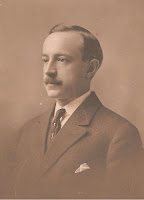
The   photograph of Walter Lugrin Sr  (1878-1940) shows a man who is meticulous in details of dress. He wears a stick pin in his carefully knotted tie, a white handkerchief in the pocket of his expensive-looking suit. The moustache is bushy but neat, somewhat between a chevron and a paintbrush (American Moustache Institute). I wouldn’t expect less than thoughtful, measured care in the looks of a watchmaker and businessman who worked for  the  A. Wittnauer Co in Manhattan.  Married to my great-aunt Hattie Edwards, Walter was a family favorite who had gotten jobs in the jewelry store for Hattie and three of her sisters.
 

Edward John Scott (1857-1925) also sported a moustache although we have no photos of him as a young man. He too was a “company man” who worked for the same employer for over 20 years, as a printer in New Mexico for the Las Vegas Optic newspaper.  This photo (around 1918) shows a more casual  approach to dress. appropriate for the West. Hand cocked on hip, jacket thrown open, topped with a straw hat to keep off the New Mexico sun, E. J. Scott wears a bushy moustache too, not quite as contained as Walter’s but nevertheless in the “chevron” mode.  His expression is less business-like, less imposing than that of Uncle Walter back in New Jersey E. J. is often shown with that same affable smile in photos with his grandchildren, including my father, another Edward Scott.
 

Frederick William Stanley York (1876-1968) was from the Canadian branch of the family.  His mother Catherine was a first cousin of E. J. Scott’s wife Selina Jane, whose parents had immigrated to the American Midwest in the 1860’s from Ontario.  Stanley and several siblings moved west from Ontario to Manitoba and Alberta in the late 1880’s.  Stanley’s photo shows a young man of ramrod posture, eyes staring directly into the camera, high collar and white tie.  Although not as bushy as E.J.’s moustache,   Stanley York’s bristles add a good two inches to each side, a much truer chevron. This photograph  was probably taken around 1898, about the time he traveled with a group from the Churches of Christ congregation of Carman, Manitoba, all the way to Nashville for training at the Bible School.  From  photos of his horses and chickens, I know he farmed in Alberta with his wife Ella. They lived long enough to celebrate their 50th wedding anniversary in 1953. The moustache was long gone.
 

Go back one generation from Walter, E.J. and Stanley and you’ll find that men of a certain age—staid, married men—wore beards. But, the beard only really came into fashion in the United States in the 1850’s after several decades of a vogue of clean-shaven faces.
By 1920, the beard went out of style again, replaced by either a moustache or goatee, no doubt influenced by Gillette’s invention of the safety razor which became standard-issue gear for U.S soldiers in World War I (source: “Safety Razors”). As fashionista Heidi Klum might say, “Bristles. One week they’re in, one week they’re out.”

Sources:

 “The Lemania Legacy.”
“Moustache Styles.” American Moustache Institute.
Safety Razors.” Wikipedia. 


 *Please note that Carol was very late in finishing her essay today, and Megan's essay reflects that fact. 


Megan:
The many uses of Bristles
Yesterday, on the way to the movies,  Mom and I had a conversation about this topic. Conversation is probably not the right word. I tried to guess what she was going to write about and she wouldn’t tell me.

“Are you going to write about hair brushes?” I asked thinking it sounded like something she would write about.
“No,” she replied. “I thought that might be what you were going to write about.”
“I could write about how it annoys me that you think your scalp is too sensitive for my brush, and I can’t even get your brush through my hair.”
“You mean like how you bristle about the bristles on brushes?”
“Oh my god.”

“Bella has bristles on her chin” she suggested.
“Those are whiskers. Are you going to write about facial hair?"
“I’m not sure how much I have to say about that,” she said, stroking the whiskers on her own chin.
“This morning,” I offered,  “I found this long curly black hair growing right out of the side of my face.”

She finished choking just as we arrived at the movie theater and saw the worst movie of the year – One Day. It was so bad. Also, it had the same premise as a story I’ve been working on which follows a character (me) on the same day each year. I was going to use my journals. I’ve put a lot of hours into this project, not to mention the ten years that had to pass in order for me to accumulate the entries. I’m not sure it’s going to work – it’s more of an exercise, but I can assure you that the unedited and angsty journaling from my late teens is still much more interesting than that movie we saw yesterday.

I guess the fact that the movie was bad is a good thing. It’s worse when you come up with an idea and then someone else has beat you to it and theirs is better. At least I have a chance to improve it.

Anyway, I’m not doing too well with this topic today. I keep wanting to add that my mother did not finish her essay because she had obligations this morning, obligations she has known about for a while – so she could totally have written the essay before. But I skipped out all last week, and I knew about Kelly’s visit for months. So, I don’t have any right to be annoyed. Except, have you ever noticed that getting annoyed at something is not a logical reaction anyway, it happens whether you have been rightly wronged or not? Still, when I write and she doesn’t, I bristle with annoyance.
   

Tuesday, July 26, 2011

Topic 197: On Going to War

Carol:
     Soldiers of God
Today’s topic was one of the first we pulled from the basket eleven months ago when we started our daily theme project. Too complex, too controversial, too somber, too personal—too everything-- for a 500-600 word essay. Megan is braver than me, more honest in tackling the tough topics that enflame debate and fracture families. But, I’m thinking this morning about The Battle Hymn of the Republic and the thousands of American clergymen who had heart and spirit wrenching decisions to make about their congregations, their families and their own roles in the unfolding of the American Civil War.
 
My paternal grandmother had DeWitt, Malone and Caldwell relatives in most of the southern states. As might be predicted, her great-grandfather Lewis Lee DeWitt Senior, pastor of Bassett Creek Baptist Church, took up the battle cry of the Confederacy and volunteered for the Home Guards of Clarke County, Alabama. Four of his sons, numerous nephews and son-in-law had already joined.  But, the battle lines were not so clearly drawn in the larger Baptist denomination. By the beginning of the war, the Church had already split over the issue of slavery, with the Southern Baptist Convention formed in 1845 in Augusta, Georgia (source “Southern Baptist.”).
 
The Presbyterian Church had also split into southern and northern factions. My grandmother’s Caldwell relatives during the Civil War were mostly Presbyterians:  Rev. Cyrus K Caldwell in Tennessee, Rev Andrew Harper Caldwell of Panola County, Mississippi,  and Rev John Madison McKnitt in Rome, Georgia. Rev. Robert Caldwell Grundy had become the pastor of a Presbyterian church in Memphis, Tennessee in 1857, but despite his southern roots,  
In the climactic period leading up to the Civil war he courageously and loyally opposed the secession of the southern states. . .after the war was precipitated and the city was occupied by Confederate troops they compelled him to close his church, besides which he suffered other indignities by reason of his adherence to his convictions (Connelley and Coulter 66)
 By the end of the war, Rev. Grundy had moved his family from the hostility of the Memphis congregation to Ohio where he died in 1865.   


My paternal grandfather had numerous clergy relatives in his Grandfather Cowles’ extended family, many of whom  who had dispersed throughout the Midwest from Connecticut and New York. In September 1862, Congregationalist Minister Salmon Cowles was living in Lee County, Iowa when he wrote to a Massachusetts cousin:
 
I do not know what are God's designs by such terrible judgments upon our beloved Country -- But my mind was struck forcibly with the conviction from the first, & the conviction has been increasing up to this time, that God has some grand purpose to accomplish, by this mighty uprising, & awful chastisement.

Unlike the Bapists and the Presbyterians, the Congregational Church had escaped the divisiveness of the Civil War mainly because of demographics( few adherents in the southern states) although the Church was divided among its leadership on how to end slavery.
 

Another Cowles cousin, Presbyterian minister Sylvester Cowles of New York wrote to the American Anti-Slavery Society of of the anguish of a young church member who had visited family in Alabama. “To see members of the same church sit at the communion table of our Lord one day, and the next to see one seize any weapon and knock  the other down, as he had seen, he could not live there” (Source: American  Slavery as It Is 177-178).
 
It turns out religion in America, the twists and turns that take us in different spiritual directions, is not so simple. Religion is not a tall, steady, oak tree with a sturdy Methodist branch here and a Baptist branch there but a rambling, prickly vine that sends shoots into unexpected places. And, in 1861 for the clergy of America, soldiers of God, never was the issue of going to war more complex, more controversial, more sober, more personal.

Sources:
American  Slavery as it is: Testimony of a thousand witnesses.
Connelley, William Elsey and Ellis Merton Coulter. History of Kentucky, Vol. 5. P 66


Megan:

Today I have transcribed selections from my journal written in March and April 2003, when we first invaded Iraq. At that time, I had been studying abroad in England, but was back in the US for Spring Break. I could probably say more to contextualize and/or explain these entries, but I'm just going to let them stand.
March 19, 2003
WAR today.
I’m in Arizona now. Bush gave Saddam Hussein 48 hours to leave Iraq. 
Tonight we bombed them. And the war began.
 
I have no thoughts.

March 22, 2003

The WAR. (It’s called Operation Iraqi Freedom) For f***’s sake.

I leaned against a pillar, eating ice cream and watching the protest like it was another form of entertainment, like this war itself – flip on the TV, there it is, we can watch the bombs get dropped for free, without risk, without much concern for those standing below and when it gets boring, we turn it off. And when the marchers turned the corner towards me, I practically ran to the car – didn’t want to be recognized with my ice cream apathy and I drove to the mall to complete the transition into a person I loathe. I can’t make any excuses. This is not okay.

Later:
How is a foreign attack on an American fort while we are at war considered an act of terrorism? If they resist, defend themselves, they become terrorists? Where is the logic? What am I missing? The reason I don’t pay attention is because I am so irritated by the vocabulary, the implications of “evil doers” and “regime change” and “Operation Iraqi Freedom.” It feels like propaganda.

I’m not paranoid, but I don’t believe what’s going on. I think the government is hiding information. We don’t know that he has Weapons of Mass Destruction. Aren’t we just making a country of soon-to-be fatherless children hate Americans more?

But the soldiers are surrendering. Maybe they do want him gone. Maybe this is the right thing.

I’ll never pretend to be politically and socially aware again.

April 9, 2003
In the mornings, we watch WAR on television. My friend thinks if we were at war all the time, there would be WarTV because people wouldn’t want to watch it on every channel. We can turn the war on and off. The TV is dark and we sit on the porch because it’s a sunny day. We watch the cat watch the birds.

They took down a statue of him and the Iraqis rode the head through the street. Wonder briefly if it was a good idea, maybe the war is good. But Rumsfeld apologizes to the relatives of an Afgani family, accidentally killed yesterday. We don’t know where Saddam is. Or Osama. And we change the channel and watch Regis and Kelly.

April 21, 2003

On the plane to England, but still on the ground.

The WAR might be over. Dunno. The Regime is over anyway. Strange how I thought I’d experience war in a foreign country, but it starts just after I leave and is over before I return. Not that the military action is over… I wish I knew more about things, but I never know if what’s being said is true. And I don’t know what I mean by truth.

Thursday, May 5, 2011

Topic 158: The Penalty of Violating Convention

Carol:
The Penalty of Violating Convention
  
My family history research has provided an interesting window into some of our country’s most significant—and controversial—periods in history. Take the War of Independence. We call the families who fought for separation from England “Patriots,” so we may oversimplify the political positions and issues that split communities and families in Colonial America. In fact, only about 40-45% of the Colonists were Patriots, and a full 40% were neutral. Not only did about 20% of the population remain loyal to England, but others choose not to take sides, and still others were religious pacifists who paid severe penalties for choosing NOT to fight.
 
One such group, of course, was the Society of Friends (Quakers), which at the time was about 10% of the population. Fundamental to Quaker philosophy was not only pacificism but equality regardless of race or gender. Early American Quaker women enjoyed incredible freedoms, and the Society itself condemned slavery far ahead of the Abolitionist Movement.
 
At their 1774 General Yearly Meeting in Philadelphia, the leadership ordered a letter to be sent to all members of the Society to maintain their principles of pacifism and peace. The letter reminded Quakers that “under the King's government they had been favored with a peaceful and prosperous enjoyment of their rights” (Wetherell), and it suggested that members who disobeyed the orders be “disowned.”  Expulsion from the Society of Friends meant not only separation from the religious community but family members as well, and a common reason for excommunication was marriage outside of the denomination. 
 
Betsy Ross (1752-1836) is a name we all recognize from our earliest lessons in American history, credited with making the first American flag. But she was born a Griscom, one of 17 children of a Quaker family who upheld both the philosophy of their denomination and its simple lifestyle.  Her own great-grandfather Andrew Griscom, a Quaker carpenter, had arrived in  the Pennsylvania colony a year before a much more famous Quaker, William Penn, founded Philadelphia. When Betsy Griscom eloped in 1773 with John Ross, an Episcopalian, she was “read out” of the Society of Friends. Although she was reinstated after she was widowed, and later joined a group of disaffected Quakers who supported the Revolution, now called “Free” or “Fighting Quakers.”  By the end of her life, the last Free Quaker meeting house was closed. (source: Betsy Ross)
 
Those Quakers who remained non-combatant during the Revolutionary War often received vicious treatment from their neighbors. The Bull family of Dutchess County, New York, may be a typical example. Quaker John Bull had immigrated to this area near the Hudson River in the mid-1700’s along with 9 children, including 6 sons. According to family genealogy, two of the sons were taken prisoner during the War of Independence and sent to New York.
 
The treatment of Quaker non-combatants in New England was not less severe than that meted out to their co-religionists in Pennsylvania, as one of the Bull brothers died from violence and privation, while the other survived only long enough to be rescued by his relations, and died soon after. (Bowerman)


Quakers George & Phoebe Bull
Generations of the Bull family would suffer temporary excommunication for marrying outside the denomination or by joining a liberal branch known as the Hicksites. Many of the Bull family immigrated to Canada, where many of the Quaker pacifists and Loyalists from the Revolutionary War had moved decades early (The United Empire Loyalists’ Association of Canada estimates that 1 in 10 Canadians has a Loyalist ancestor.)
 
Despite its long history of peace and equality, the Society of Friends had its own penalties for members who violated its religious and social conventions. And that’s no Bull.


Sources:
Betsy Ross: Her Life. 
Bowerman, Dr. A.C. “Genealogical List of the Bull Family of the County of Prince Edward, Ontario.”
United Empire Loyalists’ Association of Canada.

Megan:
The Convention of Violation without Penalty:
a brief survey and critique of reality television

Nowadays, it seems that if you violate conventions, you are rewarded with a reality TV show. Shows like 16 & Pregnant, Sister Wives, 19 Kids and Counting, Hoarders and the obviously named, Taboo – draw upon the novelty of people who live or act contrary to what is common and acceptable in our society. The arguments against reality television are fairly well-known, as its detractors tend to be loud and smug in their derision.

These shows reflect a dangerous sociological evolution, wherein people behave badly in order to get their own show. Jennifer Del Rio, a 16 year old mother of twins, is being sued by the father of her children who claims she got pregnant to get onto the popular MTV show. Whether or not this is true almost doesn’t matter. Supporters of this show claim that it portrays the harsh reality of teenage parenthood and relationships. It is true that these girls are rarely able to finish high school or maintain a good relationship with the fathers of their children, but they are paid for being on this show. Perhaps they are unhappy, but surely they must be financially secure. I have no idea what they are paid, but generally viewers assume that if you are on a TV show, you get money for it. Reality TV is not actual reality – people act differently when they know they are being observed. Not only that, people act differently in order to ensure they are observed.

These shows also uphold the  unhealthy standards of beauty so often represented in films and advertising. Even music competitions like American Idol, The X Factor and The Voice which claim to be talent-based, constantly refer to cultivating brands, having “the whole package,” and in the case of The X Factor, that certain je ne se quoi, the unknown quality that makes one unique. These shows pretend to promote individuality, but instead conventional beauty is valued over talent, The exception is when  the person is unattractive but super-talented, in which case their strangeness and ugliness is part of the spectacle. Look what happened to Susan Boyle – the shock expressed by the judges and audience during her audition indicated that it is hard to believe talent can come in a misshapen, ugly package. After her makeover (and her breakdown), when the novelty wore off, Ms. Boyle was marketed to a demographic closer to her age who still appreciate music for the sound and not the image in the video.

 The Voice, with its blind auditions gives the impression that the acts are chosen with no regard to the contestant’s appearance, but you can see the delight on the judge’s faces when they turn around and see an attractive face and body. It’s the first thing they comment on. From that point in the show, the judges compete with each other to shape the real people into marketable, Hollywood cookie-cutter pop-stars.

My mother likes to watch the cooking competition shows, but occasionally I discover that she has clogged the TIVO with Reality Housewives of Atlanta, (or Houston, or Beverley Hills.) I have only seen the previews for these shows, but as far as I can tell, the allure to the public is rich people behaving badly. Despite the dramatic and ridiculous way these women are portrayed, they cater to an envious audience who aspire to their wealth and circumstance. These shows portray extreme moments edited together to seem like a coherent, and achievable lifestyle.

Despite the fact that I obviously fall into the loud and smug detractor category, I do watch some of these shows. After 4 years without a television, I find myself oddly transfixed at times by the bizarre scenarios playing out on screen. But I think these shows are dangerous because they manipulate people’s emotions and insecurities, their dreams and narcisstic tendencies, present illusion as reality without acknowledging the fiction.


Wednesday, April 20, 2011

Topic 149: Mental Precipitates

Carol:
Plumbing the Family Gene Pool   

John Marshall
 I turned  on my computer this morning at 5:30 a.m  and  opened up the genealogy site to fill in some missing dates of the southern ancestors in Virginia. When I got to the Randolph family, I recognized a name worth investigating. Could it be, I thought, that we are related to someone that my lawyer husband will appreciate, John Marshall, Chief Justice of the United States?
My sister-in-law has been working on our family genealogy for over 20 years, and she is very serious about it. She has taken classes, traveled around the country visiting family gravesites and hometowns  and belongs to a genealogy group. She sticks to direct family lines and relies on direct evidence from official records, census reports, veterans’ documents, etc, which is why her files on the Scott, Malone, Caldwell, DeWitt, Grassmyer, Fike, Edwards and Olssen families are more reliable than mine.
Other than a total lack of training or discipline, my problem with doing genealogical work is that I get excited when I see a tangential but famous connection. These serendipitous finds  precipitate hours of wild, connect-the-dot research to show how I am tied to this famous academic or that slaveholder or—omigod, to a guy who died at the Alamo. I’m not really a historical snob as I get kind of excited when I find anything unusual about our ancestors, like the poor woman whose census reports show she spent 20 years in a mental hospital or the farmer who put rocks in his pocket and drowned himself after his health failed.
I get most excited when I get even a hint of DNA connection to a literary figure. This week’s “find” was Henry Wadsworth Longfellow.  If I follow one family line, Longfellow is my 5th cousin 5 x removed, and if I follow a different family line, he is my 3rd cousin 5x removed. Samuel Clemens is my 5th cousin 4x  removed, and Louisa May Alcott is my 6th cousin 4x removed. Like I said, such little forays into genealogical dreamland not only generate hours of frivolous computer time, but precipitate frustration from family members and neglect of more important activities such as completing my book project or playing with Bella the beautiful and Milo the magnificent.
One benefit of all this genealogical dabbling is that it has rekindled my  interest in American history. I used to say that I didn’t like history classes because they seemed to focus on famous generals and famous battles, and war, war, war. But, when I’m looking at the enlistment and pension records of ordinary people, or when I read their written accounts of the day-to-day life of a lonely soldier, I begin to see the Revolutionary War or the Civil War with greater interest. As tedious as my “Guess who we’re related to” stories get, Marc is now reading books about Gettysburg and watching Ken Burns’ Civil War series with me.
I really admire my sister-in-law’s fastidious approach to uncovering our family roots. And I really admire her self-discipline in being able to spend so many years on a project without letting it become an obsession. Sometimes when I trip across a really surprising genealogical link, I call her to share the news. She never gets as excited as I do because, frankly, she doesn’t really care as much as I do about the 2nd cousins   6 x removed or their in-laws.. But, maybe it will be different when I tell her about John Marshall because she is a retired attorney. She can go to her genealogy class and proudly announce that Chief Justice John Marshall is the grand- nephew of the wife of her husband’s first cousin 9x removed.
Law and literature. They’re in the genes.

Megan:
Mental Precipitates

I initially interpreted this topic as meaning a sort of a ‘mental storm’ (after all, precipitation means rain), but according to Merriam-Webster, precipitate can also mean “to bring about abruptly” or “to move or act with violent or unwise speed.” In other words, impulsively - sort of like how I acquired my puppy.

I have had Bella for a week now and some things are better, some are worse. She sits on command, her accidents are less frequent and usually by the door. She spends most of the night in her crate, and is very sweet and cuddly when she is tired. I’m getting used to my new sleeping arrangement and schedule. I woke up in the middle of the night at the foot of my bed, with my fingers twisted through the bars of her crate; I must have passed out in the middle of trying to soothe her. Milo loves her and she adores him, and mom is already talking about how sad they will be when they are separated.


Worse is her destructiveness. She feels comfortable enough in our home that she’s now ready to tear it apart. Our screen door has a Bella-sized hole in the bottom. Her hound blood, which, with the exception of her long legs, does not really show in her appearance, is obvious in her howling and her sense of smell. I left some treats in a pair of pants and she chewed through the pocket to get to them. She likes to bite and then hang on to anything that dangles, be it hair, earrings or poor Milo’s penis.

I’ve never been completely responsible for an animal before, and I forgot how much work a puppy can be. Sometimes I look at her and feel only a panic that I am no longer free – I imagine this feeling is a cross between buyer’s remorse and post-partum depression (and now my friends with children want to punch me in the face.) I think about the commitment, about how if she lives as long as our other pound-puppies, she may see me into my mid-40’s. She will be a part of everything I want and need to accomplish over the next decade, including finding a way to have a family of my own.

It’s hard to think about anything else right now, which has kept me from dwelling on the disappointment of not getting that job, of not feeling completely settled. But when I look at her and see everything I still need to do, for a moment it feels like a fist is squeezing my heart. 

But then she’ll grunt in her sleep and push her nose into my neck and be the most adorable thing ever. And that pulls me back from the panic and the what-ifs into the present moment (in that Eckhart Tolle sort of way).  Maybe I acted too quickly by introducing this dog into this untethered and transitional period in my life, but now that I have her to account for, in the future I will avoid acting abruptly or with violent and unwise speed.


Wednesday, March 23, 2011

Topic 130: On Nursing a Grievance

For reasons that may later be obvious, I am posting today's essays in reverse order.

Megan:

On Nursing a Grievance

To be honest, if I’d been able to think of something to say about this topic yesterday, I would have written the essay before the interview (which went ok, I think). But ever since we pulled the topic out of the Wicker Basket of Possibilities (hereafter known by it’s rapper name: W-BOP), I’ve been wandering around thinking smugly about how I don’t hold grudges.  And then, as we’re driving to the movie (Limitless – not great),  my mother turns to me and says, as if she’d been reading my mind, “Don’t you think there is a difference between a Grievance and a Grudge?”

Immediately, I saw that there was a big difference. A grievance is a genuine complaint of being hurt – physically, emotionally or mentally. A grudge is a ball of resentment you carry in your chest and stomach where the  hurt has been converted to anger and bitterness. Maybe she talks about this is in her essay, which she has still not finished. But by now she should understand the rules. The first rule of The Daily Theme is that we do not talk about The Daily Theme until after we have finished it. Otherwise, ideas might get stolen.

But as we established, a grievance is not the same as a grudge. And this topic is about nursing it –which can either mean healing it, or feeding it. In this context the meaning is unclear. If you are trying to heal it, then addressing the problem directly is important. It’s not always possible to confront the person or situation that hurt you,  so again, you (the hypothetical you) need to find a way to get some peace. Hurt feelings, legitimate or not, are irrational and fleeting. But if you feed the hurt, encourage it, that’s when the grudge will form.

Anyway, my inability to hold a grudge is something of a novelty in my family. I think I’ve mentioned this before. It’s not that I don’t get hurt or angry or resent anyone, I just don’t like holding onto those feelings. So, either it explodes out of me right away, or if I am in a public or professional environment, I hold it until I am alone.  Which does not mean I scream and yell. I write it out. I talk to people. I listen to loud music with the windows rolled down. And then it’s gone. 

So, you just gotta find your own way to deal.
I should give up librarianship and write inspirational bumper stickers.

And now I am off to deal with my mother and her repeated flaunting of the second rule of The Daily Theme, which is “Essays must be submitted to the web master (me!)  in a timely fashion.” I could be passive aggressive about it. I could post my essay alone and tell her “too bad, you missed the deadline.” I could accuse her of having no respect for my time. But the truth is, I know she’s just trying to write the best essay she can – and half the time I’m only trying to fill the page. So, instead, I’m going to stand behind her and say “Are you done yet? Are you done yet?” over and over until she blows up and sends me whatever she’s got at that point.  And then I will make fun of her typos.  Because that is how I deal.
 
Carol:
Dear Carrie
“If I get killed, I shall go to a better world than this…if I die, Carrie, I hope we will meet again in fairer scenes than these! Where there will be no more warring, no more bloodshed, no more hatred or confusion.” (Hiram T Holt 1863 letter to his wife)
For the last few weeks, the physical cataclysms have seemed to mirror the political …earthquakes, tsunamis, floods, landslides.  I’m not trying to be flip, but I am trying to look for stories that aren’t about nursing  grievances.  I have spent the past week hiding in the 19th century, trying to put together family stories, letters and statistics from census and military records.  Ironic that I should look for peace and quiet in the remnants of one of the most tragic periods in American History. Ironic too that I would find in the Civil War a love story.
 
War was declared with the fall of Fort Sumter in April 1861 to the armies of the newly formed Confederate States.   A teacher from  Alabama  enlisted in the first Confederate company organized in Clarke County. Hiram Talbert Holt was one of many soldiers in gray or blue who  struggled with fear, hunger and homesickness during a war that eventually sent 3 million men into battle and cost the lives of 600,000 Americans (source:  “The Crossroads of our Being”).   
Soldier's Dream

 Talbert Holt was never a hero, but he was a man of religious conviction and strong love for family.  We see that in 138 letters he wrote between April, 1861 and February 1864. They record his fatigue and frustrations, his grief, and his devotion to God and Carrie.
 
They seemed like an unlikely couple.  Caroline “Carrie” DeWitt was the daughter of an illiterate Baptist minister who preached with fervor to congregations around Clarke County.  Talbert Holt was Carrie’s teacher, but not the kind you would expect for a school near the town of Choctaw Corner.  He signed on to teach not only Latin and philosophy but nine other basic subjects. Talbert was 24 years old and Carrie only 17 when they married in 1859. She was 19 when he joined the Confederate Army.
 
Talbert’s letters often encouraged Carrie to continue reading and learning.   He often passed on news of loved ones; four of Carrie’s older brothers and four of her DeWitt cousins were also fighting with Alabama regiments. He also wrote to encourage his young wife: “Ma, how does our little girl? Is she getting well? I hope so. Keep nothing back from me, neither good or bad. Kiss the baby. Give my regards to all. While I remain your devoted Husband” (Sept 8, 1862). He later wrote with grief when their baby Carrie died in early 1864.
 
As the war continued, Talbert   wrote with strengthening conviction about his faith in a loving God and kingdom of peace. His last letter was dated Feb. 2, 1864. He died on Feb. 24 after a skirmish in Dalton, Georgia. Carrie never remarried. She became a teacher and died at the age of 97. Hiram Talbert Holt’s grave is unmarked, but we know it is in the family plot at Bassett Creek Cemetery, somewhere near the grave of his Dear Carrie.

Note on Sources: 
Sometime in the 1930’s Carrie’s grand-daughter Alma Alfredia DeWitt carried a bag crammed full of letters to history professor Robert Partin, who preserved them, wrote about them, and donated them to Auburn University. In the 1970’s retired Baptist minister Irvin DeWitt and his wife Avis travelled the country tracing the family roots, collecting stories and memorabilia for her book. The information in this essay came primarily from these family sources. Carrie’s brother Lewis Lee DeWitt Jr survived the Civil War and relocated his family to Texas in the 1880’s. He too lived into his 90’s, and his obituary was pasted into a scrapbook by his grand-daughter Mamie DeWitt Scott, my grand-mother.
 
Sources: 
Auburn University Special Collections. Guide to the Robert Partin Papers.
“The Crossroads of Our Being,” Ken Burns series The Civil War. PBS.
 DeWitt, Avis Williams. “DeWitt-Duett—Roots and Shoots.” 1984: The Gregath Co.

Friday, January 28, 2011

Topic 97: On Grooves and Graves

Carol:
                       Lookin’ for Graves and Feelin’ Groovy
 So, Megan,I have this idea for a theme vacation. We talked about taking a road trip before you start your job, whatever and wherever that job is. We could just hit the blue highways on a journey without a destination.  Or, and this idea is just too cool, we could visit famous graveyards, preferably of people in the arts and letters. I know you’d like it because we have already experienced the thrill and awe of standing in the Poet’s Corner at Westminster Abbey. This would be the American version, and I wouldn’t mind including some of those ancestors I’ve been researching for the last three years.
 
Certainly, there is no American equivalent of “The Poet’s Corner,” but the biggest conglomeration of famous groovy but dead people is in Los Angeles County. Forest Lawn Cemetery is the eternal home to such celebrities as Gracie Allen, Gene Autry, Lucille Ball, Humphrey Bogart, Nat King Cole and Benji. Let’s be accurate here, Benji did not get his own tomb; his remains were put in the casket of his trainer, Frank Inn. Another notable cemetery is Westwood Memorial Park, the final resting place of such notables as Eddie Albert, Jim Backus, Rodney Dangerfield, and my beloved SF author Ray Bradbury. Ray Bradbury? He isn’t even dead yet. Futurist that he is, he has already reserved his plot. But, since we go to LA several times a year, I propose heading east instead. 

We can fly into Boston, rent a car and spend several weeks visiting the graves of some of our greatest American authors and musicians and still hunt for the graves of our not-so-famous relatives. I know how much you want to see the 9th great-grandfathers I’ve been researching.
 
Our first stop on the “groovin’ graves” theme trip can be Sleepy Hollow Cemetery in Concord, Mass. To say a pilgrimage to Sleepy Hollow would be transcendant is, well, the literal truth. Located in Sleepy Hollow are the family plots of the Alcotts, the Emersons and the Thoreaus.  It is also the forever home of Nathaniel Hawthorne and Ephraim Wales Bull, the original cultivator of the Concord grape. We have a lot of Bulls in our family—a lot of bull, too. Perhaps, Ephraim is a relative.
 
From there we would head down to New York, Brooklyn to be exact. Two cemeteries caught my attention.  First is Green-Wood Cemetery, home to Leonard Bernstein (section G, Lot 43642), inventor Samuel Morse (Section 25/32, Lot 57161-69), and Roger Williams --the famous religion guy not the famous piano guy. Green-Wood Cemetery itself is worth the visit because it is not only the highest point in Brooklyn, but it is a 478-acre National Historic Landmark. And, roll of drums, it is the forever home of my great-grandparents John Edwards and Emma Olssen Edwards, their oldest daughter Helen (all in Lot 4436 sec 101), Emma’s nephew William Olssen, his wife and their children (Lot 6429). I’m sure we would stumble across more Edwards and Olssen graves as we stroll through the beautiful grounds of Green-wood.
 
The second cemetery is also conveniently in Brooklyn, Woodlawn, which really adds the groove to graves. Instead of the aged rusticity of Sleepy Hollow, or the lush landscape of Green-wood, close your eyes and imagine the finger-snapping sounds of such jazz greats as Duke Ellington and  Miles Davis. Or hum the famous notes of “White Christmas” composer Irving Berling and “Rudolph the Red-nosed Reindeer” composer Johnny Marks. We might even do a little fox-trot around the graves of Irene and Vernon Castle before marching past Butternut Plot, everlasting home of George M. Cohan.
So, what do you think, Megan? 
 Source:
All information for daily theme 97 came from the grooviest grave site of them all, Findagrave.com.
http://www.findagrave.com

Megan: 
How grooves can become graves

When we pulled this topic, my mother and I both groaned. She reminded me that if we threw it back, we’d still have to deal with it eventually. “Maybe it’s an expression,” I said, “like ‘shit from shinola.’” That doesn’t seem to be the case, not according to Google anyway.

I could only find 4 results not related to our website or the book, and two were set in a religious context, one in a poem and one an apparent advertisement for an air conditioning unit, but reads like poorly translated science fiction. The poem makes sense, because alliteration can be a useful tool.

Somehow the spiritual references make sense too. “Don’t let your grooves become your graves” is the title of one. The suggestion seems to be that grooves and graves are both pits  in the ground into which you may fall, but only one need be permanent.

So, how does one prevent a groove from becoming a grave? The answer is not in the ensuing entry, which is about revivalist prayer. Instead, I’ll attempt to answer the question based on my own interpretation. 

First,  we must have definitions! I think we can all agree that a grave is a hole in the ground in which a dead body is placed. The word groove, however, has many different meanings. It seems to me that there are dangers which might affect any of the definitions and turn a groove into a grave. Let’s address them one by one:

1. a long narrow channel or depression
I was walking through some farmland once and came across a long irrigation channel at the end of the property. Instead of walking a mile to the next crossing, I decided to jump it. I underestimated the width of the groove, and began sliding down towards the icy water. Luckily, I managed to grab a handful of vines and stop my descent. Unluckiliy, the vines were stinging nettles. As I was hanging there in the side of the ditch, I tried to decide which would be a worse way to die – hypothermia from the water or stinging. Anyway, I managed to pull myself out eventually but my hands had a rash for days. 


2 a fixed routine : rut b : a situation suited to one's abilities or interests : niche


I need the routine of having a job -- something to keep me occupied or else I dissolve into a little puddle of inactivity. Ever since we started this website, the routine of writing daily is enough to keep me sort of focused on what else needs to be done. It feels like a job. But there’s no money. Or accountability. The past 7 months have disappeared into what feels like one long day. This is the one that will kill me.


3 top form <a great talker when he is in the groove>
I’m not sure what to say about this one… but top form is as high as you can go. If you think this is the best you can do, you’ll probably never do this well again. And then you’ll die. 


4 the middle of the strike zone in baseball where a pitch is most easily hit <a fastball right in the groove>
This is a very dangerous groove.  If you’re standing there, you could get hit by the ball or the bat or both and the force of contact could kill you.


5 an enjoyable or exciting experience
Ever heard the expression “too much of a good thing”? That’s right. It’s called an overdose, and people die from those all the time. 


6 a pronounced enjoyable rhythm
Has music ever killed anyone? I knew a prisoner once who got beat up for having his radio too loud. Just because you like the song doesn’t mean everyone else does. And then maybe they’ll kill you. 


Friday, December 10, 2010

Topic 68: The Passing of Modesty

Carol:
Hats Off to the Ladies

Family Hats, 1940's
I got up this morning thinking about hats. I have seen dozens of hats in the last week as I have taken the vintage family photos under the magnifying glass to try to identify faces. When the hats weren’t on the ladies’ heads, they were gripped in their hands. Hats with feathers, hats with yards of lace, bows fruit, polka dots, all in the name of fashion…. and modesty. Women wore hats in public, and they wore them in church.  Modesty in dress, modulation of the voice, and body carriage were all formal, outward signs of humility and respect. People did judge a book by its cover.  
 Now the leap from modesty and civility to hats may seem extreme, even ridiculous, but in fact for centuries people (not just women) have shown veneration and respect—and the virtues of modesty and humility—through different types of clothing.  And the choices we make about how we dress, what we wear for which occasion, what we adopt as our personal “uniform” reflect our customs and values.
 
Head coverings of all kinds are an integral part of religious traditions, whether a yarmulke, a prayer shawl, a mantilla or a veil. In Hebrew the word for modesty is “tziut,” and particularly within Orthodox Judaism, the word describes not only the idea of humility and modesty in dress but religious laws that govern conduct between the sexes. Muslims use the Arabic word “hijab” to describe both the use of head coverings and modest clothing in general. Like traditional Jews and Muslims, Catholics and other Christian groups use head coverings at services to show reverence and humility. All of these customs are rooted in religious scripture whether the Hebrew Bible, the Qur'an, or the New Testament.
 
The use of head coverings for religious purposes has become increasingly controversial in westernized, secular societies. Some people argue that such traditions devalue women as subservient to men, or reflect slavish obedience to outdated and unpopular religious rules, or worse that they are evidence of dangerous religious and political fundamentalism.  We may seem to honor the principle of religious freedom without the tolerance of religious custom.
 
Most Americans wore hats to uphold social rather than religious traditions. Etiquette and local customs dictated what kind of hat to wear for different occasions. “In the Edwardian age it did not matter if you were poor or rich, old or a child, whatever the status a person wore a hat, only beggars went bareheaded.  Even militant suffragettes did not campaign without a hat” (source: Fashion-era.com).  Hats for formal occasions are no longer in vogue, not even Easter bonnets. In our town, cowboy hats, ball caps and Tilley head gear are fashion of the day except for at a fund-raiser at our local women’s shelter, a gathering of the red hat ladies,  or a celebration of Territorial Days.   

I love hats, and I have a whole basketful in my front hall closet—two Tilley hats, a gardening hat, and several ball caps showing school and team allegiances. Not a single Easter Bonnet.
I’d like to make a proposal… a modest one. Bring back the hats. 

Family Hats, 1960's

Source: 
Fashion-era.com
 

Today, we are baking christmas cookies and getting ready for a party. We (and by we, I mean me) are also operating on less than 2 hours of sleep. 

I'll be back on Monday.

Friday, December 3, 2010

Topic 63: Seasonal Joys

Carol:
 The Family Tree 
When Megan announced today’s topic, I was delighted. Finally, something I can write about without googling the subject or bugging neighbors for ideas.. My seasonal joy is decorating.  I have boxes in the laundry room labeled “Easter,” boxes in the garage labeled “Thanksgiving,” and boxes in the laundry room, the garage and the basement labeled “Christmas.” My Yule-time enthusiasm came from my mother Winnie and traditions all centered around the Christmas tree.

I imagine Winnie came by her “seasonal joy” from her own mother and grandmother when they all lived together in Plainfield, New Jersey. In 1919, Winnie wrote a story called “The Brightest Star”:
 
             When Christmas was a time of wonder working, three children of Happy
             Valley were getting ready for the day.  One morning they found a Christmas
             tree standing in the best room. It was not decorated so the children said, “How
             Shall we make it beautiful”? A wise and dear old Grandmother who lived with
             them said, “Only by keeping the Christmas Spirit can you make it beautiful,
             children.”

Christmas 1919
The nine-year-old Winnie’s notion of “keeping the Christmas Spirit” grew into her grown-up joy in sewing hand-made gifts, baking cookies for the neighbors, and putting up the tree in her own “best room” with me, her only daughter, as #1 helper. As we pulled the Christmas ornaments from the box, I would look for my favorite ornaments, two tiny glass figures of an old-fashioned Santa and a pink-dressed angel. Once they were placed on the tree, the holiday had officially  begun.

After I got married and we started a family, we created our own version of “keeping the Christmas Spirit” embellished with our own traditions. The Season officially starts the day after Thanksgiving when I put the turkey decorations and the cornucopia centerpiece back in the garage and clutter up the living-room with Christmas boxes while I unpack my collection of Christmas mangers and hang the Advent Angel on the wall. But, it’s always about the Tree.

 A Christmas tree is really just a giant hanger for all the glass balls, hand-made dough ornaments, and tiny framed pictures of the nieces, nephews, and eventually the kids.  After Megan was born, I began to collect soft, unbreakable toys: furry little teddy bears, quilted candy canes and stars made from kits, and all sizes of bright red apples. After all, a teacher can’t have a tree without apples. After Marshall was born, we added a few dinosaurs. My favorite is the one with the red Santa hat.

As the family grew, so grew the trees. As the family shrank and left me with an empty nest, so shrank the tree. I now have an artificial tree that is permanently attached to a stand and permanently strung with lights. I can put it up by myself in 15 minutes. I like to organize the ornaments the way I organize my kitchen, like objects together. The little felt mouse in the gingham dress should be near the mouse in the stocking and the mouse in the red hammock. Ann of Cleves needs to be near the other wives of Henry the 8th along with the two different Elizabeth  I ornaments. But, the little furry teddy bears need to be spread out, not clumped together.

This year, Megan was here the day after Thanksgiving for the first time in 10 years, so I handed her the boxes of ornaments and put her work….unsupervised.  She’s tough. “Mom, this red ball is really ugly and its hanger is a big, white paper clip. Throw it out it !”  And, “Mom, you just have way too many teddy bears.”  But, I noticed that she did hang the little gray mice together.

“Hey, Mom, look at this ornament. With all those fake jewels it really is pretty gawdy, but let’s keep it anyway. It’s the one I made for Grandma.” 


Megan:
Since outgrowing Santa Claus, I look forward to this time of the year because of the food. Specifically eggnog and pumpkin pie. In fact, food is probably my favorite part of any holiday – chocolate at Easter and Halloween, BBQs for the 4th of July. The food sometimes means more to me than the day itself.

This attitude runs in the family. When he was younger, my brother’s favorite seasonal “food” was the Cadbury Crème Egg. The commercials would show up on TV, with the rabbits who laid the eggs,  and he would remind our mother again and again that he needed Cadbury Crème Eggs in his Easter basket.


So, imagine his surprise when he came to visit me in the England and realized that Cadbury Crème Eggs were available year round in every supermarket check out line. You can get individual eggs, or you can buy them by the half dozen.  There are mini eggs and giant eggs and caramel eggs and crunchy eggs. The variety of choice is frankly astonishing. I think it kind of ruined it for him.

Speaking of England, have you heard of Pancake Day? On the day before Ash Wednesday (Mardi Gras), the British eat pancakes. They are not like the pancakes we have in the US – they are closer to French crepes and are served with lemon juice and powdered sugar. While I was living there, I tried several times to make the pancakes and never got them right (even though the ingredients came out of a box, just like they does here). I never heard of anyone ever having pancakes except on that one day each year. Maybe if one of my English friends came to visit me, and realized that we eat pancakes every Saturday morning, the novelty would wear off for them.

I’m glad my seasonal favorites aren’t available year round – especially eggnog. This is the only time of the year that I willingly go to Starbucks. Most of the time I support local businesses, but I make an exception for eggnog lattes. Also, my father makes the best eggnog with milk and ice cream. He hasn’t made it yet this season because we’re all trying to eat a little healthier, but after I pick my brother up at the airport for Christmas, I’m going to stop at the store for the eggnog supplies and I'll also make a pumpkin pie.  And cookies. Maybe some gingerbread. I love Christmas.

Monday, November 29, 2010

Topic 59: The Valor of Ignorance

Carol:
Biting the Apple: It’s Not All About Eve

            The best way to determine whether an apple is sweet or sour
            is to eat it. Only thus can one decide what at sight is a doubtful condition of the
            apple. (Adna R. Chaffee, Lieutenant-General U.S.A. Retired)


I don’t know anything about the background of the Indian Wars, the Spanish-American War, or the Boxer Rebellion. Adna Chaffee not only fought in all of those wars, but he rose in rank to become the Chief of Staff of the United States Army from 1904-1906. I know this because out of a slight vexation with T#59 “The Valor of Ignorance,” I googled the topic. 

Lieutenant-General Adna Chaffee
Finding Homer Lea’s 1909 book The Valor of Ignorance online, I started reading it, which is how I came across Chaffee’s introduction to the book. His use of the apple gave me the hook I needed to think about Topic #59 in a different way, that is after spending two hours looking up Chaffee and Lea and pondering the significance of the book’s title.  Frankly, it scares me to think that a “bite the apple” strategy determines what wars we get into, or which side we choose to fight on.  So, I left my reading behind before I got to the actual text of the book.
I will have to return to Lea another day to find out how his book title relates to predicting the rising prominence of Japan’s military might in the early 20th century or why it became required reading in Japanese military schools (source:  Roger Yung).


Chaffee’s “bite the apple” quote did lead me into thinking about less world-shaking situations that might exemplify the notion of “valor of ignorance.”

Consider our cave-dwelling ancestors. Some Neanderthal took the first bite of an unknown animal, vegetable or mineral not knowing what it tasted like or whether it was safe. Well, maybe the first one to take the risk was just hungry, not a hero. It was the second one, maybe the Neanderthal’s now widowed mate who skinned it, roasted it or removed the seeds and tried again.  That showed “valor of ignorance.” How many early American oystermen got sick before they figured out that eating raw shellfish in months with an “R” was safe? 

Consider  too our ancestors who were explorers, pioneers, homesteaders. They migrated from the known to the unknown in search of something different— fewer wild beasts, better climate, greater tolerance of religion, more opportunity for work, or just plain curiosity.  In 1735, a group of about 250 “Switzers” (Dutch, German and Swiss) arrived in South Carolina to form a colony at Orangeburg near the banks of the North Edisto River.  Those on board the ship from Rotterdam included 5 brothers and sisters (Source: Geneology of the Rumph Family): David, Jacob, Abraham, Peter and Catherine Rumph. There was certainly some valor in the risk they took to leave behind everything to immigrate across the world, even given the promise of reimbursement for their expenses and free provisions for a year. What conversations took place at the dinner table with their parents, what stories did they hear about the New World that made them bite the apple and take the journey?

Consider, finally, another action that might require “valor of ignorance,” the leap of faith called marriage. The Rumph siblings who immigrated to South Carolina in 1735 married into local families over the next decade. In 1741, Catherine Rumph married James Pendarvis, who had inherited the vast landholdings and slaves of his father Joseph in 1735. In 1745, David Rumph married James’ sister Mary Ann Pendarvis. The Switzer Rumphs married the two wealthy but illegitimate mixed-race children of Joseph and his mistress of many years, a Black woman named Parthena (Source: Pendarvis). What conversations took place, what stories were ignored, prejudices set aside that made them bite that apple?

Ask Adam.


Sources: 
Pendarvis: The Blurred Lines Racial Lines of Famous Families. PBS: Frontline 
Yung, Roger. Who is Homer Lea?


Megan:

The Valor of Ignorance
 Today’s topic reminds me of the proverb What you don’t know can’t hurt you. On one hand
it suggests that one is brave if ignorant of danger, but it might also mean that being ignorant is an example of bravery.  I’m comfortable with neither of these analyses, yet Western culture is inundated with other proverbs extolling the virtues and benefits of ignorance – such as Ask no questions, hear no lies.  There is no need to bother with critical thinking or analysis when it is so much easier to bury one’s head in the sand.

The Valor of Ignorance is a little known book written by Homer Lea, published in 1909. Born in Colorado in 1876, Mr. Lea was a student of military history and politics.  He traveled to China during the Boxer Rebellion to offer his services and was made lieutenant general in Kang Youwei’s  army. After helping to liberate the Boxers, Lea traveled through Hong Kong and Japan and met Sun Yat-sen. He returned to the US for health reasons and published his book which predicted the Japanese Pacific invasion and the Pearl Harbor attack. He had hoped the book would become compulsory reading in the US’s military academies – a goal supported by Generals Chaffee and MacArthur-- but it was panned by critics and sold poorly in the US.  Meanwhile in Japan, it sold 84,000 copies in its first 3 months.  I’m not really suggesting that Lea gave the Japanese the idea (a little knowledge is a dangerous thing), but rather that America may have dismissed its warning because ignorance is bliss.

But Valor means courage. Courage is perseverance in the face of danger. If we accept that the title is ironic, then we can recognize the dangers of willful ignorance. Indeed, not all proverbs are pro-ignorance. Ben Franklin’s words are probably the most famous: The only thing more expensive than education is ignorance. Common sense tells us that It IS better to light a candle than curse the darkness which will help you to seek and ye shall find.   And Lea would probably admit that those who do not learn from history are doomed to repeat it. He would especially agree that a prophet is not recognized in his own land.

Sources:
http://www.phrases.org.uk/meanings/proverbs.html