Carol:
Comma Chameleons
Fact: chameleons are lizards. They do not change color to camouflage themselves
but rather in relation to temperature, light and mood. In other words, chameleons
are not chameleons.
We watched an amazing HBO program the other night called “Brave New Voices 2010,” a broadcast of the July National Poetry Slam team championships. Think of poetry slams as competitive performance art where the term “body language” takes on new meaning; the judges rank the poets both by what they say and how they say it.
I have been to a lot of poetry readings. The audience waits until the end of a poem to applaud, sometimes mistaking a comma for a period and clapping too early. The performance is in the poet’s voice which adds color and emphasis—to the words. I like to close my eyes so that I can listen better. A great poet can be a lousy reader, and a great reader can make any poetry sing, flow and mesmerize. I sometimes cry.
Slam poetry blows all that away. Slam poets trade the podium for the stage, mic up and shout, whisper, punch, cry, gyrate, and mourn their way through the poems, sometimes alone, sometimes in groups. The audience shouts, whispers, cries and gyrates right along with them, interacting with the power and emotion of the performance. Slam poetry is raw, rough and real. It is about serious stuff—foster care, immigration, body image, addiction—and it totally blows away any stereotypes we old folks may have about whatever X-Y-Z alphabet generation these mostly teen-agers are with their brave new voices. They made me cry.
Whether you are the audience/reader or performer/writer, loving The Word is all about being a chameleon. Not in the negative way we apply the term to waffly politicians and religious opportunists, but in the way we step out of our own skin of experience and circumstance and shout, whisper, cry and gyrate with Nicholas Nickleby, or Pippi Longstockings or Little Eva or a Brave New Voice:
Last words from a brave, old voice, who shape-changed me from a fat-cheeked girl into an adventurous space traveler. And the beauty of his words makes me cry.
I have been to a lot of poetry readings. The audience waits until the end of a poem to applaud, sometimes mistaking a comma for a period and clapping too early. The performance is in the poet’s voice which adds color and emphasis—to the words. I like to close my eyes so that I can listen better. A great poet can be a lousy reader, and a great reader can make any poetry sing, flow and mesmerize. I sometimes cry.
Slam poetry blows all that away. Slam poets trade the podium for the stage, mic up and shout, whisper, punch, cry, gyrate, and mourn their way through the poems, sometimes alone, sometimes in groups. The audience shouts, whispers, cries and gyrates right along with them, interacting with the power and emotion of the performance. Slam poetry is raw, rough and real. It is about serious stuff—foster care, immigration, body image, addiction—and it totally blows away any stereotypes we old folks may have about whatever X-Y-Z alphabet generation these mostly teen-agers are with their brave new voices. They made me cry.
Whether you are the audience/reader or performer/writer, loving The Word is all about being a chameleon. Not in the negative way we apply the term to waffly politicians and religious opportunists, but in the way we step out of our own skin of experience and circumstance and shout, whisper, cry and gyrate with Nicholas Nickleby, or Pippi Longstockings or Little Eva or a Brave New Voice:
Last words from a brave, old voice, who shape-changed me from a fat-cheeked girl into an adventurous space traveler. And the beauty of his words makes me cry.
Run fast, stand still. This, the lesson from lizards. For all writers. Observe almost any survival creature, you see the same. Jump, run, freeze. In the ability to flick like an eyelash, crack like a whip, vanish like steam, here this instant, gone the next—life teems the earth. And when that life is not rushing to escape, it is playing statues to do the same.. . .What can we writers learn from lizards, lift from birds? In quickness is truth. The faster you blurt, the more swiftly you write, the more honest you are. In hesitation is thought. In delay comes the effort for a style, instead of leaping upon truth which is the only style worth deadfalling or tiger-trapping. In between the scurries and flights, what? Be a chameleon, ink- blend, chromosome change with the landscape. Be a pet rock, lie with the dust, rest in the rainwater in the filled barrel by the drainspout outside your grandparents' window long ago (Ray Bradbury from Zen in the Art of Writing)
Sources:
“Brave New Voices 2010.”
Ray Bradbury "Run Fast ...," Zen in the Art of Writing, Capra Press (1989).
Found on Dictionary.com Quotations
Megan:
Chameleons as People
I started to Google Chameleons and one of the suggested phrases that came up was “Chameleons as pets,” which was not what I’m looking for today. I once knew someone in college who had two pet chameleons. They lived in a potted tree in her apartment. One of them grew bigger than the other, and there was concern that the little one wasn’t getting enough food, so my friend gave them each their own tree. Then the big one died. I don’t know why. I don’t know anything about chameleons, except that they (and other lizards) can be very temperamental.
 |
| Kelly's tattoo, designed by me, 2001. |
Which is sort of the opposite way I think of Chameleons as people. I was thinking about my friend Kelly, and how I have never seen her be unfriendly. She has never avoided speaking to someone (except by not answering her phone – when she is busy), she says hello to everyone. When we were in college, it never seemed like she cared about social status, or was even aware of it. I think her open friendliness comes as a surprise sometimes, but eventually it wins everyone over. She can move from group to group and always seemed welcome and welcoming. I thought of her when we drew this topic, but I realize now she is the wrong example because she does not change herself to fit in with her surroundings. Rather, the surroundings seem to adapt to her, like flowers following the light.
So, maybe a better example would be me. I have a habit of picking up the emotional tone and personality quirks of my friends. I have a few groups of friends and acquaintances that know me pretty well and I’m comfortable with them. I’m still myself, but it’s the self that comes out around them. This is not uncommon, I don’t think. But if my friends were to intermingle, it’s would be very jarring for me – and I wouldn’t know which self to be.
I’m one of those people that ‘you have to get to know’ – by which I mean, it takes a while. I’m not very confident in social situations. In fact, the only way I’m really able to interact with people I don’t know very well is if I am working – then I’ve got my professional hat on and not worrying about whether or not people like me. There was one time I was at work and I took a phone call in front of my library officer. When I got off the phone she asked, “Who was that?”
“My boss. Why?”
“Oh. You sat up straight, your voice changed. I’ve never seen you so professional.”
This was coming from someone who supposedly worked for me. I did the only thing I could at that moment – I stuck out my tongue at her.
Anyway, I wish I was more like Kelly sometimes because she has a gift for making people feel comfortable around her. I stand by quietly and people think I’m stuck up or shy, but as Kelly could tell you, once you get to know me, I basically never shut up.
So, maybe a better example would be me. I have a habit of picking up the emotional tone and personality quirks of my friends. I have a few groups of friends and acquaintances that know me pretty well and I’m comfortable with them. I’m still myself, but it’s the self that comes out around them. This is not uncommon, I don’t think. But if my friends were to intermingle, it’s would be very jarring for me – and I wouldn’t know which self to be.
I’m one of those people that ‘you have to get to know’ – by which I mean, it takes a while. I’m not very confident in social situations. In fact, the only way I’m really able to interact with people I don’t know very well is if I am working – then I’ve got my professional hat on and not worrying about whether or not people like me. There was one time I was at work and I took a phone call in front of my library officer. When I got off the phone she asked, “Who was that?”
“My boss. Why?”
“Oh. You sat up straight, your voice changed. I’ve never seen you so professional.”
This was coming from someone who supposedly worked for me. I did the only thing I could at that moment – I stuck out my tongue at her.
Anyway, I wish I was more like Kelly sometimes because she has a gift for making people feel comfortable around her. I stand by quietly and people think I’m stuck up or shy, but as Kelly could tell you, once you get to know me, I basically never shut up.
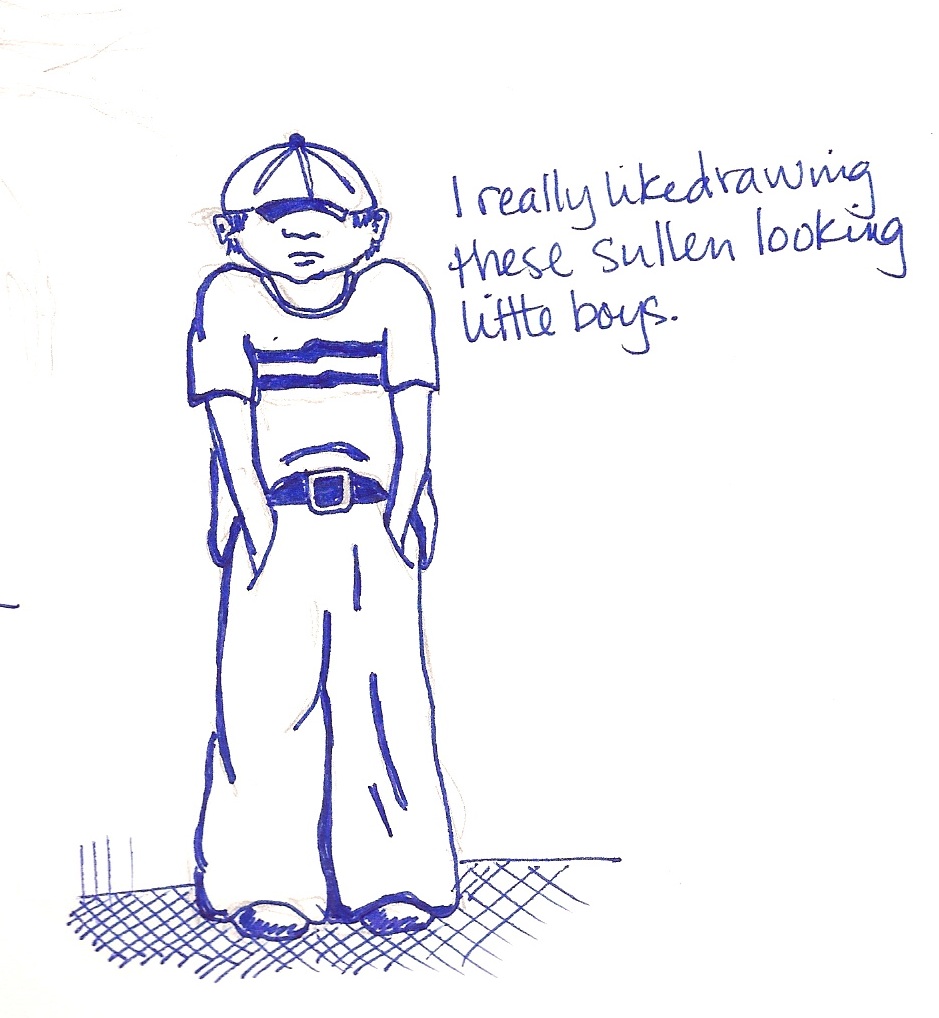 |
| Essentially a self-portrait (if I was a boy), 2001. |


