Showing posts with label Bella. Show all posts

Tuesday, August 2, 2011

Topic 201: Behind the Teeth

Carol:
Mouthing Off
Sometimes don’t you just feel like putting your hands over your ears and screaming? The kind of “behind the teeth” primal howl of emotion that implodes if you don’t open your mouth and let it out?  I start to feel it when my daughter gets “that tone” in her voice as she asks “Are you finished with the essay yet?”
 
Yesterday, we decided to forego the essay. Megan suggested it, and I didn’t argue because every other Monday I get really stressed out.  That’s when I experience the convergence of writing the daily theme, picking up the house for the arrival of the cleaning crew and getting ready for my volunteer “job.” Stress makes me get “that tone” in my voice, too, and I feel like putting my hands over my ears and screaming. I must have a really tough life, eh, if I let such minutia make me feel crazy. 
 
Not that I have never experienced real scream-worthy stress. I was teaching one January when both my pre-school kids got chicken pox. I would get up at 5 a.m. to grade papers and prep for the class, drive in through the slush of a winter storm to teach, then head back home to start soaking them in oatmeal baths to alleviate the itching. I worried a lot about what new illness would create day-care havoc. 
 
My major stress relief back then, besides hiring a cleaning lady, was being with the students. Most of them were women, most mothers. They knew exactly what I was going through and commiserated with the right amount of sympathy and humor. In fact, I felt more relaxed at work than at home.
 

Right about that same time my husband was experiencing his own scream-worthy stress. He hated his job, didn’t much care for the people he worked with, and was frustrated with demanding, angry clients. His body reacted with debilitating migraine headaches, so It became obvious that some kind of change needed to happen. That was the spring we decided to take a year off and travel the country in a motorhome.
 
For the most part, that odyssey  provided just the respite from the screaming, howling stress that we both needed. We threw away all our work-centered routines, got up with the sun and went to bed with the moon. And, over an 18,000 mile journey, we only had two loud, emotional melt-downs, both times when we were hungry, tired and cranky.  And we returned to Prescott with plenty of memories to sustain us when the stress started to roll over us again.
 
I don’t know all that much about the Norwegian painter Edvard Munch, but I saw his painting “The Scream”(1893) when I was studying in Europe.  It was part of a larger Munch exhibition but I only remember “The Scream.” I was mesmerized by the anguish of the figure, shown through primitive, broad strokes. Apparently, Munch himself understood that “behind the teeth” raw emotion of suffering. He wrote to a friend, “You know my picture, ‘The Scream?’ I was stretched to the limit—nature was screaming in my blood…After that I gave up hope of ever being in love again” (source: “Edvard Munch”).
 
Okay, so I was exaggerating a bit. I do feel stretched to the limit sometimes, even without juggling work and family, but I have never experienced that deep angst of Munch’s painting, thankfully never experienced such loss of hope or love.
 
Any minute now, Megan is going to call up to me with The Question. “are you finished yet?” I don’t have to put my hands over my ears and scream because…. I’m finished.
 
Source:
“Edvard Munch.” Wikipedia.
Megan:

We didn’t write yesterday for a few different reasons, but if I’d been able to think of something to say about his topic, we probably wouldn’t have taken the day off. Today we don’t have any early morning obligations, so I can’t weasel my way out of it again. Even Googling the topic didn’t help, but I did learn that there are behind-the-teeth braces available now. That’s cool. But I’ve never had braces so I can’t talk about how nice it would have been to have the new ones, instead of the other, front-of-teeth kind. Instead, I’m going to talk about the dogs. Again.

Last Friday, Milo got into a fight with a friend’s neighbor’s dog. Every Friday we have coffee at this neighbor’s house, and we let the dogs off leash to roam her giant fenced in yard. Usually Milo ignores the neighbor’s dogs, but for some reason – and I think Bella was the reason – they went for each other at the fence. I heard the noise and ran with my father to break them up. The other dog had squeezed its head through the fence and clamped onto Milo’s jaw. My father had to kick the dog several times before he let go of Milo’s face.

There was a fair amount of blood, from both animals, because before the dog got Milo, Milo got the dog. I didn’t see how it started, but since Milo is the least aggressive dog ever, I think he must have been protecting Bella – who’d spent the whole fight leaping straight into the air and howling. After the bleeding stopped, Milo was fine, but my mother and I agreed that we should not take the dogs back to our friend’s house.

So, we decided to try the dog park. I’d taken Bella the week before, but we hadn’t tried it with both dogs. Milo immediately joined a pack of males, each determined to mark every plant, chair and garbage can, while Bella followed along. I wasn’t sure how our two dogs would interact with each other with so many other distractions around. At home they are pretty attached (correction, Bella is attached to Milo), but I just figured it was because there were no other options. But the only time she left his side was if he sneaked off without telling her. When she noticed he was missing, she’d run over to me and wait for Milo to come back into view.

After awhile, we were joined by two pit bulls – one was a little puppy, much smaller than Bella, and the other was huge and terrifying but very sweet.  He took a liking to Bella, and Milo took a liking to the pit puppy. Neither of the younger dogs appreciated the attention. Bella hid under my chair and the other puppy crawled into my lap, Milo still salivating by her rear end. And then I noticed he was dripping blood all over the puppy’s back. He’d somehow opened the wound he’d received the day before. 

I’m not that familiar with dog parks, but it is my understanding that there is an etiquette. Don’t bring aggressive dogs, or dogs in heat, or unvaccinated animals. One dog bleeding all over another also seemed like bad manners, so we apologized and left. But as soon as I’m sure he’s healed up, we’ll go back again.

Wednesday, July 27, 2011

Topic 198: Talkers

Carol:
The Biography of Phil A. Buster
Right now it seems like the folks we elected to serve our needs in Washington are all talk and no show. Will they come to an agreement on the budget, raise the debt ceiling or not, to increase taxes or not, stall or vote? With all that discussion and debate, even the F word has been thrown around.
 
Filibuster, the process by which United States Senators can delay or even prevent a vote on a bill with a tag-team style talkathon. The word itself, according to the US Government website, comes from a Dutch word meaning “pirate,” as if politicians who invoke the filibuster rule are high jacking the ship of state, if only temporarily.
 
There are rules to the filibuster rule, of course. Speak as long as you want on any topic you choose unless or until three-fifths of the Senate (it was two-thirds until 1975) calls for closure under Senate Rule XXII, or “cloture” if you prefer the more elegant French term. Rule XXII, adopted in 1917 under pressure from Woodrow Wilson, was first used in 1919 to end a filibuster against the Treaty of Versailles. How a propos.
 
Filibusters were most often used in the mid- 20th century on civil rights issues, and particularly by southern Senators.  When my family lived in  Louisiana during the 1940’s, my mother sent her parents an editorial from the Houston Post “which amused us but also burned us up a little too. The attitude of the South is so different from ours. They think they are a law unto themselves… And to think that a group of senators could take up a week of valuable time pulling a filibuster as they did!”
 
The 1942  filibuster my mother was referring took place over five days, when southern senators were attempting to forestall legislation that would eliminate the poll taxes used in their states to keep low-income residents from the voting booths (most often African-Americans).  Over thirty years later, South Carolina Senator Strom Thurmond would take the record for the longest individual filibuster  when he spoke for 24 hours and 18 minutes against the 1957 Civil Rights Act (source: “Filibuster and Cloture”).

Huey Long in mid-talk
My mother also mentioned Huey Long in her letters from Louisiana. Long had been assassinated in 1935 after serving first as Governor of Louisiana and then as its Senator from 1932 until his death. He was a colorful and effective communicator whose Senate tactics are captured for posterity in The U.S. Capitol’s Statuary Hall, where his bronze statue shows “this master of the Senate filibuster captured in mid-sentence” (source “Huey Long Filibusters"). His most famous filibuster took place in June 1935 when he spoke for over 15 hours. He began by reading and dissecting every page of the United States Constitution.  When he ran out of topics, reporters in the press gallery sent him notes, and eventually he resorted to talking about southern recipes such as fried oysters.
 
The most famous invoker of Rule XXII was Jefferson Smith—not a southerner and not even a real politician. Who didn’t cry when the naïve young Senator, played by Jimmy Stewart in Mr. Smith Goes to Washington, talked himself into exhaustion in defense of his reputation.  Who hasn’t seen that movie and wished for a real Jefferson Smith to bring his honesty and high ideals to Washington.  It took a 1939 movie by Frank Capra to show the world what Phil A. Buster is all about.
Filming Mr. Smith Goes to Washington.


Sources: 
“Filibuster and Cloture.” US Senate website.
 “Huey Long Filibusters June 12-13 1935.” US Senate website.
          

Megan:

My extended family is full of talkers – people with big voices and big ideas, eager to share gossip, stories, anecdotes and memories. Get us together and everyone is talking at once, and it’s so loud that sometimes my dad has to sit in the car. My immediate family isn’t really like that. My father and brother are very quiet, and I’m only talk a lot if I’m with a good friend. Even my mother, who has the loudest voice after years of projecting it to the back of a classroom, isn’t really a talker.  As with any of us, if there’s a topic we are interested in or passionate about, we can’t shut up about it (I’m looking at you, Genealogy) but generally speaking, there’s a lot of quiet time in our house.

Or, there was before we got the puppy. Milo only makes noise if someone has pulled into the driveway, or Bella is pulling on his ears.  Bella, on the other hand, is a talker. She has a vocal response to pretty much everything (except intruders), but nothing valuable to say. This morning, on our walk, we were plodding along at our usual pace with no wild or domestic animals in the area to distract us, but Bella kept up a steady whine for blocks at a time. She wasn’t pulling on the leash or acting agitated in anyway, but she wouldn’t shut up either.

In the house, she’s been driving my mother crazy by barking to go out, barking to come in, barking to get Milo excited. Even when she’s asleep, she makes noise. If I shift her out of my way, she keeps her eyes closed but releases a deep, guttural rattle – not a growl, more like a groan. She growls too, if I bug her too much, but I ignore that and keep bugging her because I don’t want her to think she can take that kind of attitude with me. It’s not polite.

The other day, I took Bella over to a friend’s house to play with her dog. Our dogs have play dates. I can see how easy it is to let pets become surrogate children --  especially when we use the same language to describe their activities. Anyway, we were sitting in my friend’s back yard and the neighbor pulled into the driveway next door.  My friend’s dog, Lucky, totally ignored the neighbor while Bella went all territorial. 

Her guard hairs stood up, and I always wish I had a camera when that happens because it is the least impressive thing I’ve ever seen. Milo gets a full Mohawk from head to tail when he’s on alert. Bella has one tuft between her shoulders, and one just above her tail – it just looks like she was brushed the wrong way.  But up went her little hairs and she tore over to the fence barking and hollering until I called her back. I reminded her that we were guests, and that if the resident dog wasn’t alarmed, there was no reason for her to be either.

Despite her near-constant vocalizations, she’s turning out to be a good dog. She hasn’t eaten a dead animal in 4 days and hasn’t had an accident in weeks. We’ve still got a ways to go on obedience and sleeping through the night. The other night I found myself quoting to her a specific passage from this book – and by passage, I mean the title. 


Friday, July 22, 2011

Topic 195: The Monotony of Being Good

Carol:

  Shooting the Breeze
Our pack of dogs and their walkers met this morning for our usual Friday coffee chat at Marilyn and Lou’s house up the road.  When it’s warm, we sit outside while the dogs roam around the almost two acres of fenced land.  We spend the hour of sipping and socializing before heading off to work or chores or whatever--relaxed, enjoying both the gentle breeze and the meandering conversation.  Still, all are keeping an eye on the whereabouts of their various animals.
 
Koda, who lives here, rarely leaves the patio.  She appears to be bored with anything that doesn’t lead directly to food. She doesn’t play with the other dogs, she doesn’t poke around. She does sit beside the person most likely to drop a crumb or give in to her sad eyes by pulling out a dog treat, which is usually me. She is so quiet most of the time that we forget she is there. Good doggie.
 
Milo takes off in full throttle and covers  the whole yard, jumping over walls and poking under bushes. Sometimes we see the tip of his tail whiz by or track his direction by the scatter of birds.  Eventually he works his way back to the patio and sits at full attention if there is food on the table, hoping for a reward for his good posture and self-control.  He would never lunge at the plate of cookies, he would never leap up to grab food out of someone’s hand. He does, however, poke his nose into a pocket if he smells crumbs from a doggie treat. His behavior would be monotonous if it weren’t for those infrequent times when quiet presages trouble. Like the day he tipped over Koda’s food container and ate enough kibble for a week. Good doggie (mostly).
 
Bella is also predictable, not by the monotony of her behavior but by her absolute lack of predictability.  So far, she has been tentative about exploring the open spaces of Marilyn’s yard. Sometimes she will watch for evidence of Milo, a quick view of his tail through a bush or a flash of striped coat flying by in the distance. Sometimes, she will stop, frozen into a pose that betrays her German Shorthair DNA.   This morning she completely ignores the large dog bowl of water, instead jumping up to hook her paws over the cement lip of the bird bath to drink from the deeper pool of water.  She eventually settles down under the patio table, still licking the crumbs from the cookie she grabbed off the table.   We are using “off” and “no” a lot these days with Bella. Bad puppy (mostly).
 
Today we are joined by another neighbor and an extra dog is added to the mix,  Spirit, a 10-year old with beautiful long pristine white fur. He is quite patient as Bella takes a playful lunge and even indulges her with a few enthusiastic laps around the patio. He doesn’t beg, doesn’t bark, doesn’t lunge, well, isn’t he just about perfect. The kind of monotonous good behavior that parents of young pets and young people are grateful for.  Good doggie.
 
The hour is up, chairs are pushed back, cups retrieved, leashes snapped on collars. Bella, come. Milo, come. Where’s Spirit? The monotonously good, the beautifully white, long haired majestic animal is in the flower bed behind a bush, behind the flowing water sprinkler, barely visible behind the flying dirt from the hole he is digging with muddy black paws.
 
So much for the monotony of being good.


Megan:
The Monotony of (Writing About) Being Good


Yesterday I took my grandmother to Walmart, and while she was shopping, I wandered around the store. I hadn’t eaten lunch and I stood in the snack aisle for  a long time trying to convince myself that Cheeze-its were vegan because the cheese was probably all chemicals anyway. I didn’t actually read the label, I just stared at the front of the box. I put some Wheat Thins in my cart, and took them out again.  Then I picked up a small container of fresh fruit from the produce section and ate that while I waited for Grandma to finish.

Eating healthy is only a problem if I get hungry while running errands. After I dropped my grandma off at her house, I went to my favorite coffee shop because I had time to kill before I picked up my mother (I’m the family chauffer). I was so proud for not eating the crackers that I rewarded myself with an oatmeal chocolate chip cookie. It was probably not a vegan cookie, but I didn’t beat myself up over it because one cookie is better than (or at least not as bad as) an entire box of crackers.

I just reread those two paragraphs and nearly died of boredom. At least I’m on topic. I didn’t intend to be one of those bloggers – who writes about weight loss and diets and the silly things dogs do (which reminds me: on this morning’s walk, Bella tried to eat 2 birds, 1 mouse, and 1 rabbit leg – all dead before she got to them). And it’s not that I have a problem with people who write about those topics; most of the blogs I read cover the same issues. I just didn’t want that for myself, because it’s not particularly interesting (except for cataloging Bella’s dead animal collection).

The most exciting anecdotes and stories often involve dangerous excess, errors in judgment and unfamiliar environments. I have plenty of those stories in my past. As I get older though, it’s harder for me to remember why I thought that was fun. Young people take stupid risks with themselves without considering consequences. I never got in any trouble, but that was luck. Not all of my friends escaped their youth unscathed. We had some great times, but right now I think I would rather have a good life than an exciting life. And perhaps that means I will have to seek inspiration for my stories from my imagination rather than my good but boring life.

Tuesday, July 19, 2011

Topic 192: The Glory of the Commonplace

Carol:
Glory Be to Poets               

“Nothing is so beautiful as spring—   
When weeds, in wheels, shoot long and lovely and lush;” ( from  Hopkins “Spring” 1880)

Summer monsoons have brought new life to my front yard; unfortunately, I don’t find “glory in the commonplace” when it comes to weeds. Mine are shooting long and lush, but I won’t add “lovely.” Such is the spiritual vision of Gerard Manley Hopkins that his poems burst with passion for the smallest details of his God’s creation.  In weeds, he sees God; I see the Devil.


George Manley Hopkins
I first encountered Gerard Manley Hopkins(1844-1889) in high school. The story of an Anglican convert to Catholicism who became a Jesuit priest intrigued me. He must have been a very complicated man of competing passions because, after he entered the novitiate in 1867, he vowed to give up his writing and burned of all his poems. He kept that vow until 1875 when he began to write again after a tragic shipwreck at the mouth of the Thames that killed most of its passengers, including a group  of Franciscan nuns. The result was his poem “The Wreck of the Deutschland” (source:  poetry.org)

   Whatever his inner spiritual and emotional battles, Hopkins created poems that play with language and rhythm. My favorite poem is “Pied Beauty,” which must be read out loud for its sound but also to experience how the mouth, tongue and teeth release the words: 


  “ Glory be to God for dappled things –
   For skies of couple-colour as a brinded cow;
   For rose-moles all in stipple upon trout that swim; “ (1877)

The poet who saw loveliness in a weed now praises cows and trouts and “all things original, spare, strange.” How can I greet the day any other way than with joy and gratitude for the commonplace? Glory be to Hopkins

I enjoyed Hopkins’ poetry for the same reason I had fallen in love with the poetry of E.E. (Edward Estin ) Cummings. A generation apart, an ocean apart, a worldview wider apart than that ocean,  yet Cummings and Hopkins shared a radical sense of form, stretching words and phrasing in new ways that challenge the reader to see the commonplace in new ways.  The first Cummings poem I read was “in just”

“in Just-
spring       when the world is mud-
luscious the little
lame balloonman
whistles       far       and wee” 

In this poem, he celebrates a world that is “mud-luscious” and “puddle-wonderful,”
a world of youthful delight in the commonplace. This morning I found another  Cummings poem that takes me back to Gerard Manley Hopkins.  The Unitarian Cummings glories in the same world of the ordinary and divine in his poem “I thank you God for most this amazing”

“i thank You God for most this amazing
day: for the leaping greenly spirits of trees
and a blue true dream of sky; and for everything
which is natural which is infinite which is yes”

I look back out my window and the world is waking up. In the distance a neighbor is throwing flakes of hay into the stall where his horses greet every morning with an exuberant kick of the hooves and gallop around the pasture. Glory be to Cummings. 

Celebrate the commonplace in your day. Read “Pied Beauty” out loud or listen to Cumming’s poem “I carry your heart with me” on YouTube. Glory be!


Megan:
The Glory of the Commonplace
This topic seems like it could be on a bumper sticker. Live for the Moment. Seek the Glory of the Commonplace. It has a certain Tolle-esque ring to it. That’s the second time I’ve used the suffix –esque this week, and it’s only Tuesday. I’m going to try to use it every day.

For some people, like my father, living in the moment is a desirable but often unachievable state. For others, like myself, it’s such a natural condition we need to remind ourselves to consider the future. Somehow staring at my toes and applying for jobs don’t seem to go well together. But yesterday I sat down to work on a job application and when I looked back up at the clock, four hours had passed. That hardly ever happens. I suppose losing track of time while writing a cover letter is a more productive example of living in the moment than staring at my toes.

By the way, the reason I am staring at my toes so much is because I got a pedicure over the weekend and my feet have never looked so cute. As my friend Noel put it, I got “taken for a ride” by the pedicurist. I could neither hear nor understand what he was saying to me, so I just nodded every time he raised his eyebrows and now I have flowers on my toes. For a lot of people, getting a pedicure might be a regular thing. Maybe they are used to having flowers on their toes. This is new for me.
Flowers! On my toes!
And I was so delighted with the result that I didn’t even resent the fact that my post-pedicure feet are so slippery on the carpet that I fell down the stairs. I ignored the rug burn that extended the entire length of my calf, more concerned that I might have chipped the polish. Priorities, people.


Anyway, right now I’m sitting in the living room writing this essay, and Bella is on the floor next to me chewing on a bone I gave her as a bribe to not be so annoying. 
What she is doing
 We’ve already had our walk, but it wasn’t long enough to put her to sleep. My father is off on a motorcycle trip, so I have to walk both the dogs. I tried walking them together, but on Sunday morning (shortly after I fell down the stairs), we were chased by a coyote and it’s a lot easier to cope with that kind of situation with only one dog. I threw rocks, but I could hear the rest of the pack approaching and for a moment there, I was pretty nervous.  So, now I walk the dogs one at a time. I go the same distance, but their walk is halved. 
What I wish she was doing
I didn’t expect I would enjoy these walks so much. In addition to the wildlife, I also get to watch the sun come up every morning.  I’ve watched the sunrise more in the past few months than I have in the past 20 years. Of all the places I’ve lived, I’ve never seen anything as beautiful as the Arizona sky. It’s easy to take for granted what you see everyday, but not this:
  

Image credit:
The sunrise image came from here.

Monday, July 11, 2011

Topic 187: Laughter as a social asset

Carol:
Did you hear the one about the Priest who….


I really can’t think of any profession that doesn’t require a sense of humor. And that includes religious vocations. I haven’t seen a job description for minister, rabbis or priests, but people skills must be on the list, including not just compassion and patience but a sense of  “Humor In Uniform “

One of my favorite Mary Tyler Moore episodes revolves around inappropriate laughter. Chuckles the Clown, a rarely seen but often gossiped-about character on the show, dies under bizarre circumstances; prompting all kinds of jokes in the newsroom by Mary Richards’ colleagues. The always prim Mary is appalled at their poor taste and lack of respect for the dead. Later, Mary lapses into uncontrollable giggles during the minister’s eulogy at Chuckles’ funeral, then into loud guffaws as the rest of the attendees remain somber, even shocked at her behavior. The minister turns the situation around, encouraging Mary to “Laugh…Laugh for Chuckles,” at which Mary bursts into tears. This episode is ranked by TV Guide as #3 in list of televisions “100 Great Episodes of All Times” (source:  “Chuckes Bites the Dust.”)

A few months ago I went to a funeral for a judge who died in his early sixties after a  battle with brain cancer.  The church was packed with  colleagues, friends and family,  all of whom  admired and loved him as a special person of humanity and faith. Certainly there were tears and mourning, but the judge’s wife, son and large extended family chose to honor him with laughter and whimsy. Every participant in the service, every family member wore black trousers, white dress shirt and a large necktie from the judge’s own infamous collection of outrageous, gaudy, unique ties. Music provided by the folk choir his wife directed, and which he had belonged to for many years, included a recording with his voice.  How many people get to sing at their own funeral? His wife smiled, quipped and encouraged a spirit of gratitude for a life well-lived, if short, and for a dignity that was anything but stuffy.  The laughter followed us to the church basement after the service as we mingled with family over lunch, humor alleviating the awkwardness that often accompanies such social occasions.

In both funerals, the imaginary and the real, the tone of humor was encouraged by the “Pastor in Charge.” When I announce the music at our Saturday church service, I have learned to wait while ‘Father Woz” slips in a joke after the final blessing and before the last hymn. The congregation appreciates his humor, which often involves a story that sets up a pun or corny joke. Father Woz even self-published a collection of his favorite jokes to raise money for charitable projects. But, one of my favorite homilists is a big, tall, wide, loud convert from Wyoming who does a terrific job of poking fun at himself before he slides beautifully  into the gospel message.

I have no doubt that laughter is a social asset, but is it a spiritual one as well? I took me a while to wade through all the websites that popped up when I googled “Is laughter good for the soul?” but I found a website with Bible quotes. Proverbs 17.22 “A joyful heart is good medicine, but a crushed spirit dries up the bones.”

So, in honor of  Father Woz, I’ll end my essay with a joke:


Sources:
 “Chuckles Bites the Dust.” Wikipedia.  


Megan:
Laughter is my only social asset

So, maybe you noticed, maybe you didn’t… but we forgot to write on Friday. Mom had an early morning appointment and I was busy doing very important things that I not going to share because I cannot remember them. I know I walked 3 miles in the morning and then 2 miles that evening, but I remember nothing of the hours between except that at one point, mom looked at me and said, “Hey… we forgot to write our essays.” And I said I was too tired to write (on account of the walking 5 miles) so we left it until today, both of us hoping that the extra days would give us a chance to come up with something funnier to say.

Let’s see… what else happened this weekend? On Saturday, my father and I climbed Thumb Butte with the dogs. It’s not a long or difficult hike unless you are me, and you haven’t climbed that mountain in more than 15 years. So, we went up the shallow side and came down the steep side, and if you’ve ever hiked with a really strong puppy who doesn’t know how to heel, you know there are benefits and draw backs. Bella pulled me up the mountain, but nearly killed me on the way back down. Dad and I switched dogs halfway down, and by the time we got to the bottom, Bella knew how to heel. Afterwards, Dad commented on how different he was treated by the people we passed while he walked Bella instead of Milo. People smiled and talked to him while he had the puppy, but avoided him when he had Milo (probably because Milo looks like a scary dog). I too, have noticed the puppy phenomenon in the past, but on this particular day I was focused on staying upright on legs made of jell-o.

The rest of Saturday was spent running errands, going to see Horrible Bosses (which was hilarious if you like really bad language, which I do) and then dinner at a Mexican Restaurant. I managed to stay vegan with the entrée, but blew it with the sopapilla for dessert. It was probably this lapse that caused me to cut Sunday’s walk short because I had what my nutrition instructor refers to as McDougall’s Revenge (McDougall being the name of the doctor who wrote the book on the particular type of vegan diet we are attempting to follow). 

After I recovered, my father and I went to a Native American Art Show that he got free tickets to in exchange for allowing the exhibitors to park in his building. That was pretty nice except for and handful of white artists who called themselves names like Felicity Honeycomb or Terrence Ladykiller, which I thought might be offensive, but I couldn’t really tell if it was, so I was just uncomfortable. Then I saw a statue I liked and turned into the jackass who says too loudly, “Hey, that would go really well with our living room sofa.”

When I got home, I made a vegan pizza (again, not according to McDougall’s plan, but still so delicious). Mom had some, and she did this thing she does with everything I make, where she tells me how good it is and then she completely changes it. “This is the best pizza I’ve ever hard, “she said, and then added olives and real cheese.  I don’t take it personally, but next time she’s making her own damn pizza.

Finally, I spent the rest of Sunday re-upholstering a chair my mother bought from a neighbor for $5. I streamed Bones from Netflix to watch while I worked on the chair, and the entire project took 8 episodes. I was really enjoying myself and started thinking maybe this could be a new career path for me, restoring old furniture, but when I finished, I couldn’t straighten my back and my fingers were bleeding from repeated pricks by this giant curved needle, and I changed my mind. The chair looks awesome though.
I tried to take a "before" picture, but I forgot to press the button.


Wednesday, July 6, 2011

Topic 185: Animal Facial Expressions


Carol:
Making Faces                   
 Lots of websites help pet owners interpret the facial expressions and body language of their animals. That includes such variables as the position of the tail, alignment of the body, position of the eyes, lips and teeth, and appearance of hackles. Vocalization is another thing all together. Mostly, with domestic animals, I think we interpret animal facial expressions as we would human expressions. Lips curl up as if to smile says, “Look, I’m happy to see you.” Eyes look sad, happy, or angry.  We spend a lot of time in the daily theme talking about the antics of our two canine pets and the challenges of introducing a puppy into our once placid environment.. Dogs have always been a part of my life.  But in reality there is one animal I have always loved to  watch with fascination on television or at the zoo. Chimpanzees.

I have viewed almost every documentary about the work and life of Jane Goodall, and I was given time off from work to hear her speak when she came to Yale. The large room was absolutely full of students crammed into every possible space. Twenty-five years later, she continues to attract the interest—and affection of people all over the world. And, her website “Lessons for Hope” provides opportunities for students and teachers to learn more about chimp behavior. She describes her experiences with the chimpanzee William in her work The Shadow of Man (68). William, a scarred, submissive male used both facial expressions and hand gestures to send notice to other adult males that he knew his inferior status; he would “often pull back the corners of his lips and expose his teeth in a nervous grin.” (source: Lessons for Hope)

Researchers continue to examine the behavior of chimpanzees, including how they communicate using facial expressions and body language. The Yerkes National Primate Research Center housed at Emory University (Georgia) conducted research into Chimpanzee facial expressions under the direction of director Lisa Parr, not just to learn more about chimpanzees but to help understand “the evolution of human emotional communication” (source: Science Daily). Parr notes that the study has determined chimpanzee expressions to be much more complex than they expected, requiring more detailed studies. For instance, an open mouth and bared teeth that may appear to be “playful” must also be examined for muscle action, whether the eye brow is raised, etc.

When we say a chimpanzee, or any animal for that matter, smiles or pouts or frowns, we are associating human emotions to their expressions that may be inappropriate.  Right now, my dog (the well-behaved prematurely grizzled one) is looking right at me. He is in a full state of relaxation with ears slightly cocked, lower lip jutting out a bit (caught in his teeth again), and I would interpret that to mean he is relaxed but alert—wondering if I’m going to come over and give him a treat or a pat on the head. He’s tired because he had a big adventure on his morning walk. When he turned around at the sound of barking behind him, he took Marc by surprise and leapt for a young coyote, dragging his extension leash behind him, ruining in fact the second one in several weeks. The first time it was a rabbit. I wasn’t there to observe his facial expression, but it was probably one of completely satisfaction since he had been in full running mode all over the hills for about 15 minutes.

But, I wasn’t going to talk about dogs today.
 
Sources;
“Chimpanzee Facial Expressions…” Science Daily. 26 Mar 2007.      

Image of chimpanzee at LA Zoo. Wikipedia

Megan:
Animal Facial Expressions: a photo essay


I spent a long time this morning looking at the photos I've taken of Bella and Milo, and I have to be honest. There's little change to their to their expressions. Milo almost always looks resigned and calm (but maybe that's just the expression he adopts when I pick up my phone to snap a picture).

Considering that Bella is one of the clumsiest dogs I have ever seen, she does manage to look dignified,  and even noble every now and then. Of course, it could be the camera angle.


Usually, Bella looks like this:
 

Milo, on the other hand, almost always looks dignified. Except when I force him out of his comfort zone. Here, he is looking profoundly embarrassed.

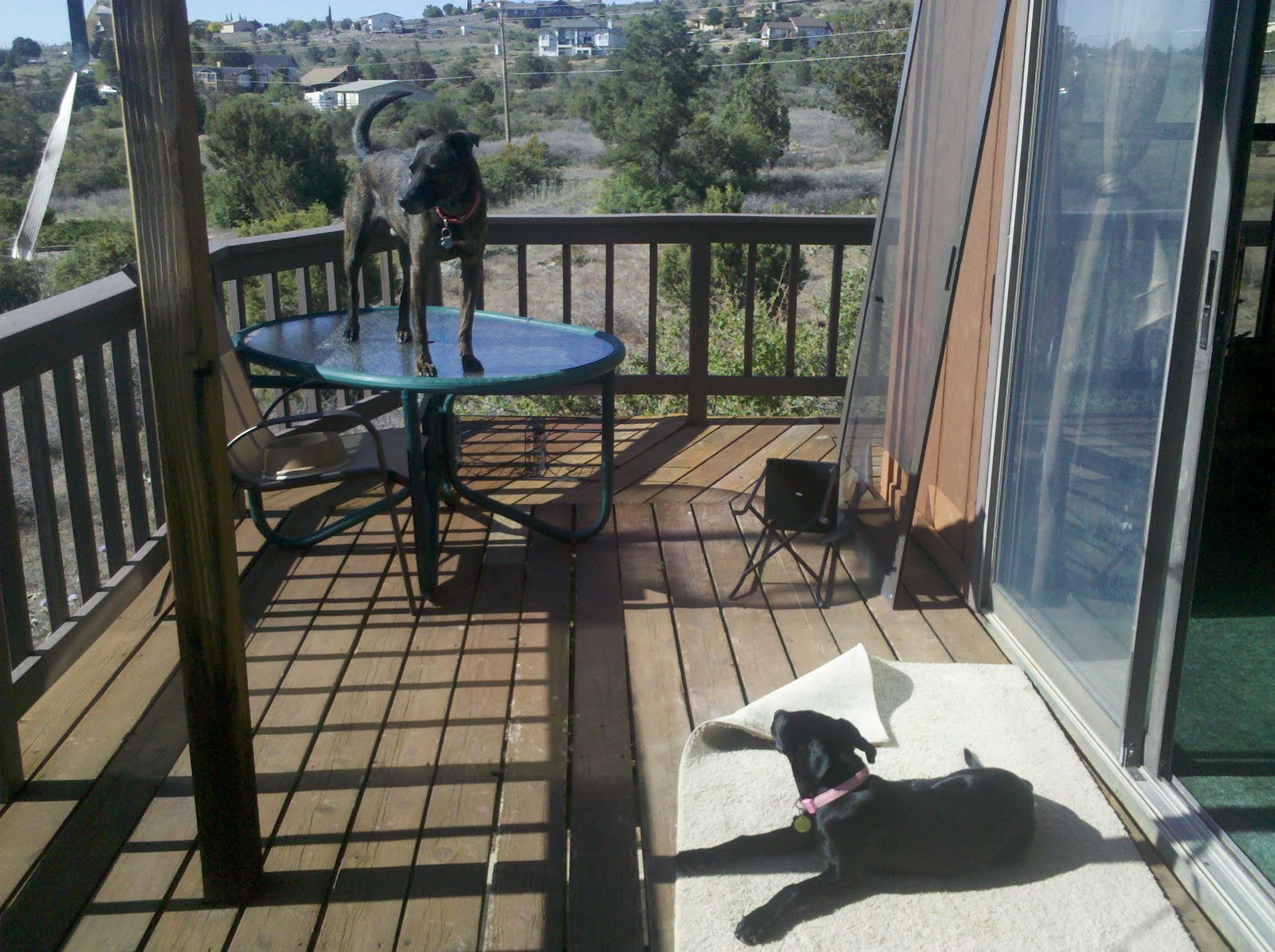
Milo likes to hang out on the porch in the sunshine. Until a certain someone irritates him and then he retreats to higher ground.
Note that the furniture in disarray, and the torn screen courtesy of Miss Bella.

 Speaking of Miss Bella. She has a bit of a temper. This is the only picture I could get of her in "demon" mode. The white flashes by my blurry finger are her teeth.

But she's a pretty good girl, aside from her occassional outbursts. We finally got her the pool she's always wanted, which she seems to enjoy.

Friday, July 1, 2011

Topic 183: Diddling

Carol:
Hey, Diddle Diddle
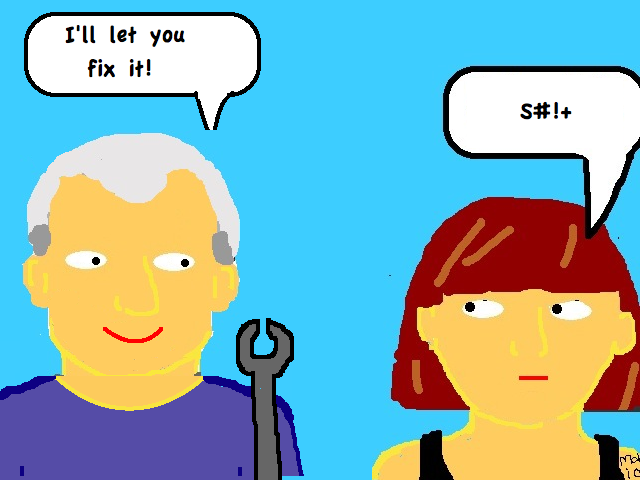
Oh, fiddle faddle. The kitchen sink is stopped up, and  the water is full of tiny, moisture -seeking ants. We have tried the usual non-mechanical “solutions” with no results.   After a phone call to one of the family fix-it types, we are at the stage of (1) taking the pipe apart or (2) calling a plumber. We can’t really diddle around because the same family fix-it types are coming for 4th of July weekend;  we want to de-clog the sink , take control of the pile of dishes, and make the ants disappear before they arrive.
 
Now here’s the real problem. One member of our family considers calling a professional plumber a waste of money, so he has decided to tackle the pipe himself. This man is very bright and creative, the best kind to call in a legal emergency  or personal crisis. But, he is what we call mechanically challenged.  This is the guy who proudly  installed vertical blinds in the dining room—didn’t even need to use the directions—and then held up a “left-over” metal clip.“ What do you suppose this does?”  So, Mr. Not-so-Fixit  is going to disconnect the garbage disposal, pull apart the pipes, and then finish the job hours later when he gets back from taking his mother grocery shopping.
 
The response to that idea was an almost unison cry of protest from his wife and daughter. I’m surprised the dogs didn’t join in with their own howls of protest. After we talked him into waiting, Megan walked him to the door and took control of the situation. “Dad, I’ll fix the pipes. I’ve done it before in England.”  I think I detected a little spring in his step as Mister Mechanically Challenged walked out the door, fully confident that his daughter was not only up to the challenge but wouldn’t diddle around before getting to it (although she does need to finish her daily theme first).
 
You see, we do have a family fix-it type living in this house. She has been honing her mechanical skills  since she was a young girl, usually after her father’s efforts had failed. Like the downstairs toilet. It had a leak that made it run off and on,with a disconcerting sound of water rushing that can be heard all over our house.  Sir Fix-it-Not made several trips to the hardware store, changed out part.  Just when he thought the toilet was working, we would hear it run again.  One day when we arrived from work, 12-year-old Megan greeted us at the door. Grinning, she proudly announced, “I fixed the toilet.” And she had. After the vertical blind incident,  she decided to install the blinds in her bedroom herself. She followed the directions, no extra parts, no swearing (which always accompanies her father’s efforts at home repair). 

I may sound like I’m complaining about my husband. Like I said, he is a talented, creative and resourceful guy, just not with a tool or mechanical device like a TV remote or a DVD player. But, why should he diddle with projects that waste his time and raise his blood pressure when we have  Ms Tool Time living in the house. She’s the real “go-to” person for things mechanical.  I know she’ll be really excited when I show her the little to-do list I’ve been working on. I’ll even let her use my tool box, the one I keep in the downstairs closet for when I tackle home repairs. Heck, now that I’m retired, I may just give her that tool box.

Megan:
Diddling: an illustration
When we drew this topic yesterday, my mother and I looked at each other with exasperated confusion. She recited the nursery rhyme (hey diddle diddle) and I was wondering if I was once again going to have to write an essay about euphemisms. Separately we looked up the word in the dictionary, but when I shared the definitions with her, my mom seemed surprised – as though the definitions she found didn’t line up. Or maybe she was just surprised I was sharing any information with her at all, since I’m usually so concerned about her stealing my ideas.

What I didn’t tell her was that I found a delightful essay by Edgar Allan Poe on this very topic. He starts the same way she did, with the nursery rhyme, and then proceeds to philosophy, and then:
 
Diddling; or the abstract idea conveyed by the verb to diddle; is sufficiently well understood. Yet the fact, the deed, the thing diddling, is somewhat difficult to define.
The rest of his essay is then concerned with examples of diddlers – examples of con-men really. I encourage you to read it. And since I have nothing to add to the topic, instead I will simply illustrate the definitions as I found them in Merriam-Webster. 

 1. to move with short, rapid motions

 2. to waste (as time) in trifling

3. hoax, swindle

4. often vulgar: to copulate with


Sources:

Thursday, June 16, 2011

Topic 178: Earth Odors

Carol:
Hawaiian Holiday       
A honeymoon in Hawaii seemed out of reach as my law student fiancé and I planned our wedding.  We would have been happy with a camping trip to Sequoia; but, thanks to a resourceful travel agent, we got a package deal to Honolu for $50 extra that included a stop-over in California for the wedding. Most visitors to Hawaii will talk about the vibrant colors of the vegetation, the deep and clear pools of water, and the dramatic vistas from atop the volcanic islands’ highest peaks. I remember the smells.
 
The first smell I remember is the fragrance of flowers.  The lei I received as I stepped off the plane in Honolulu was a surprise, part of the honeymoon package.  I think the lei was made of white plumeria, and its fragrance filled our hotel room that first night.  The sweet scent was already familiar to me because in high school I had been asked by a neighbor to write an advertisement for a Hawaiian perfume she was selling in her Canadian gift shop. Everywhere we went on Oahu and Kauai, we were met with the scents of blooming plumeria and orchids.  I wore a flower in my hair from the lei for several days.
 
Another smell I remember is dead leaves, the rich loamy blanket of decaying vegetation that nonetheless smells clean and dusty in a good way. While visiting a park near Honolulu, Marc decided that it would be fun to venture “off the beaten path” of the designated walkways (smooth and asphalt-topped therefore “boring” I guess). As he pulled me into the bushes beside the path, I looked down at my flowered muumuu and pink suede clogs and thought for a moment that maybe I wasn’t dressed for adventure, but hey it was my honeymoon and my new husband assured me it would be exciting to explore the forest of tropical trees and plants in search of…birds, insects? As I gingerly made my way through the heavy growth, the vegetation under my feet grew deeper and “spongier,” and my feet sank deeper into the leaves the farther we moved. When I inevitably fell face down into the bed of leaves and branches, I was already perspiring from the humidity and ready to return to the safety of the walkways. As I pulled myself up and tried to scrape off the dirt on my face and dress, I saw a foot away a discarded beer can. So much for adventure “off the beaten path.”
 
I should have known better when later in the week Marc took me sightseeing to an area near a volcanic crust. Where that spot is I can’t recollect after 38 years, but it was probably somewhere along the Pali highway near the Koolau Volcano. I may not be able to remember the place, but I remember the smell, the powerful odor of sulphur and rotten eggs. Despite warning signs, Marc convinced me that it would be a unique experience to walk out onto the lava crust—just a little ways—to get a closer look at a steaming, yellow-green deposit of rocks. The first few steps onto the dark volcanic rock were firm, but suddenly I could hear the crunch as the ground underneath sunk an inch or two with each step. As the odor of the sulphur became overwhelming, I suddenly imagined the headlines as the Honolulu newspaper reported a young honeymooner falling to a hot death through a crack in the volcanic crust. Another tourist who ignored the warning signs—and common sense—in search of adventure.
 
The strongest odor I remember from our Hawaiian Holiday is not the sweet fragrance of the plumeria but the not-so-sweet odor of …FEAR. 


Megan:
Bella Smells
A few weeks ago, I took Bella with me when I went to Cornville to babysit my cousin’s kids. When I let her out of the car, instead of going to greet the kids she ran haphazardly through the big yard, nose on the ground, tail straight up in the air. It wasn’t the first time I’d brought her there, but it was her first time off leash. My cousin’s son, who hadn’t met her before, asked why she was running around smelling everything. I said to him, “Imagine if you went to a new place and it was full of toys and food and kids you never played with before, and everyone was calling your name.” That’s what I think it’s like for dogs sometimes.
Chasing a fly

I don’t always understand how Bella chooses what to be interested in although sometimes it’s obvious. I know that, as a retriever, bringing me long dead animals is instinctual for her. She’ll dig through a pile of laundry to find an used tissue or a handful of dog treats I left in a pocket. But I don’t know why, when she stops to sniff poop, she’ll ignore one kind and eat another. I had to pry the same (progressively smaller) ball of manure out of her jaws three times this morning.

Sometimes in the middle of a long drink of water, she’ll pause, growl and then start digging in the bowl, knocking it over and spilling everywhere.  When I took her to Cornville that day, she reacted the same way in Oak Creek, snapping at and digging in the water. I want to get a kiddie pool and see what she does, but my father is not interested in paying for one just to satisfy my curiosity. Bella was too timid to get all the way in the creek,  and was content to eat the remains of a crayfish she found on a rock. Of the four of us, I was the only one who managed to get caught in the current and swept down stream. I was still holding onto Bella’s leash, so she trotted along the bank with me while I tried to grab something or catch my footing. The kids thought this was funny.
Before I got swept away

After we went swimming, we got some fast food to eat in the car and Bella made herself an enemy to those children forever. They were already nervous around her because she’d jumped on them, but when she smelled the grilled cheese and popcorn chicken she went into a frenzy. I was driving so I couldn’t react right away and the kids screamed and cried as she first stole the sandwich and then buried her face in the container of chicken. The children’s tears were nothing compared to mine on the drive home as she produced odors that made the little hairs in my nose burst into flame.
Similar to what happened to the chicken

Bella’s grown so much the past few weeks that she’s almost as tall as Milo. She can stretch and span the width of the bed and it’s harder for me to sleep well when both dogs are with me. We always start in the same position: me on the right, Milo curled up on the pillow next to me, and Bella down by my feet.  But In the middle of the night, she still likes to scoot up next to us, and usually wakes me up with a wet nose in my armpit.  I guess she’s comforted by the familiar smells of her teachers and friends. She stays there for a minute and then moves again, this time resting her nose by Milo’s butt.

Wednesday, June 15, 2011

Topic 177: Making up one's mind

Carol:
Eenie Meeny Miny Mo
Megan and Marc and have taken the dogs on an extra early morning walk. They are both trying to increase their exercise and decrease their protein intake while taking a nutrition class at the college. Meanwhile, I am feeling a little bit of pressure to get this essay underway before Megan gets back and starts asking me how far along I am. It isn’t that I don’t have any ideas or that I am particularly slow as a writer. It’s just that I often have a problem making up my mind about what to write about.
 
For instance, the first thing that came to my mind for today’s essay was coin flipping. What was the history of using “heads or tails” to determine an outcome? Or, even “rock, paper, scissors,” which I usually played with someone to decide who had to take out the trash, or the dog, or do the dishes.  Drawing the short straw is another “device” for helping people make decisions.
 
Another idea that came to my mind was hung juries. Megan had to report for federal jury duty yesterday, which she used as an excuse for not writing her essay even though she got herself eliminated by 10:30 a.m.  A few years back I made it all the way to the final jury selection and opening arguments because the judge, prosecutor and defense attorney—all of whom I knew—thought I could be fair and impartial.  When they were conducting the “voir dire” on the panel of prospective jurors, they didn’t ask what I think is one of the most important questions, “Do you have trouble making up your mind?”  I thought about that at the time as I had a certain fear that we would end up in a Twelve Angry Men-like protracted deliberation while 11 men and women stared at me as I tried to decide “guilty” or “not guilty” Luckily, the case settled in one day and we were excused from jury duty.
 
Just as a point of interest, my intensive research on Wikipedia uncovered an unusual trial that used “rock, paper, scissors” to determine an outcome. In 2006 a federal judge in Florida who apparently got tired of the protracted and petty bickering between the opposing sides over where a deposition should be held.  Judge Gregory Presnell subsequently crafted an elaborate ruling that the two sides should meet in a kind of “hand duel” using rock, paper, scissors to determine the location of the deposition. According to Wikipedia, the ruling was intended to “shame” the litigants by showing just how extreme their dispute had become (source: “Rock-Paper-Scissors”).
 
Currently, being retired, I don’t have a lot of pressure on me to make up my mind on anything other than a choice of restaurants and menu items.  I get around that by letting the other people in the car hash out where we will eat, and then by always ordering last so that I have just that little cushion of a few extra minutes to “eenie, meenie, mo” the menu options—burrito or taco, burrito or taco.
 
The dog walkers are back, and I can hear the sound of spoons hitting bowls as Marc and Megan consume their healthy morning helpings of oatmeal. I like oatmeal, but for me it’s a winter breakfast and I can already tell this is going to be a hot day. When they asked if I wanted some, I didn’t really have a problem making up my mind.  “No thanks,” I yelled down, “I’m too busy right now to eat. I can’t make my mind up what to write my essay about.”

Source:
Rock-Paper-Scisorrs. Wikipedia.

Megan:
I Changed My Mind
I thought we’d written on this topic already. I searched the archives and although this is a new topic, I’ve already written on it a number of times. When we started this website, I didn’t want to call it a blog because I associated it with online journaling and this wasn’t supposed to be a journal. Except that writing familiar, personal essays by its very nature involves writing about the familiar and the personal, so it’s sort of turned out like a journal anyway (well, my essays have).

So, I’ve already written about how I made up my mind to quit the job in the prison, how I decided to move back to the USA (one year ago today), how I made up my mind to write The Book, to apply for an MFA, to get a puppy, to become a vegan and get in shape.  I make up my mind a lot. I also change it a lot. Sometimes after it’s too late.

I’ve been having more days where I changed my mind about quitting that job and moving back to the States. I found out that there was a surprise inspection of the prison back in January, and that the report had just been published this week. I downloaded it and skipped right to the part about the library. There were no recommendations for improvement. I’m not going to say that I’d hoped the library had failed in my absence, but since I’m having such a difficult time finding a new job, I sort of wished there was evidence that my old one missed me.

I’ve changed my mind about writing because I’m not in the mood, changed my mind about the MFA because I’m afraid of not getting in. I’ve changed my mind about going vegan because even though I watched a very compelling video last night in class about how dairy proteins cause cancer, I came home and ate cheese and crackers at 11 at night because the garbanzo bean salad I had for dinner was not adequately filling.

I changed my mind about the puppy because she’s causing problems in the family. I want to blame the set back in her housetraining because we were gone for four days and although my father walked, fed and watered her, he’s just not a dog person and she probably didn’t get the level of attention she needs. But the fact is, she wasn’t completely trained before we left on our trip. Also, she’s weird. I can walk her for an hour in the morning and she won’t squat once, but in the hour before bedtime she has to go every five minutes.

Anyway, I’ve been changing my mind a lot. And I’ll change it back again. I’m still going to do all those things (and keep the puppy).  And maybe some day I’ll look back on this frustrating and transitional point in my life and think of it as the point where I finally got it together.