Tuesday, July 12, 2011

Topic 188: On Being Small

Carol:
Nano, Nano
Today’s paper had a photograph of a baby born last Friday, a whopper at 16 pounds. Ouch.  Pretty well anything that is bigger, higher, taller, longer gets notice: the world record giant pumpkin at 1810.5 pounds, the tallest cornstalk at over 31 feet (higher than an elephant’s eye), the longest bull horns (4 feet 7”) (Guinness Book of World Records).  We tend to think of the other end of the measurement spectrum as wanting in some way, too small is stunted, too short a range is a dud. But, modern science has created a whole new world of miniaturization and a vocabulary to describe that world.
 
Micro: Greek prefix meaning “small.” In the metric system, used by every industrialized country except for the United States, “micro” means 1 millionth of something. But, in common language it identifies any number of smallish devices (microphone, microbe, microscope, micrometer). The microchip is the miniature “wafer” of semiconducting material that carries the electronic devices or transistors that run cell phones, computers, cameras, I-pods, etc.
When microchips were first invented, only a few transistors could ride on a wafer, but current technology has increased that capacity to millions or even billions of transistors on a single chip (source; “Integrated Circuit”).  Microchips about the size of a large grain of rice are routinely implanted into not only domestic pets for identification but wild animals and livestock for tracking and research.
Cat X-Ray with microchip

Nano: another Greek prefix for a measurement that is a billionth of something, most often used in science and electronics.  So, a nanosecond is one billionth of a second or 1 thousandth of a microsecond.  How people ever created the equipment to be able to measure something in nanoseconds I don’t know.  But, that’s what I get for studying literature and not computer science, and what I get for using Wikipedia rather than a physics or computer science academic journal.
 
Hopper: is not a Greek prefix.  Hopper, as in “Grace Hopper” is a link at the bottom of the Wikipedia entry on “nano.” She was an American scientist who was a pioneer in computer science. Her concepts led to the development of modern programming language such as COBOL, FORTRAN, etc. Hopper spent the last part of her life working as a consultant for Digital Equipment Corporation, travelling a lecture circuit to its different facilities. Hopper received standing ovations for her presentations and was particularly well known for her ability to illustrate the concept of the “nanosecond.”
 

Hopper graduated from Vassar in1928 with degrees in mathematics and physics, earned graduate degrees at Yale. In 1943, she volunteered for the US Navy Reserve, graduated first in her class at Naval Reserve Midshipmen’s School, and ended up working on the Mark I computer project. The next 30 years of her life measure the evolution of computer science. Thank her for introducing the term “debugging” into our computer vocabulary.
 
Grace Murray Hopper maintained her loyalty to military service throughout her career. After being recalled to reserve duty several times, she retired for good in 1986,   the oldest commissioned officer in the US Navy and a few months shy of her 80th birthday.  One of the few US military vessels named for a woman, the USS Hopper was launched to honor her in 1996 and nicknamed  Amazing Grace. (source: “Grace Hopper”)
 
Amazing Grace, Rear Admiral Grace Murray Hopper, had to get an exemption to enlist in the Navy back in 1943  because at 105 pounds, she was 15 pounds under the weight limit. Talk about miniaturization. 


Sources:
“Grace Hopper.”  Wikipedia.
Image of cat with identifying microchip above the spine. Wikipedia. Attribution: Joelmills 
“Integrated Circuit.” Wikipedia.


Megan:
On Being (Sort of) Small

I don’t think of myself as a small person. At 5 foot 3 inches, I am the shortest full-grown member of an extended family that tends to be taller than average. If I sit back in a chair, my feet barely touch the ground. I have the smallest hands of anyone I’ve met except for my one friend who is also shorter than me. I make fun of her shortness, but she is not small either. Our voices and opinions and laughter make us seem bigger than we are, even if we are whispering. Even though I am used to looking up at the world around me, I rarely ever feel short or small.

There are a few exceptions. I eat soup with a teaspoon, because a soupspoon is too big for my mouth. Trying on pants is a hassle. Regular pants come up my chest, long ones up to my chin. Do you know how hard it is to find a pair of pants that are both petite and plus-sized ? When I joined my softball team, I requested an XL uniform shirt to be sure it would fit. It is comfortably wide enough, but the ¾ length sleeves extend past my fingertips.

My shorter friend has the disadvantage of having tiny feet. Her legs might as well end at the ankles, is what I mean. She has to wear children’s shoes or else order online.  So, she has little patience when I complain about the inconvenience of being short. Reaching high shelves is a problem for both of us. At home, I use a step stool or my father. I was over at my friend’s house the other day and I opened a kitchen cabinet looking for a cup. The first two shelves were perfectly organized, but the highest shelf was a disheveled mess of Tupperware. Unable to reach that shelf, she tosses items up and then shuts the door quickly to stop them from bouncing out. She also has a step stool (and a husband) but this system works for her, I guess. 


Recently, my mother and I visited family in California. My aunt and uncle are less mobile than they used to be, and have difficulty bending over to pick things up off the floor. So, they have this grabber thing that does it for them. Mom thought it was a nifty invention and kept mentioning that she would like one, so I picked on up from the hardware store. It’s useful as long as we can remember where it is, but since I have no problems bending over, it was mainly a novelty toy as far as I was concerned.

The other day, we discovered another use for it. I was getting ready to re-upholster that chair, and needed a sewing kit. I have one my mother gave me when I was little, but it was in the back of my closet and I couldn’t reach it. Mom offered to get it down for me, which I thought was strange because she’s started shrinking the past few years and is now only barely taller than me.  But she walked into my room with the grabber thing, and used it to pull down the sewing box. The grabber thing is not mean to support any real weight though, so the box fell out of its grip and landed on her head. Still, it did the trick.

Monday, July 11, 2011

Topic 187: Laughter as a social asset

Carol:
Did you hear the one about the Priest who….


I really can’t think of any profession that doesn’t require a sense of humor. And that includes religious vocations. I haven’t seen a job description for minister, rabbis or priests, but people skills must be on the list, including not just compassion and patience but a sense of  “Humor In Uniform “

One of my favorite Mary Tyler Moore episodes revolves around inappropriate laughter. Chuckles the Clown, a rarely seen but often gossiped-about character on the show, dies under bizarre circumstances; prompting all kinds of jokes in the newsroom by Mary Richards’ colleagues. The always prim Mary is appalled at their poor taste and lack of respect for the dead. Later, Mary lapses into uncontrollable giggles during the minister’s eulogy at Chuckles’ funeral, then into loud guffaws as the rest of the attendees remain somber, even shocked at her behavior. The minister turns the situation around, encouraging Mary to “Laugh…Laugh for Chuckles,” at which Mary bursts into tears. This episode is ranked by TV Guide as #3 in list of televisions “100 Great Episodes of All Times” (source:  “Chuckes Bites the Dust.”)

A few months ago I went to a funeral for a judge who died in his early sixties after a  battle with brain cancer.  The church was packed with  colleagues, friends and family,  all of whom  admired and loved him as a special person of humanity and faith. Certainly there were tears and mourning, but the judge’s wife, son and large extended family chose to honor him with laughter and whimsy. Every participant in the service, every family member wore black trousers, white dress shirt and a large necktie from the judge’s own infamous collection of outrageous, gaudy, unique ties. Music provided by the folk choir his wife directed, and which he had belonged to for many years, included a recording with his voice.  How many people get to sing at their own funeral? His wife smiled, quipped and encouraged a spirit of gratitude for a life well-lived, if short, and for a dignity that was anything but stuffy.  The laughter followed us to the church basement after the service as we mingled with family over lunch, humor alleviating the awkwardness that often accompanies such social occasions.

In both funerals, the imaginary and the real, the tone of humor was encouraged by the “Pastor in Charge.” When I announce the music at our Saturday church service, I have learned to wait while ‘Father Woz” slips in a joke after the final blessing and before the last hymn. The congregation appreciates his humor, which often involves a story that sets up a pun or corny joke. Father Woz even self-published a collection of his favorite jokes to raise money for charitable projects. But, one of my favorite homilists is a big, tall, wide, loud convert from Wyoming who does a terrific job of poking fun at himself before he slides beautifully  into the gospel message.

I have no doubt that laughter is a social asset, but is it a spiritual one as well? I took me a while to wade through all the websites that popped up when I googled “Is laughter good for the soul?” but I found a website with Bible quotes. Proverbs 17.22 “A joyful heart is good medicine, but a crushed spirit dries up the bones.”

So, in honor of  Father Woz, I’ll end my essay with a joke:


Sources:
 “Chuckles Bites the Dust.” Wikipedia.  


Megan:
Laughter is my only social asset

So, maybe you noticed, maybe you didn’t… but we forgot to write on Friday. Mom had an early morning appointment and I was busy doing very important things that I not going to share because I cannot remember them. I know I walked 3 miles in the morning and then 2 miles that evening, but I remember nothing of the hours between except that at one point, mom looked at me and said, “Hey… we forgot to write our essays.” And I said I was too tired to write (on account of the walking 5 miles) so we left it until today, both of us hoping that the extra days would give us a chance to come up with something funnier to say.

Let’s see… what else happened this weekend? On Saturday, my father and I climbed Thumb Butte with the dogs. It’s not a long or difficult hike unless you are me, and you haven’t climbed that mountain in more than 15 years. So, we went up the shallow side and came down the steep side, and if you’ve ever hiked with a really strong puppy who doesn’t know how to heel, you know there are benefits and draw backs. Bella pulled me up the mountain, but nearly killed me on the way back down. Dad and I switched dogs halfway down, and by the time we got to the bottom, Bella knew how to heel. Afterwards, Dad commented on how different he was treated by the people we passed while he walked Bella instead of Milo. People smiled and talked to him while he had the puppy, but avoided him when he had Milo (probably because Milo looks like a scary dog). I too, have noticed the puppy phenomenon in the past, but on this particular day I was focused on staying upright on legs made of jell-o.

The rest of Saturday was spent running errands, going to see Horrible Bosses (which was hilarious if you like really bad language, which I do) and then dinner at a Mexican Restaurant. I managed to stay vegan with the entrée, but blew it with the sopapilla for dessert. It was probably this lapse that caused me to cut Sunday’s walk short because I had what my nutrition instructor refers to as McDougall’s Revenge (McDougall being the name of the doctor who wrote the book on the particular type of vegan diet we are attempting to follow). 

After I recovered, my father and I went to a Native American Art Show that he got free tickets to in exchange for allowing the exhibitors to park in his building. That was pretty nice except for and handful of white artists who called themselves names like Felicity Honeycomb or Terrence Ladykiller, which I thought might be offensive, but I couldn’t really tell if it was, so I was just uncomfortable. Then I saw a statue I liked and turned into the jackass who says too loudly, “Hey, that would go really well with our living room sofa.”

When I got home, I made a vegan pizza (again, not according to McDougall’s plan, but still so delicious). Mom had some, and she did this thing she does with everything I make, where she tells me how good it is and then she completely changes it. “This is the best pizza I’ve ever hard, “she said, and then added olives and real cheese.  I don’t take it personally, but next time she’s making her own damn pizza.

Finally, I spent the rest of Sunday re-upholstering a chair my mother bought from a neighbor for $5. I streamed Bones from Netflix to watch while I worked on the chair, and the entire project took 8 episodes. I was really enjoying myself and started thinking maybe this could be a new career path for me, restoring old furniture, but when I finished, I couldn’t straighten my back and my fingers were bleeding from repeated pricks by this giant curved needle, and I changed my mind. The chair looks awesome though.
I tried to take a "before" picture, but I forgot to press the button.


Thursday, July 7, 2011

Topic 186: On Deceiving Oneself

Carol:
What’s Up, Doc?   
I haven’t pulled a topic out of the daily theme basket lately that really excited or challenged me.  Megan thinks it’s because we are getting down to the end of the basket where the topics we rejected over the last nine months are starting to pile up. I think it’s because the topics are starting to overlap in my mind, and I feel like “been there, done that.” Frankly, I’m deceiving myself here with excuses. I’m often not enthusiastic because I have given in to one of my demon qualities, procrastination. And, when I rush to finish an essay instead of letting ideas percolate, my efforts become mediocre.
 
Trickster Coyote
Today, I procrastinated on getting my materials ready for the OLLI class I am co-facilitating on “Mythology and the Human Experience.” My job was to prep the introduction  for a segment on Native-American Trickster myths (raven, coyote, spider and hare). Trickster figures are “self-deceivers.” They often think they have the cunning and imagination to outsmart everyone else. They flaunt the tribal rules, go against the natural order of things, and end up oftentimes getting smacked for it in different ways.  In their elaborate efforts to deceive others, they deceive themselves into thinking this next time, this next trick…they will prevail. They DO prevail often enough to keep trying. I guess you might say they are “sophomoric,” the incarnation of the wise fool.
 
One such trickster is the Rabbit.  Like all tricksters, Rabbit boasts that he can do anything anybody else can...and better. He deceives himself into thinking that cunning will surpass his true nature so that he can fly like a bird or swim like an otter. In a Cherokee tale, even though he can’t swim, Rabbit shows off to Otter by “proving” that he eats ducks just like Otter.  He fashions a noose and rope, then dives from a bank into the water to catch a meal of duck just like Otter does. After several sputtering efforts, he reaches a duck and throws a noose over its head. The bird flies up from the water with Rabbit still hanging onto the noose. Rabbit cannot hold on and lets go of the rope, falling into a large tree stump: “and there he stayed until he was so hungry that he had to eat his own fur, as the rabbit does when he is starving.” (source; Mooney 40).
 
Rabbit eventually finds a way out of the tree using his cunning. Like the Energizer Bunny, the Trickster always keeps on going despite starving, drowning, incinerating and other near-death experiences. 
 
Trickster Br'er Rabbit
The trickster Rabbit appears in other cultures besides the folklore of the Cherokee, such as western, central and southern African stories. They are the basis of the southern stories of Bre’r Rabbit and the Uncle Remus stories, which Joel Chandler Harris wrote and published from oral forms. Looney Tunes brought us Bugs Bunny, who has many Trickster qualities except that his trickery usually leave him on top in his confrontations with Elmer Fudd, Yosemite Sam, etc. Imagine the voice of Bugs Bunny as he speaks the words of his creator Bob Clampett:  “I always treat the contest with my pursuers as 'fun and games.' When momentarily I appear to be cornered or in dire danger and I scream, don't be consoined[sic] – it's actually a big put-on” (source: “Bugs Bunny”).
 
I see that my morning has disappeared, and I need to finish up. I hear in my head the words of another famous rabbit “I’m late, I’m late for a very important date…”


Source:
“Bugs Bunny.” Wikipedia.

Mooney, James.  Myths of the Cherokee.  P. 40

Megan:
On Deceiving Oneself

In a different mood, I might have a different response to this topic. I might think of all the times I’ve said things like “I let myself believe…” or “I fooled myself…” or “I was lying to myself…” We claim an ability to “trick” ourselves, when in reality we are belatedly trying to justify an action that we knew was wrong. I don't believe it is possible to deceive your own self.

Examples of other kinds of deception abound. Commercial advertising, for example, often deceives consumers by pairing a product with a desirable or aspirational image (ie shampoo with a supermodel), which suggests that the former produced the latter, and can do the same for you!  By inundating the public (and especially girls and young women) with unnatural and unattainable standards of beauty, these companies ensure a continuous demand for their products. But this is common knowledge, right? Everyone knows that stick thin models are bad examples for insecure teenage girls. Yet new ads come out all the time, for diet plans and prepackaged “healthy snacks” all following the same template -- because it works, because people still buy the products, because people still want to believe.

In the nutrition class I am taking, we recently watched a video lecture about how to respond to people who will criticize or naysay the benefits of a vegan diet. The lecturer was a psychologist named Doug Lisle, author of The Pleasure Trap (from where his lecture was drawn). He pointed out that the challenges will come from two separate groups – from those who are nutritionally ignorant (“Where do you get your protein?”) and from those who know the benefits, but for whatever reason choose not to follow the diet themselves. And, he warned us,  it is from this second group that the criticisms will be more emotional and manipulative. Alcoholics in recovery often lose their drinking friends, who perceive abstinence to be an indictment of their own behavior. Dr. Lisle warns that people who “know the truth” but are unable to apply it in their own life, will feel threatened and judged by one who can.  But it is Ego, rather than self-deception, that provokes this reaction.

I use these two examples on purpose, and I want to acknowledge the “hypocrisy.” I’m very vocal about my resentment of the advertising industry, and not because I am able to rise above and see it for what it is. I resent it because I have fallen for it. I buy the department store makeup, the hair dye, and the shoes that are supposed to make my ass look great. I’ve resisted dieting in the past (with one dangerous exception*) because I didn’t want to be one of those women – obsessed with calorie counting and scales and “a moment on the lips, forever on the hips.” I told myself being overweight was a way to rebel against the superficial.

I don’t consider veganism a “diet.” For myself, this is a bit of an experiment. What I’m learning in class makes sense to me, and I’m seeing results. I don’t just mean weight loss. It’s easier for me to get up in the morning, and I have more energy. I don’t feel tired after I eat. So, I’m going to stick with it for a while and see how it goes, even if it does seem that by trying to lose weight I’m allowing myself to be deceived by a superficial and artificial ideal.

* I tried the Cambridge Diet a few years ago when a lot of my colleagues were also doing it. I lost a lot of weight very quickly, but my hair started falling out and my gums began to recede. I am more concerned about keeping my teeth and hair than I am about losing weight – probably because toothless, bald women are not considered attractive in our society.

Wednesday, July 6, 2011

Topic 185: Animal Facial Expressions


Carol:
Making Faces                   
 Lots of websites help pet owners interpret the facial expressions and body language of their animals. That includes such variables as the position of the tail, alignment of the body, position of the eyes, lips and teeth, and appearance of hackles. Vocalization is another thing all together. Mostly, with domestic animals, I think we interpret animal facial expressions as we would human expressions. Lips curl up as if to smile says, “Look, I’m happy to see you.” Eyes look sad, happy, or angry.  We spend a lot of time in the daily theme talking about the antics of our two canine pets and the challenges of introducing a puppy into our once placid environment.. Dogs have always been a part of my life.  But in reality there is one animal I have always loved to  watch with fascination on television or at the zoo. Chimpanzees.

I have viewed almost every documentary about the work and life of Jane Goodall, and I was given time off from work to hear her speak when she came to Yale. The large room was absolutely full of students crammed into every possible space. Twenty-five years later, she continues to attract the interest—and affection of people all over the world. And, her website “Lessons for Hope” provides opportunities for students and teachers to learn more about chimp behavior. She describes her experiences with the chimpanzee William in her work The Shadow of Man (68). William, a scarred, submissive male used both facial expressions and hand gestures to send notice to other adult males that he knew his inferior status; he would “often pull back the corners of his lips and expose his teeth in a nervous grin.” (source: Lessons for Hope)

Researchers continue to examine the behavior of chimpanzees, including how they communicate using facial expressions and body language. The Yerkes National Primate Research Center housed at Emory University (Georgia) conducted research into Chimpanzee facial expressions under the direction of director Lisa Parr, not just to learn more about chimpanzees but to help understand “the evolution of human emotional communication” (source: Science Daily). Parr notes that the study has determined chimpanzee expressions to be much more complex than they expected, requiring more detailed studies. For instance, an open mouth and bared teeth that may appear to be “playful” must also be examined for muscle action, whether the eye brow is raised, etc.

When we say a chimpanzee, or any animal for that matter, smiles or pouts or frowns, we are associating human emotions to their expressions that may be inappropriate.  Right now, my dog (the well-behaved prematurely grizzled one) is looking right at me. He is in a full state of relaxation with ears slightly cocked, lower lip jutting out a bit (caught in his teeth again), and I would interpret that to mean he is relaxed but alert—wondering if I’m going to come over and give him a treat or a pat on the head. He’s tired because he had a big adventure on his morning walk. When he turned around at the sound of barking behind him, he took Marc by surprise and leapt for a young coyote, dragging his extension leash behind him, ruining in fact the second one in several weeks. The first time it was a rabbit. I wasn’t there to observe his facial expression, but it was probably one of completely satisfaction since he had been in full running mode all over the hills for about 15 minutes.

But, I wasn’t going to talk about dogs today.
 
Sources;
“Chimpanzee Facial Expressions…” Science Daily. 26 Mar 2007.      

Image of chimpanzee at LA Zoo. Wikipedia

Megan:
Animal Facial Expressions: a photo essay


I spent a long time this morning looking at the photos I've taken of Bella and Milo, and I have to be honest. There's little change to their to their expressions. Milo almost always looks resigned and calm (but maybe that's just the expression he adopts when I pick up my phone to snap a picture).

Considering that Bella is one of the clumsiest dogs I have ever seen, she does manage to look dignified,  and even noble every now and then. Of course, it could be the camera angle.


Usually, Bella looks like this:
 

Milo, on the other hand, almost always looks dignified. Except when I force him out of his comfort zone. Here, he is looking profoundly embarrassed.

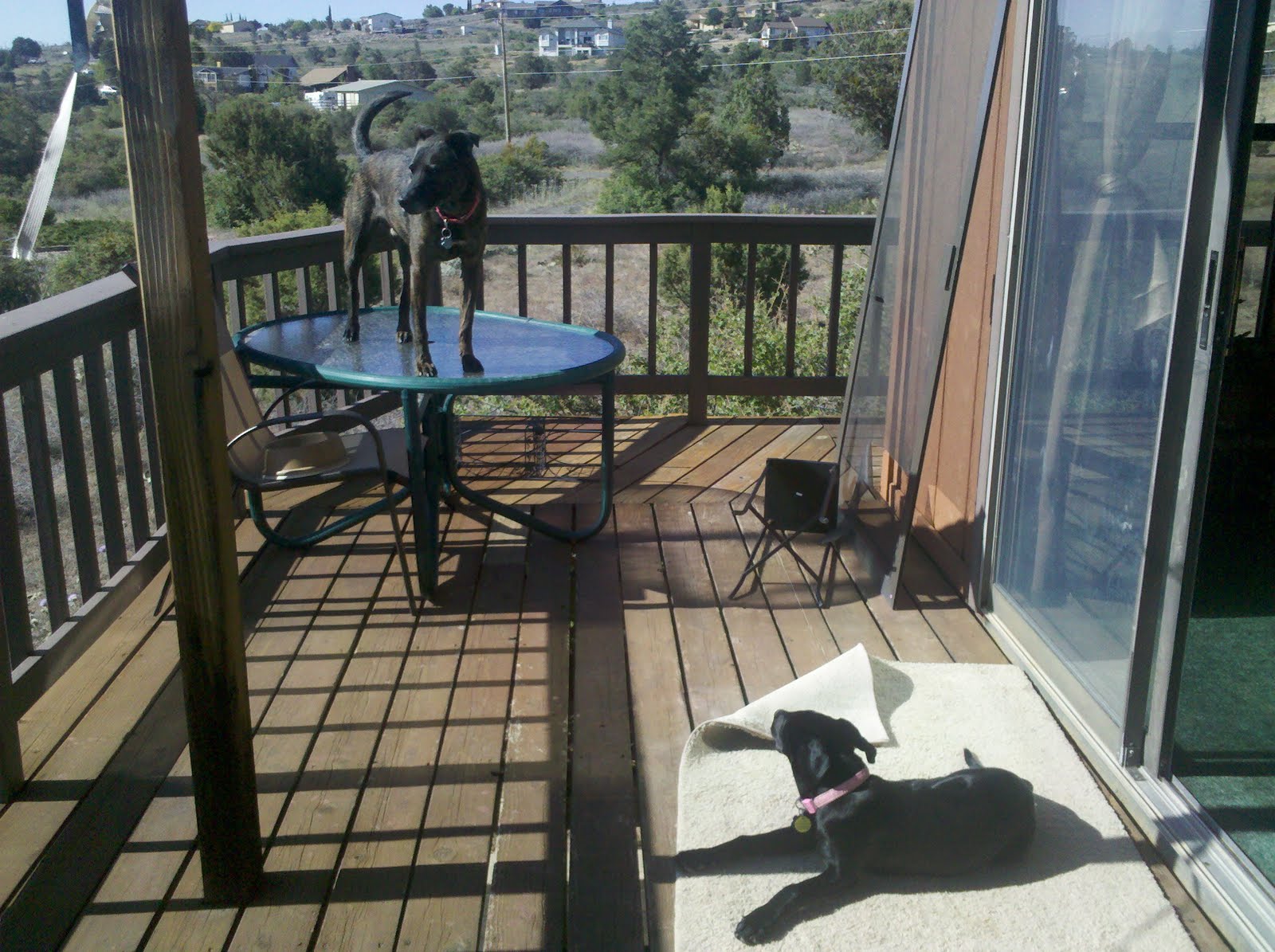
Milo likes to hang out on the porch in the sunshine. Until a certain someone irritates him and then he retreats to higher ground.
Note that the furniture in disarray, and the torn screen courtesy of Miss Bella.

 Speaking of Miss Bella. She has a bit of a temper. This is the only picture I could get of her in "demon" mode. The white flashes by my blurry finger are her teeth.

But she's a pretty good girl, aside from her occassional outbursts. We finally got her the pool she's always wanted, which she seems to enjoy.

Tuesday, July 5, 2011

Topic 184: On Keeping Step

Carol:
Oh Say, Can You Step
This weekend, I got out of step with the traditional rituals that mark America’s birthday as an independent nation in the making.   According to the U.S. Census bureau, a government agency which should know of what it speaks, the rituals of  4th of July include parades, fireworks and backyard barbecues.
 
The parade part I have always loved—any procession that includes music, costumes and marching in cadence. One of my favorite 4th of July parades was at Sequoia National Park in 1986. Enthusiastic campers from all over the world cheered and waved as the park employees processed through the visitors’ center either on foot in their official uniforms or riding on a variety of park vehicles (trucks, fire engines, jeeps, lawn mowers, anything that moves).  Prescott has two parades as part of  its annual Frontier Days. The official 4th of July parade on  Saturday attracts marching bands from around the country, equestrian groups, cloggers, and politicians, especially  during election time.  But, the best parade is the day before, the Kiwanis Kiddie Parade, which circles the Courthouse Square on Friday morning.  I was pretty proud of the “horse” Marshall rode in that parade when he was 3 years old, his tricycle sporting a mop for a tail and a painted cereal box for a head. Somehow, we didn’t make it to either parade this year.
 
I always liked the fireworks too, although I can count as many times fog or rain obscured the fireworks when we lived in California.  In drought-plagued Arizona we always wait for the announcement…will the fire conditions cancel the fireworks? When the kids were little, we went to the high school for the official Prescott display, picnicking on the football bleachers while we waited for the sun to go down and the music and fireworks show to begin. Lately, I have enjoyed sitting on our back deck with the same kind of anticipation for darkness to come, at which point we would begin to see one after the other—Prescott Valley, Prescott and then off to the left Chino Valley—the skies light up from the tri-city celebrations.  Last night, we had the best light show of all, magnificent monsoon lightning storms in all directions,  illuminating massive clouds and cracking thunder.  Soon the insects got to us, so we moved indoors; but,  I did catch a glimpse of the Prescott fireworks show from the window of our loft.
 
Barbecue?  Well, we’ve got a grill, but Megan and Marc are taking a nutrition class that espouses a plant-based (i.e. Vegan) diet. No oil, no dairy, no barbecued chicken, no big, thick juicy hamburgers or chips and dip. Saturday’s menu was Louisiana rice and beans without the Andouille sausage. The menu for 4th of July was steamed broccoli accompanied by a medley of barley, butternut squash, apples, and red peppers. Dessert was fresh strawberries dolloped with coconut milk ice cream. It was delicious actually, and especially so because I didn’t have to do the cooking (thanks, Megan).
 

So, what is Independence Day without the parades, the fireworks and the barbecue? Well, I may not have been keeping step with 4th of July traditions, but I did have family here to celebrate the weekend.  We set up the pop-up camper in the yard for a min camp-out, and the littlest family members played all over of our multi-storey house.  Frankly, I just didn’t have time to miss the parade, the fireworks or the barbecue.
 
P.S.  As inconvenient as it is to heft loads of groceries or laundry up all those stairs, sometimes I am really happy to keep steps.

Megan:
On Keeping Step

There’s something about dancing that must be instinctual. Babies dance all the time, often without encouragement. I’ve watched my little cousins, in the midst of another activity, suddenly do a little hop-skippity thing to the music, and then go back to what they are doing.  Small children dance without hesitation, self-consciousness or embarrassment.  That part comes later.

I remember, in first grade, being part of a dance group that performed to New Kids on the Block songs on the playground. In 1989, with crimped hair and sideways pony tails, three pairs of neon socks and white high stop sneakers, we certainly looked the part.  Have you seen Donnie Darko? We were like Sparkle Motion without the organization or motivation to get on Star Search. Anyway, some of the other girls in my class had taken ballet, tap or clogging, so they had some understanding of rhythm. They also had MTV. I had taken gymnastics and no cable. I was put in the back, even though I was the shortest and I remember knowing this meant I was the worst dancer, but I was still happy to be included.

The traumatizing moment came several years later on a Church trip to Universal Studios. I was walking through the theme park with my best friend Noel, when a familiar song came over the speakers. “I really like this song!” I said, and started dancing to it. It’s not that she laughed. I could have handled simple laughter. It was that she clutched her stomach in pain, and then fell onto her hands and knees, tears streaming from her face as she SCREAMED with laughter. For years after, bring it up again: “Remember that time you tried to dance?”  and then she would crack up all over again. I never danced (sober) in public again.

When I moved to England for the first time, I was introduced to clubbing by my housemates. I kept telling them I didn’t know how to dance, but they assured me that if I got pissed (drunk) dancing would be easy. This turned out to be true. Once I stopped being so self-conscious, dancing was fun again. And strobe lights make even the most awkward mover a rhythmic genius. An added benefit to all the dancing was the exercise. Despite a year of complete excess and unhealthy living, I managed to dance off more than 20 pounds.

This fall, nearly 10 years after I last danced in public, I will be taking a Zumba class at the local community college. I have convinced another friend to take it with me. She’s not the same one who laughed at my dancing, but since I regularly send her into paroxysms of laughter, I’m not entirely sure this is a good idea. But, I’m a more confident person now and I bet she can’t dance either.

Monday, July 4, 2011

Happy 4th of July!

We hope you all have a nice holiday weekend!
See you tomorrow.

Friday, July 1, 2011

Topic 183: Diddling

Carol:
Hey, Diddle Diddle
Oh, fiddle faddle. The kitchen sink is stopped up, and  the water is full of tiny, moisture -seeking ants. We have tried the usual non-mechanical “solutions” with no results.   After a phone call to one of the family fix-it types, we are at the stage of (1) taking the pipe apart or (2) calling a plumber. We can’t really diddle around because the same family fix-it types are coming for 4th of July weekend;  we want to de-clog the sink , take control of the pile of dishes, and make the ants disappear before they arrive.
 
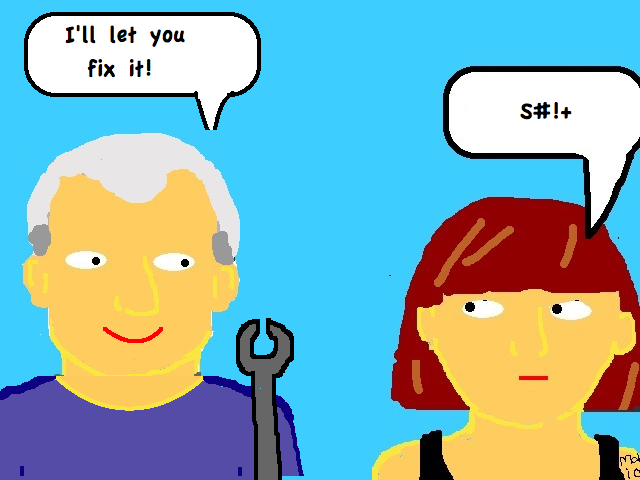
Now here’s the real problem. One member of our family considers calling a professional plumber a waste of money, so he has decided to tackle the pipe himself. This man is very bright and creative, the best kind to call in a legal emergency  or personal crisis. But, he is what we call mechanically challenged.  This is the guy who proudly  installed vertical blinds in the dining room—didn’t even need to use the directions—and then held up a “left-over” metal clip.“ What do you suppose this does?”  So, Mr. Not-so-Fixit  is going to disconnect the garbage disposal, pull apart the pipes, and then finish the job hours later when he gets back from taking his mother grocery shopping.
 
The response to that idea was an almost unison cry of protest from his wife and daughter. I’m surprised the dogs didn’t join in with their own howls of protest. After we talked him into waiting, Megan walked him to the door and took control of the situation. “Dad, I’ll fix the pipes. I’ve done it before in England.”  I think I detected a little spring in his step as Mister Mechanically Challenged walked out the door, fully confident that his daughter was not only up to the challenge but wouldn’t diddle around before getting to it (although she does need to finish her daily theme first).
 
You see, we do have a family fix-it type living in this house. She has been honing her mechanical skills  since she was a young girl, usually after her father’s efforts had failed. Like the downstairs toilet. It had a leak that made it run off and on,with a disconcerting sound of water rushing that can be heard all over our house.  Sir Fix-it-Not made several trips to the hardware store, changed out part.  Just when he thought the toilet was working, we would hear it run again.  One day when we arrived from work, 12-year-old Megan greeted us at the door. Grinning, she proudly announced, “I fixed the toilet.” And she had. After the vertical blind incident,  she decided to install the blinds in her bedroom herself. She followed the directions, no extra parts, no swearing (which always accompanies her father’s efforts at home repair). 

I may sound like I’m complaining about my husband. Like I said, he is a talented, creative and resourceful guy, just not with a tool or mechanical device like a TV remote or a DVD player. But, why should he diddle with projects that waste his time and raise his blood pressure when we have  Ms Tool Time living in the house. She’s the real “go-to” person for things mechanical.  I know she’ll be really excited when I show her the little to-do list I’ve been working on. I’ll even let her use my tool box, the one I keep in the downstairs closet for when I tackle home repairs. Heck, now that I’m retired, I may just give her that tool box.

Megan:
Diddling: an illustration
When we drew this topic yesterday, my mother and I looked at each other with exasperated confusion. She recited the nursery rhyme (hey diddle diddle) and I was wondering if I was once again going to have to write an essay about euphemisms. Separately we looked up the word in the dictionary, but when I shared the definitions with her, my mom seemed surprised – as though the definitions she found didn’t line up. Or maybe she was just surprised I was sharing any information with her at all, since I’m usually so concerned about her stealing my ideas.

What I didn’t tell her was that I found a delightful essay by Edgar Allan Poe on this very topic. He starts the same way she did, with the nursery rhyme, and then proceeds to philosophy, and then:
 
Diddling; or the abstract idea conveyed by the verb to diddle; is sufficiently well understood. Yet the fact, the deed, the thing diddling, is somewhat difficult to define.
The rest of his essay is then concerned with examples of diddlers – examples of con-men really. I encourage you to read it. And since I have nothing to add to the topic, instead I will simply illustrate the definitions as I found them in Merriam-Webster. 

 1. to move with short, rapid motions

 2. to waste (as time) in trifling

3. hoax, swindle

4. often vulgar: to copulate with


Sources:

Thursday, June 30, 2011

Topic 182: First Impressions

Carol:
The Tricks Old Dogs Can Teach Us
On first impression, you might think Prescott is a sleepy little town full of old white-haired folks who drive too slow (or too fast) and spend their afternoons searching for the best early-bird dinners.  In reality Prescott is full of old white-haired folks –31% of the population is over 62 years old. But Prescott is anything but sleepy these days and people over 62 (of which I am one) have a lot to teach us about the quality of the “senior years.” In fact, a visit to two local organizations show just how energetic and varied the retirement community can be.

The first is the Rowle P. Simmons Community Center, home of the Adult Center, which   provides a wide range of activities and services for all adults but particularly meets the needs of a senior population for a gentle-on-the-wallet $50/year membership fee. Sure, you can sign up for the typical senior center activities such as bingo and bridge, but the Adult Center also houses the Veterans History Project (part of a national oral history initiative), provides one-on-one tutoring sessions for PC and Mac users, schedules numerous health and fitness classes—from gentle yoga to high-energy Zumba-- the Meals-on-Wheels program, and hosts political forums. And, the parking lot is always full. 

The second is the Osher Lifelong Learning Institute(OLLI)  on the campus of Yavapai College. The Bernard Osher Foundation, headquartered in San Francisco, provides funding for higher education and the arts, including OLLI programs at 118 college and university sites geared to older learners, who the Bernard Osher Foundation refers to as “seasoned adults.” A wide range of learning groups reflect the interests of OLLI members, who have a voice in choosing the curriculum and in facilitating the groups as volunteers.  In between a morning learning group discussing modern China or current events and an afternoon group studying Gilbert and Sullivan opera, OLLI participants gather in the college food court for lunch and talk, their own brand of non-digital social networking. OLLI members make a lot of noise, have a lot of fun, and epitomize the notion of “lifelong learning.” No grades, no required homework, but they show up for class, ask questions, engage in hearty discussion,  and let their facilitators know when they appreciate a topic—or not.

 So, what’s the message here for our daily theme readers who are at the other end of the demographic picture—under 62, not retired, not ready to get old (who is?). What can these “old dogs” teach you? Learn something new everyday, not because you have to but because you want to. Take a class. Don’t want the homework or stress of grades? Most cities have community education programs. Don’t have time? Turn off the TV. Don’t have the money? Many community education programs and activity centers such as the YMCA have sliding scale fees and offer scholarships.

My essay is on the short side today. That’s because I have to get ready for my OLLI class on mythology and human experience.  As a co-facilitator for the learning group, I have  research to do on trickster figures in world cultures, and the 25 participants in the class will have lots of questions.
Loki, the Nordic Trickster


Megan:
A Second Chance to Make a First Impression
Yesterday my mother wrote about our trip to New Orleans, so today I think I will fill you in on my experience. We made this trip so that I could attend the American Library Association’s Annual conference. For a week, more than 20,000 librarians converged on the city. Everywhere you looked you could see determined and sensibly dressed women (and men!)  carrying red ALA tote bags, and checking schedules on their smart phones. I’m sure the city, which has a huge convention center, is used to large professional conferences, but New Orleans has a special appreciation for librarians.
The ALA plans its conference years in advance, and in 2006, the Annual (as it is known) was scheduled to be in New Orleans. After Katrina hit, the ALA debated moving the conference but ultimately decided to proceed as planned. I spoke with people who’d attended the Annual that year, which was the first conference to be held in New Orleans after the hurricane.  One librarian told me that most of the stores were closed, and whole city blocks stood empty. She said that the city had bussed people in to work in the restaurants and hotels. Another woman told me how she would sit in a café reading and would be approached again and again by locals asking for her magazines. At that point, almost a year after the storm, nothing but essential mail was being delivered by the post office.  “Some people didn’t want to come to the conference,” she said, “but I thought it was our duty to come and just spend as much money as we could.” At the opening ceremony this year, Mayor Mitch Landrieu personally thanked the ALA for all it had done to support the city.

I didn’t attend that conference in 2006 because I was in England getting ready to start working at the prison. Though I had followed the news closely when it happened, it was hard for me to imagine the level of destruction and devastation Katrina had wrought on the gulf. And I’d sort of assumed it had been rebuilt by now. Certainly that was my first impression of the city, from the downtown area where we stayed on the edge of the French Quarter. From the pictures my mother posted yesterday, there was little evidence of the storm. The beautiful houses in the garden district all had a freshly painted look to them –as did the buildings in the French quarter. Aside from the slightly “new” look on old buildings, everything looked perfect.
As part of the conference, I spent one day volunteering in a school library. It was downtown, just off Canal street and a group of us were bussed there from the conference center. The bus driver either misunderstood our destination or decided to deliberately take us the long way, but we wound up taking what the school director called “The Misery Tour.” The bus headed uptown, beyond where the street cars stopped and drove through a lower-income residential neighborhood. These homes, though smaller than the Garden District mansions, were still average sized older family homes, with porches and yards and playground sets. It would have looked like a nice place to live except that half of the homes stood vacant, boarded up and caved in. On many doors and walls it was still easy to read the spray-painted code used by rescue teams in the days following the storm: an X with the date the home was searched, and number of dead or living inhabitants. 
 

I understand why it was necessary to rebuild the tourist areas first. New Orleans relies on the convention center and the tourist industry to fuel its economy, which has also been harmed by last year’s oil spill. And everywhere I looked in that damaged neighborhood, I saw signs of construction – houses had been lifted onto cinder blocks or simply rebuilt high off the ground. While we were there, local news reported the final safeguard to prevent another breech of the levies had just been put in place. A lot has happened in five years, just not as much as I’d expected. The ALA Annual is not currently scheduled to return to New Orleans, but no doubt we’ll get back there eventually. I hope I will  see more houses like this:

Wednesday, June 29, 2011

Topic 181: On Recovering from a Love Affair

Carol:
Trains and Boats and Planes and Trolleys and Feet

I have never really shared most Americans' love affair with the automobile.  When I travel, I really enjoy seeing new places and watching new faces while learning to navigate subways, busses, and trains. You might say, I recovered from my love affair with automobiles by forming a new attachment to Bart and Max.  
 
Our trip this last week to New Orleans (aka The Big Easy Crescent City, Saint City, Paris of the South, Birthplace of Jazz) reminded me that there are lots of places in the US where a person can live quite happily, thriftily and conveniently without owning an automobile.  

One of the best deals in town is the day pass for $3.00 that gives unlimited passage on city busses and the three trolley lines that operate along Canal Street, St. Charles Street, and the esplanade bordering the Mississippi River, Once passengers debark   at the terminus, conductors walk through the old-fashioned car, reverse the directions of the wooden seats --no need to turn the streetcar around. 
The Canal Street line goes through the heart of the city where most of the tourist venues, businesses and major medical facilities are located. One branch ends at the   above-ground cemeteries 3 miles from the streetcar’s starting point; the second branch ends at City Park and the New Orleans Museum of Art. The walk from the streetcar stop  can be either direct along the wide, European-style avenue leading to the Museum, or indirect along the meandering, lakeside shaded paths of a park that is twice as large as New York’s Central Park.
 
The St. Charles Avenue Line advertises itself as the oldest continuing operating street railway in the world, but large sections  were closed for several years after extensive damage from Hurricane Katrina to both the tracks and the cars. The seven-mile route shows off the best of New Orleans, from the majestic homes of the Garden District to Audubon Park and Zoo to the campuses of Tulane and Loyola Universities. The leisurely progress of the streetcar affords the rider a chance to view the little details of New Orleans life that become a blur to an automobile rider: moss-draped trees sparkling with gaudy beads from last year’s Mardi Gras, ornamental statues and elegant porch swings, late afternoon dog walkers.
 
The Riverfront Line is the shortest (at two miles) and newest (built in 1988). It is a popular route that takes the Convention-goers along the waterfront with views of the French Quarter and French Market before it ends at the foot of Esplanade Avenue. A tourist can hop off just below Jackson Square and spend a couple of hours on the River itself,  lunching on southern fried chicken and chugging cold drinks on the deck of the Natchez Queen, the last steam-only operated Riverboat on the Mississippi. A cheaper alternative is the ferry that crosses from the riverfront over to Algiers on the west Bank, free for pedestrians.
 
Now that I’m back in rural  Arizona, it’s back to relying on the automobile…and the kindness of the family chauffeur. There is a bus company in town, but it starts about six miles from where I live and has both a limited schedule and limited routes, The good news is that if I really can’t recover from my love of Bart (Bay Area Rapid Transit) or MAX (Metropolitan Area Express), I can head down to Tempe and try out the METRO Light Rail--$3.50 for an all-day pass. On second thought, I think I’ll wait a few months. The day we flew back to Phoenix from New Orleans, the temperature was 114 degrees.  


Source:
“Streetcars in New Orleans.” Wikipedia

Megan:

There are many ways to recover from a love affair. Some people get in shape – I know of someone who split up with his girlfriend and started walking his dog five miles a day. He’s lost 80 pounds. A good friend of mine used his breakup as an opportunity to try new things – he bought a motorcycle, learned to ride a horse, took a pottery class. Both those guys took their pain and tried to form better selves. When I was in their situation, I chose to emigrate.

Some of my relationships only came to pass after I’d already made plans to leave the country. When the time came for me to go, we’d parted amicably and said something about the timing and how it was wrong. Only once did I hesitate and consider staying, but the relationship ended anyway. I went back to England and stayed for almost 6 years.

The problem with running away is that, in order to make sense of a strange, new place, one’s mind becomes occupied with comparing the present situation with the previous. Even after putting 6,000 miles between you and the former object of your affection, you may still find your mind wandering back to the what if’s and if only’s, replaying it all in your mind and wishing things were different. Believe me, this can really ruin your experience abroad.

I sometimes  think the best way to get over a relationship is to start another. This probably isn’t the case with everyone, but I don’t have the capacity to maintain deep and emotional connections with more than a few people at the same time. I have friends all over the world, but, with a few exceptions, my closest friends at any moment are the ones who I see the most. Simply put, I’m kind of a ‘love the one you’re with’ sort of person.

The last time I fell in love, it ended badly for me. For a long time, I thought something had permanently broken inside me. As time passed, I realized I was just young and naive and I finally emerged from that pain a better person (I hope). But I worked with that man and saw him every day. I watched him meet and then marry someone else. The week their child was born was the week I moved back to the United States. I had plenty of other reasons, which have been described at length in these essays, but those relationships bookend a very significant part of my life, and I like that there’s a symmetry to what drew me to England and what brought me back.

Tuesday, June 21, 2011

Monday, June 20, 2011

Topic 180: Fashion Bondage

Carol:
Of Human (Fashion) Bondage
I suppose this topic cries out for a sophisticated X-treatment of behaviors that create a niche for black, leather, chain, fishnet  and skimpiness, I know about those things only because my husband tried to take a photo in San Diego of his old apartment building from the 1960’s with his new Android phone, and he took one of” the black, leather, chain, fishnet and skimpiness” store below the apartment. Oh yeah, so I’m not really that naïve, but I do have a nagging concern that someday I will put the wrong combination of words into a daily theme that will link to that huge subterranean digital world of people who take photos of people who buy things from “the black, leather, chain, fishnet and skimpiness” store.
So, yesterday was Father’s Day and we took the Father out to dinner at a nice but fairly empty restaurant around 5 p.m. I guess today’s topic was on some of our minds because Megan and I got into a discussion of the evolution of stockings and garters to pantyhose and tights. When I was in high school, panty hose had not been invented and teen-age girls wore girdles, which are to me one of the worst forms of fashion bondage. By the time I was ready to graduate from college, panty hose had been invented and they increased in popularity as more women entered the workforce. The contortions involved in puttiing on a pair of pantyhose were even worse than pulling on stockings and a girdle, and sometimes a fingernail positioned in the wrong place would start a ladder up the leg of the hose before I had even finished dressing. For emergencies clear plastic nail polish could stop a ladder from expanding.  By the time I was working full time as a college teacher, I was buying 10-packs of pantyhose (nude, suntan, black and off-white) via catalog. I was also wearing heels and professional suits, another form of fashion bondage that was expected in the 80’s and 90’s.
 
Somewhere along the way to the 21st century, “work clothes” took on a new, relaxed meaning and apparently pantyhose are on the decline, replaced by bare legs, “dress down Friday” and leggings. I embraced the transition to more casual clothes because that also meant a transition to comfort. By the time I retired last year, I had one pair of pantyhose in my drawer. What a relief.
 
So, what does the Father do on Father’s Day when his wife and daughter take up the dinner table conversation with stories about women’s fashion bondage? He could share his own experiences with trying to wiggle into a pair of women’s pantyhose on a San Diego beach, an extra layer for warmth underneath his wetsuit for winter scuba-diving. Or he could recount the iconic advertisement Joe Namath did for pantyhose. Or maybe how hard he laughed watching Mel Gibson shimmy into a pair of fishnet pantyhose in the movie What Women Want. Instead, well, his problem is not with the fashion bondage of too tight but the fashion embarrassment of too loose. For now, I’ll respect his privacy on the details and allow our readers to imagine what might happen when someone—who has been begged to throw out his old underwear, nagged even—realizes the waistband has given out on a pair of…. briefs, boxers?... and feels them slowly descend towards his knees underneath the trousers of his business suit.
 
I’ve got my suitcase out ready to pack for our trip this week to New Orleans. I’ve got just enough room in the pocket where I used to put two or three pairs of pantyhose for an extra book, a good mystery about vampires and murder and Mardi Gras.
 

Megan:
Here we have another topic that could quite possibly attract traffic to our site outside of our usual demographic. In fact, reversing the title to Bondage Fashion was a joke I was making all weekend. Outside of the leather straps, whips and stiletto heels, my mother has already talked about how fashion has restrained women in the past with corsets and, in China, bound feet.

I’m distracted today because we are leaving tomorrow night for New Orleans (via Phoenix), and in addition to needing to assemble my conference schedule and paperwork, I also have to pack. According to the weather predictions, the temperature will be roughly the same as here (early 90’s), with thunderstorms expected every day. I love thunderstorms, but not so much when I’m wandering the streets of a new city. Anyway, I might as well try to make this essay about the ways I have tried to make myself fashionable for the trip.

I dyed my hair yesterday. It’s the same color I’ve been dying it for the past 4 years, but because it fades so much from the initial purplish red to a lighter auburn, people who see me only occasionally, and at different stages of the fading, always ask me if I’ve changed the color.  I dye my hair myself for several reasons, but mostly because I enjoy the process. I like standing in the aisle the store and looking for the lady on the box. If they ever change the model, I’m going to have problems because I can never remember the brand or shade I prefer. I like putting on the rubber gloves, mixing the various chemicals together and then methodically parting my hair to ensure an even and consistent application. The only part I don’t enjoy is the cleanup process.  After unsuccessfully scrubbing the dye from my ears, neck and shoulders,  I didn’t try very hard to clean all the residue out of the shower because I knew the cleaning service was coming today. It was only as they pulled into the driveway that I realized the stains in the bathtub look very much like blood.

I went to Walmart with some friends of mine over the weekend. I try not to shop there, but I was looking for a variety of items and we were in a hurry and it seemed like the one place I could find a dog leash, a Pilates ball, a child’s swimming pool and self-tanner all together.  I’ve never used self-tanner before and my friend suggested a slow-developing brand that applies like a moistureiser. I’d be pretty satisfied with it except that my impatient self found it too slow, so I applied more often than instructed. But this morning I was distracted by the dog and one leg got a double dose but I can’t remember which.  I’m waiting for it to develop so I can figure out which leg is darker and avoid the problems experienced by Ross from Friends, and this entire experience is not worth the trouble.

I’m going to have to leave this essay here because a large group of men have arrived to install solar panals on our roof and I change into pants before they notice that one of my legs is darker than the other.